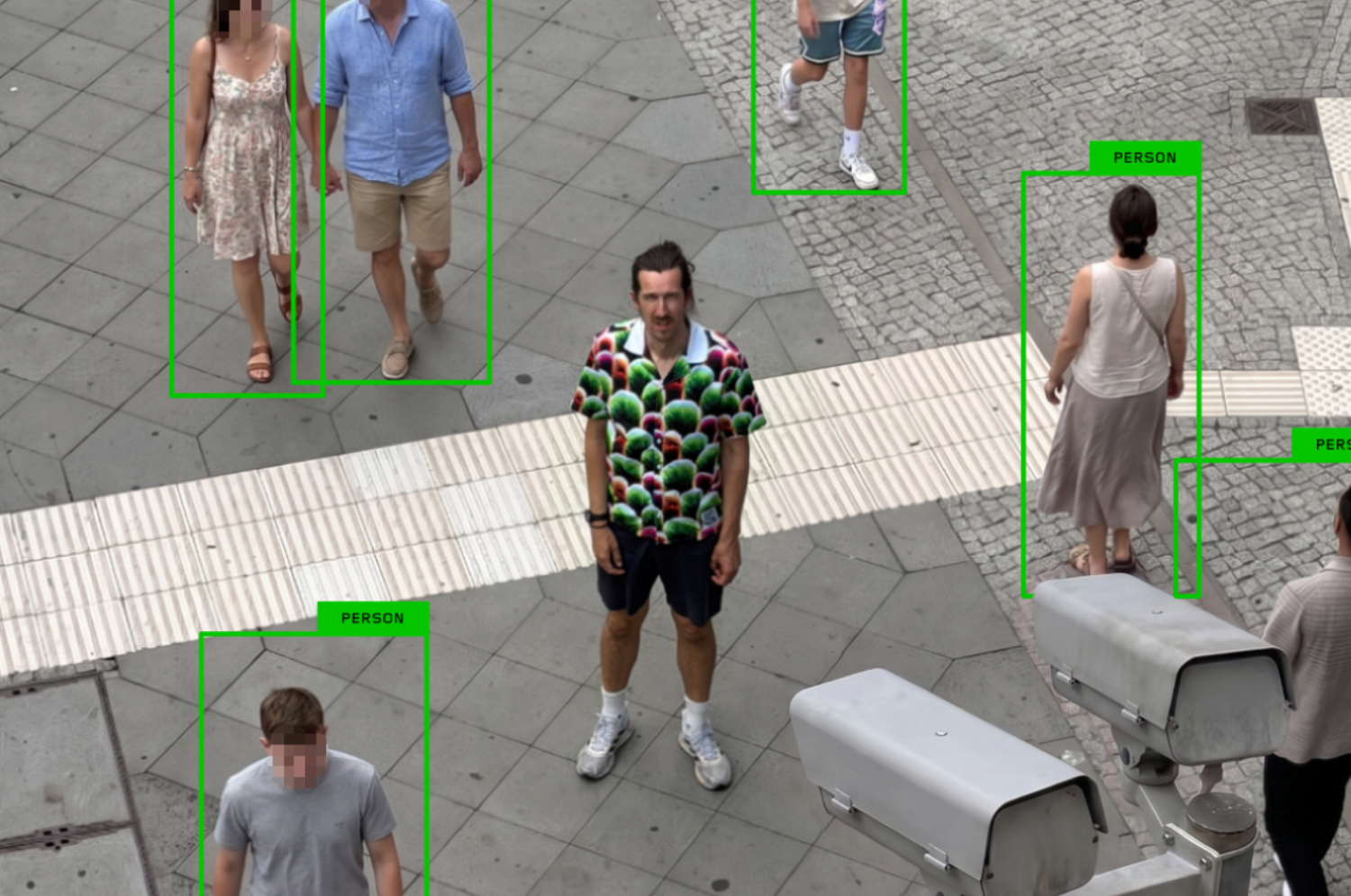
Stand on a Berlin street corner under a surveillance camera and you’re already a data point. The camera sees you, classifies you, logs you. Unless, apparently, you’re wearing Simon Weckert’s “Digital Camouflage” — a Hawaiian shirt so aggressively hideous it reportedly registers to AI surveillance systems as absolutely nothing at all. Weckert, a Berlin-based artist and technologist, designed the shirt directly in response to planned AI video surveillance at the city’s Kottbusser Tor. The goal wasn’t subtle: make the wearer disappear — not to human eyes, but to the algorithm.
How a Shirt Breaks an Algorithm
The pattern doesn’t fool your eyes. It fools the math.
AI person-detection systems — including YOLO-style models (widely used open-source tools that identify objects in real-time video) — never actually learned what a human is. They learned what humans statistically look like across millions of training images. Bodies become bundles of edges, contours, and texture cues the model has memorized. Disrupt those cues, and the “person” simply fails to assemble.
Weckert’s chaotic blobs of pink, orange, and green do exactly that:
- The pattern breaks the body’s visual outline, so the detector can’t bind torso, limbs, and silhouette into one coherent figure
- Weckert used AI itself to design the pattern — generating candidates, testing against a detector, refining, repeating — an adversarial loop where one system probes another until the algorithm breaks
- In tests against YOLO-style systems, wearers reportedly stopped registering as persons entirely
- Hard limit: it won’t defeat thermal imaging, radar, or multi-sensor surveillance systems
“AI systems are made of multiple layers and never learned what a human is — they learned what humans statistically look like in millions of training images. A ‘person,’ for the machine, is a bundle of visual statistics — and that is exactly its weakness,” Weckert has explained.
The shirt is conspicuous to every human who sees it. To the algorithm, it reads as noise. That gap — between human perception and machine vision — is the entire point. William Gibson imagined something like this in his 2010 novel Zero History, featuring a fictional garment described as “beyond punk, beyond art, and fundamentally, somehow, an affront.” Weckert just manufactured it.
Not an Invisibility Cloak – That’s the Point
Honest about its limits, and devastating as a question.
Effectiveness varies with lighting, camera angle, resolution, and how a specific model was trained. This is a provocative prototype, not a guaranteed security product. Treat it otherwise and you’re the person who shows up to a gunfight with a very stylish knife.
Weckert has earned the benefit of the doubt here. In 2020, he loaded 99 smartphones into a small red cart, walked slowly through Berlin streets, and watched Google Maps turn normally green roads red with fake traffic jams. Same instinct — absurdly simple intervention, algorithmic blind spot exposed.
The shirt may not work everywhere. But it asks a question surveillance vendors would rather you didn’t: what happens when the people being watched start dressing for the algorithm?