Every approved Alzheimer’s drug on the market does essentially the same thing: slow the loss. None of them rebuild what’s already gone. That’s the structural problem — dead neurons don’t come back. A University of South Carolina team says their injectable nanogel system, Nano-ERASER, reportedly does exactly that: grow replacement neurons inside a living brain and reverse cognitive damage in mice after just two injections. If the claim holds up, it would represent a genuine shift in how the field thinks about treatment.
The Mechanics Behind the Claim
A nanogel delivers antibodies to unlock a proposed neuron-making potential in brain support cells — but the science behind it is more complicated than the headline suggests.
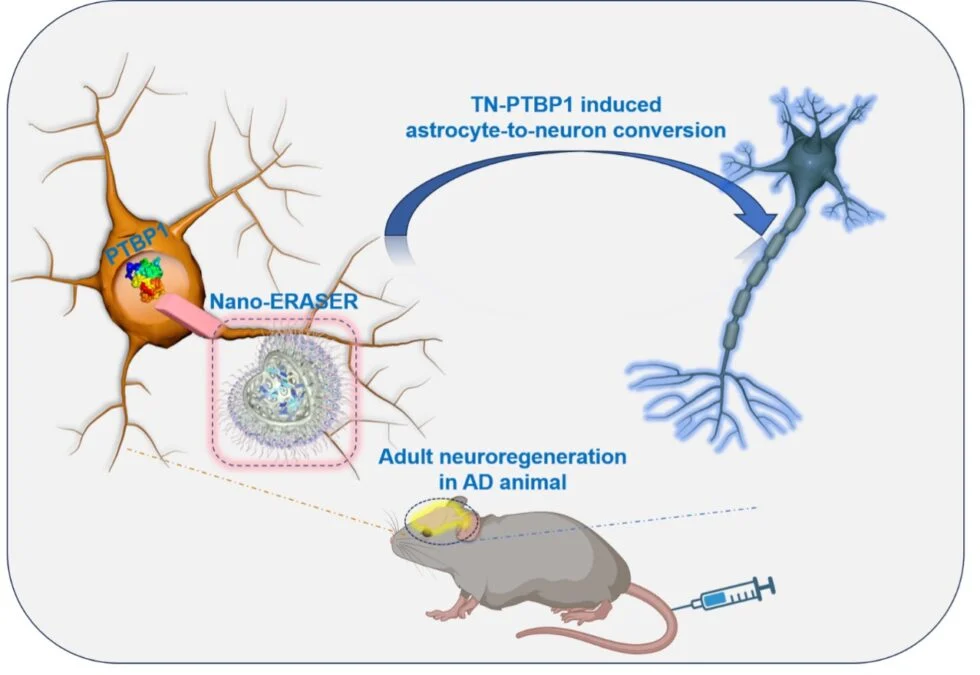
Astrocytes are the brain’s maintenance crew — star-shaped cells that support neurons and, under certain experimental conditions, may hold a latent capacity to become neurons themselves. A protein called PTBP1 has been proposed to keep that capacity suppressed. Nano-ERASER delivers antibodies directly into astrocytes to degrade PTBP1, theoretically flipping these support cells into functional replacements for neurons lost to Alzheimer’s.
The technique builds on existing science. Specifically, it adapts Trim-Away, a protein-degradation method developed in 2017 by Cambridge and Max Planck researchers, which uses antibodies and an intracellular receptor to selectively destroy targeted proteins inside living cells. The South Carolina team loaded that concept into an injectable polymer nanogel — previously tested against breast cancer cells in 2023 — and pointed it at the brain.
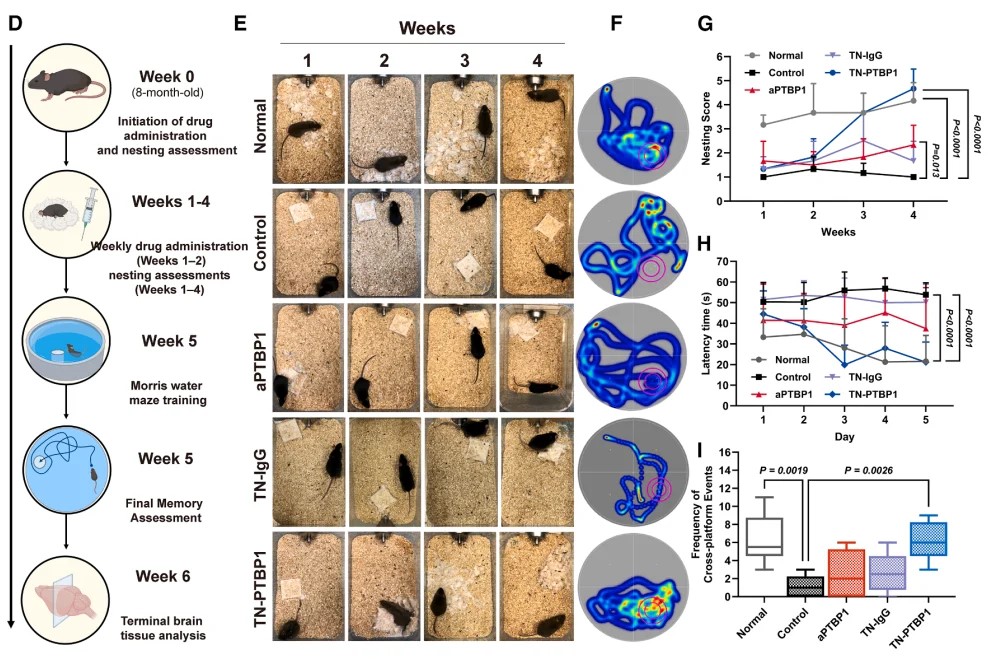
In Alzheimer’s mouse models, the results the team reports are striking. Treated animals:
- navigated water mazes more efficiently
- recovered nest-building ability
- showed higher neuron density
- demonstrated reduced amyloid-beta accumulation
The study, led by Mingming Wang and corresponding author Professor Peisheng Xu, was published in Cell Biomaterials on August 26, 2026.
“After just two injections, these mice became smarter,” Xu said. “Even after one injection, we already saw these mice’s behavior differ from that of the nontreated ones.”
Why the Field Isn’t Celebrating Yet
This specific mechanism has failed independent replication before — and researchers who have been watching this space closely know exactly why that matters.
Here’s the uncomfortable context. PTBP1-based astrocyte-to-neuron conversion was the hot hypothesis in Parkinson’s research too. It didn’t hold up. Multiple independent labs, using rigorous lineage-tracing — essentially tagging astrocytes to confirm that any neurons appearing afterward actually originated from them — found no genuine conversion after PTBP1 suppression. A Nature Matters Arising paper titled “Ptbp1 deletion does not induce astrocyte-to-neuron conversion” and a separate eLife study on Parkinson’s models both concluded that earlier positive results likely reflected leaky viral constructs accidentally labeling nearby neurons rather than true reprogramming. It’s the scientific equivalent of a deepfake passing peer review.
Nano-ERASER uses nanogels rather than viral vectors, which is a meaningful technical distinction — one that could sidestep some of the artifacts that plagued earlier work. But the core question remains open: do these new neurons genuinely come from astrocytes? That won’t be settled until independent labs run gold-standard lineage tracing on the Alzheimer’s data specifically.
“If we can advance it to the clinic, then we can have hope for patients with Alzheimer’s disease,” Xu said. The researchers themselves aren’t overclaiming. Primate studies are planned before any human trial conversation begins.
The delivery platform is legitimately novel. The mechanistic hypothesis is actively contested. And what independent labs find when they test it remains to be seen — which, for the millions of families watching this space, is both the honest answer and the only one worth giving right now.