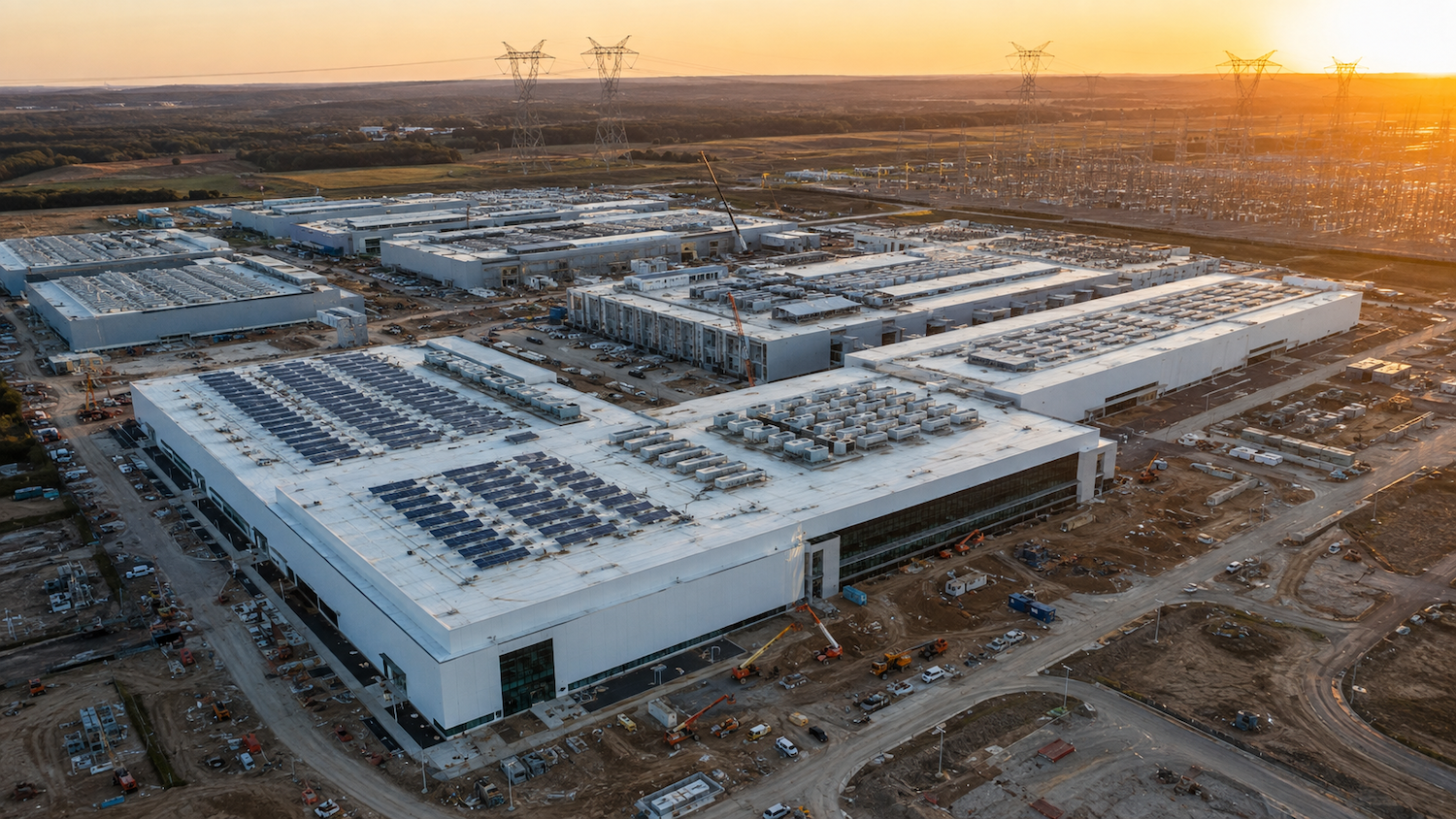
Every AI query, every cloud backup, every “smart” assistant response has a physical address somewhere in Virginia or Texas—and a power meter running continuously. A major Financial Times analysis of the 60 largest planned US data centers, tied to Amazon, Microsoft, Google, and Meta, estimates those facilities will collectively emit roughly 101.5 million tons of CO2 per year once fully operational. That’s equivalent to 24 million gas-powered cars on the road, 27 coal plants running at full capacity, or about 7% of all US power-sector emissions in 2025. From 60 buildings.
The Numbers Don’t Match the Press Releases
Big Tech’s net-zero pledges are aging badly against what utilities are actually permitted to build.
The sustainability reports stay polished. The emissions data, less so. Amazon’s greenhouse gas output rose 16% year over year, according to Bloomberg reporting on the company’s 2025 sustainability disclosures. Alphabet’s climbed 18% and Microsoft’s jumped 25%, per LA Times reporting on each company’s figures. That’s not a rounding error. That’s a pattern.
The mechanics of the problem are grimly straightforward:
- Three-quarters of the utilities serving these 60 projects are planning new gas plants or delaying coal-plant retirements to meet anticipated demand, according to the FT’s analysis.
- Solar capacity has been expanding fast in the US—but AI data centers electricity appetite is outrunning it.
- The Trump administration’s cuts to clean-energy tax credits are making renewables a less financially attractive option precisely when new low-carbon capacity is needed most.
Buried in utility investment plans across Texas, Virginia, and the Ohio Valley is the detail that changes this from a short-term story to a long-term one. Gas plants don’t retire in five years. They run for decades. Each new facility built to serve a hyperscale data center campus locks in emissions infrastructure that will still be operating long after today’s AI models are obsolete.
The Fixes Sound Like Science Fiction – Because They Mostly Are
When the proposed solution resembles a Bond villain’s contingency plan, the original problem was probably worse than the press release admitted.
The core challenge for round-the-clock AI compute is power that never stops. Solar on Earth is intermittent. Batteries remain limited at scale. So some proposals have aimed considerably higher—literally. According to secondary commentary reporting on speculative industry concepts, Meta has floated the idea of giant mirrors in orbit to reflect continuous sunlight toward Earth-based collectors. Google has reportedly discussed formation-flying fleets of satellite data centers running on space-based solar. SpaceX has allegedly sought permission to deploy up to one million satellites in a related context. It carries the same energy as a Don’t Look Up press conference—confident, cinematic, and conveniently scheduled for sometime in the future. It’s worth noting that these concepts remain speculative proposals reported through secondary commentary, not confirmed corporate filings or official product announcements.
Small modular nuclear reactors are at least tethered to the ground. Tech firms are signing agreements with SMR startups, and nuclear does offer always-on power without direct CO2 emissions. That combination aligns well with AI workloads that need uninterrupted supply. But radioactive waste, regulatory timelines, and the fact that no SMR fleet has been commercially deployed at scale mean “nuclear will fix AI’s carbon problem” remains a thesis, not a solution.
The orbital mirror concepts and satellite armadas are what organizations propose when the near-term answer is uncomfortable. AI is sold as frictionless digital magic. Its actual footprint looks more like the kitchen behind a spotless restaurant storefront—loud, hot, and running on gas.
The real question isn’t whether space mirrors will ever work. It’s whether futuristic proposals give Big Tech enough runway to avoid accountability before consumers, investors, and regulators start treating 101.5 million tons of annual CO2 as a product specification that belongs on the label.