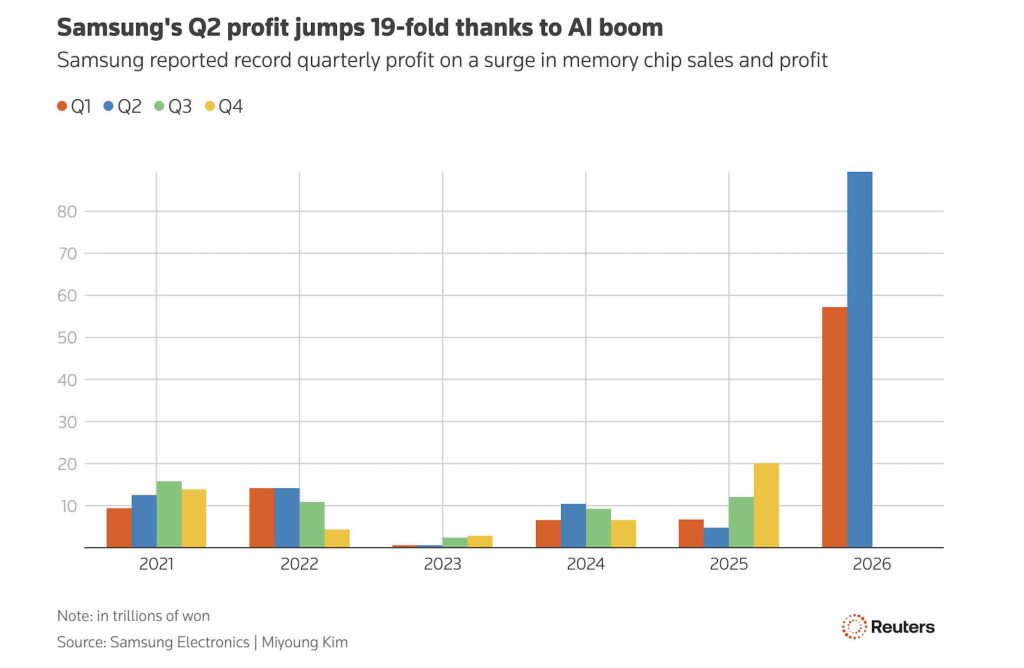
On its Q2 earnings call on July 30, Samsung confirmed it has pre-allocated 60–70% of its total future memory capacity into five-year supply agreements, according to BloomingBit. Five major data-center customers have signed. Five more are in final negotiations. Samsung executives warned that memory shortages will deepen through 2027 and extend into 2028, with AI-driven demand for high-bandwidth memory (HBM) and server DRAM outstripping production despite aggressive capacity additions. The memory industry has never operated on multi-year contracts before. Quarterly pricing cycles were the norm. That era appears to be over.
The Deals That Changed Memory Forever
Samsung’s Broadcom partnership alone is worth $200 billion over five years — and that’s just one piece.
The headline number lands hard: a five-year, roughly $200 billion partnership with Broadcom spanning advanced memory, HBM, and custom AI chips built on Samsung’s sub-2nm foundry processes, according to CNBC. SK Group has separately signed $750 billion in long-term agreements with Nvidia and other US tech firms. Together, Korean chipmakers have committed to approximately $950 billion in AI chip supply deals, per Hani and the Jakarta Post. That figure is not a typo.
Here’s what’s actually inside these agreements:
- Contracts run at least five years with upfront payments and floor pricing
- 60–70% of Samsung’s total future memory capacity is pre-allocated
- Samsung is spending 110 trillion won (~$73 billion) in 2026 capex on AI chips, HBM, and advanced foundry nodes
- Memory shortages are expected to persist through 2027–2028 as agentic AI workloads demand more memory per accelerator
What This Costs Everyone Else
Hyperscalers with signed deals get guaranteed HBM access — everyone else competes for what remains.
While the biggest cloud players lock in supply, downstream buyers — PC makers, smartphone OEMs, console manufacturers — are left competing for whatever capacity remains. Think of it as Spotify locking up all the premium playlist slots before independent artists can even log in. Samsung’s own mobile division reportedly feels this tension, as higher server memory prices squeeze conventional DRAM and NAND availability.
Samsung Co-CEO Jun Young-hyun told shareholders the company is transitioning its memory business from quarterly and annual contracts to three- to five-year deals, arguing both sides benefit from predictable stability aligned with capex planning, according to Bloomberg.
The counterargument deserves airtime. If AI infrastructure spending slows — or model efficiency improves enough to reduce memory footprints — customers locked into floor-price contracts may push back hard in renegotiations. Some market strategists caution that AI capex durability isn’t guaranteed, according to Reuters. Analysts from Korean securities houses have called Samsung’s recent earnings calls “one of the more reassuring” in the sector, per TechSpot. Floor pricing only protects Samsung if the AI buildout holds.
Memory is no longer a commodity market. It’s becoming a contracted utility — closer to LNG supply agreements than quarterly spot pricing. The companies that secured capacity early hold the structural advantage. For everyone else, including the next wave of AI startups, the queue is already long and not getting shorter.