You’ve tried the weighted blanket. The magnesium supplements. The elaborate wind-down routine that makes your nightstand look like a wellness influencer’s altar. And yet, morning arrives feeling like you barely closed your eyes. Researchers at the University of Texas at Austin think the problem might run deeper than your bedtime habits — literally deeper, inside your brain. If you’re exploring smart gadgets to improve your wellness routine, this development is worth watching closely.
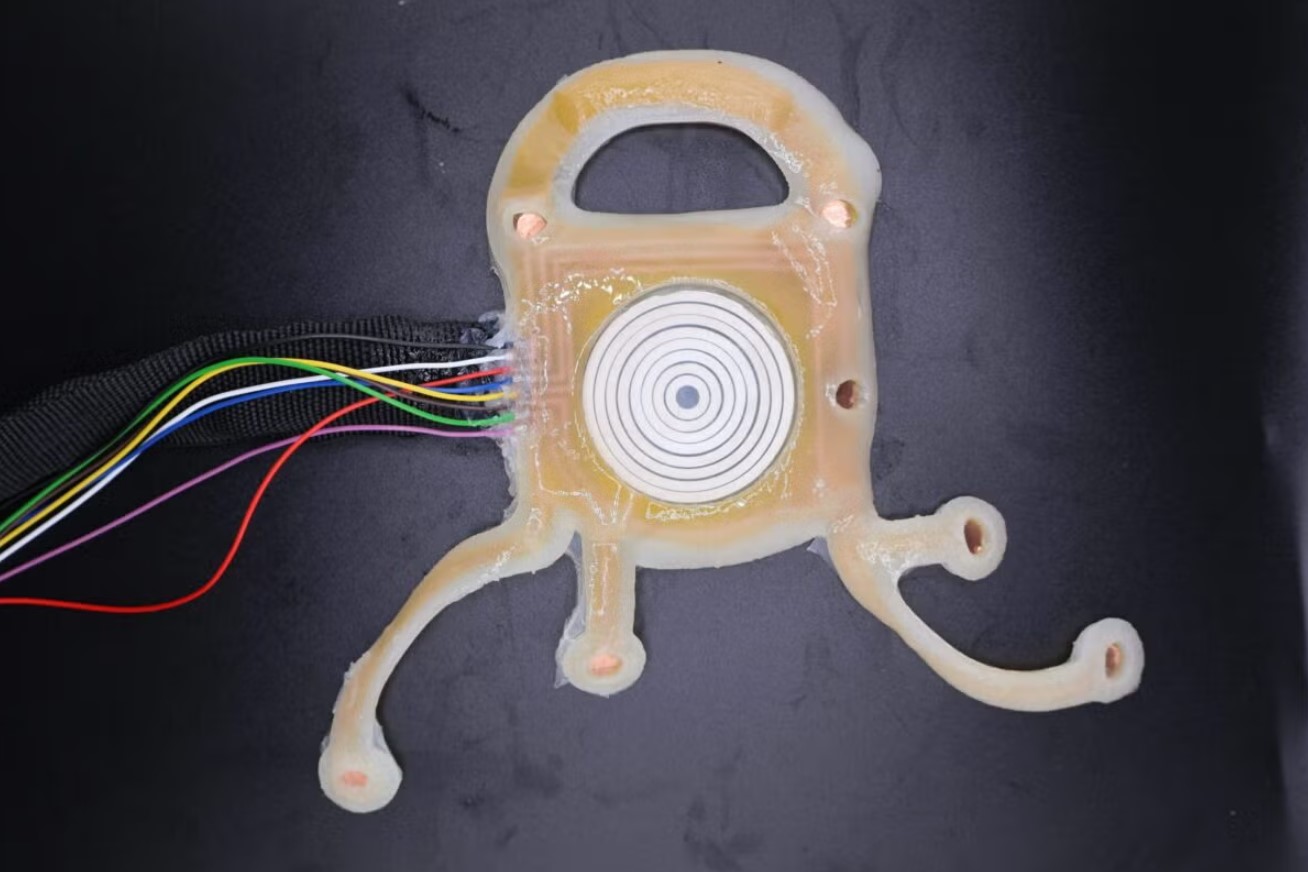
Their creation, NEUSLeeP, is a soft wearable patch that combines focused ultrasound with embedded electrodes to target deep brain regions involved in REM sleep, published in Nature Mental Health. REM isn’t just where dreams happen. According to the research team, it’s where your brain processes emotions, regulates stress, and essentially performs its nightly factory reset.
How the Patch Actually Works
Unlike implanted deep-brain stimulators, NEUSLeeP operates as a closed-loop system that reads and adjusts to your brain signals in real time — no operating room required.
Traditional deep-brain stimulation requires a neurosurgeon. This requires a bedtime routine. NEUSLeeP works by sending ultrasound pulses toward the subthalamic nucleus (STN) — a pea-sized structure deep in the brain that coordinates movement and arousal — a region that has historically been nearly impossible to reach without implanted hardware. Meanwhile, embedded electrodes capture EEG brain signals in real time, letting the wearable patch adjust its stimulation accordingly. No implants. No operating room. Think of it as adaptive cruise control for your sleeping brain.
In a study of 28 participants — both healthy sleepers and those with sleep difficulties — the results were notable:
- REM sleep reached 43 minutes sooner on average
- REM duration extended by roughly 16 minutes
- Improved heart rate variability observed among healthy participants
- Participants reported comfort with minimal adverse effects
Brain imaging also revealed changes in emotion-processing circuits. That’s why the UT Austin team is exploring applications well beyond insomnia — including PTSD, depression, and chronic stress — conditions where disrupted REM sleep isn’t just a symptom but potentially a driver.
Early Promise, Real Caveats
Twenty-eight participants is a compelling start, not a conclusion — and there’s a long corridor between a university lab and your bedside table.
If you’re hoping to snag one before your next Oura Ring subscription renewal, pump the brakes. A sample of 28 people is genuinely promising, but it’s nowhere near enough to draw firm conclusions. Larger confirmatory trials are planned and haven’t yet begun. No consumer launch date exists. No pricing. A patent application has been filed through UT’s Discovery to Impact unit, and the commercialization pathway is being actively explored — but that’s still a long way from retail shelves.
The direction, though, matters. A noninvasive alternative to sleep medications — whose side-effect lists often run longer than the problems they treat — represents exactly the kind of science worth tracking honestly, without the hype. Those following fitness gadgets and health wearables will want to keep an eye on how this technology develops toward commercialization.