Sleep trackers tell you how badly you slept; DUSQ claims to fix disruptions as they happen. Your Oura Ring delivers the bad news every morning like a stern teacher handing back a failed test. You tossed and turned for two hours, spent 47 minutes in light sleep when you needed deep recovery, and somehow your “sleep score” suggests you should feel worse than you actually do.
DUSQ’s new sleep regulation system promises something different: instead of just measuring your restless night, it claims to detect those 3 AM disruptions and actively guide you back to deeper sleep. The device positions itself as the “world’s first sleep regulation system,” combining real-time sensing with immediate intervention.
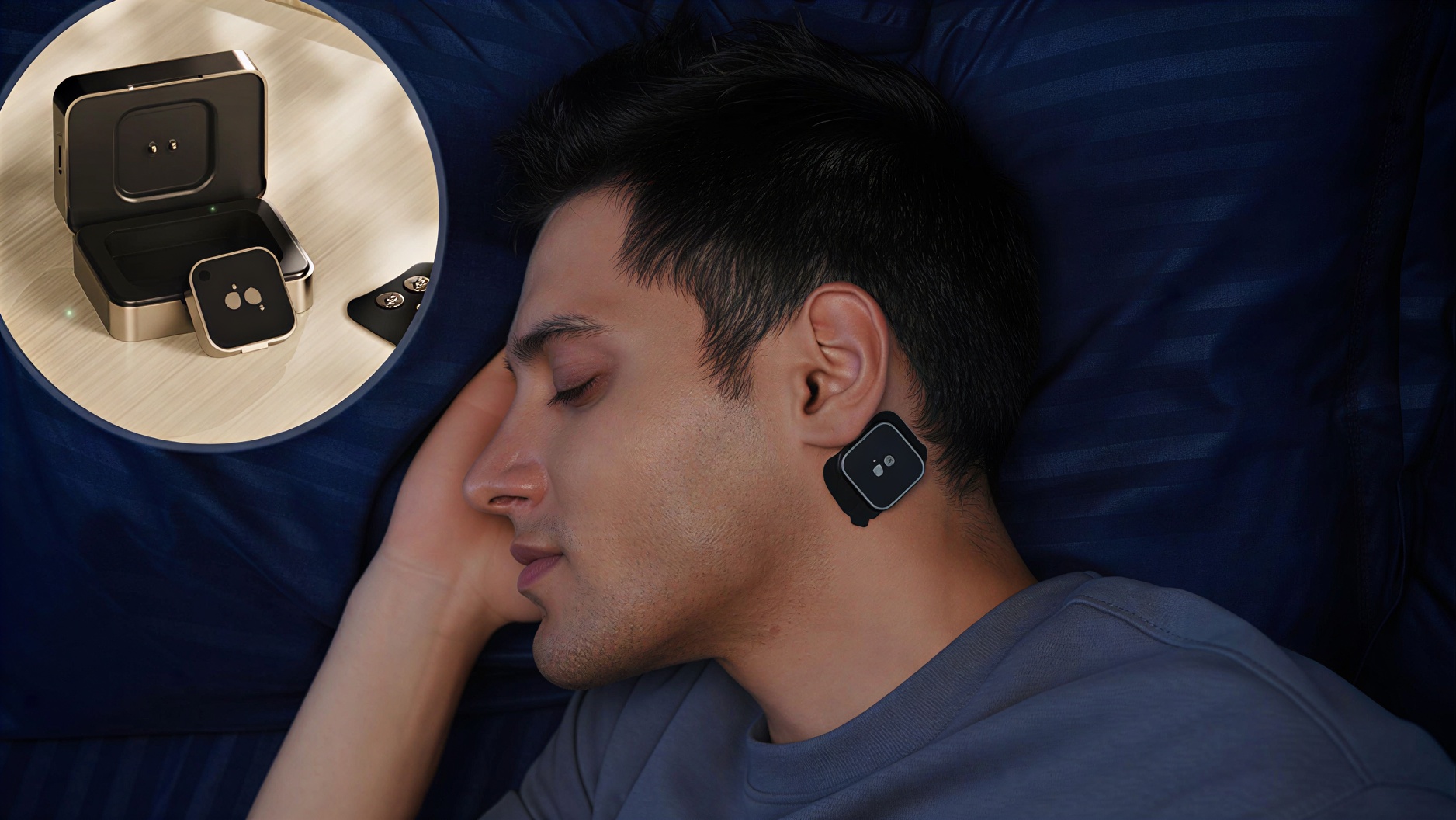
While most wearables track your sleep stages after the fact, DUSQ says it reads your nervous system directly through electrodermal activity sensors placed behind your ear, where signal quality peaks and parasympathetic pathways sit close to the surface.
Nerve Stimulation Meets Sleep Science
Behind-ear patches monitor autonomic surges, then respond with vestibular and vagus nerve stimulation.
DUSQ’s two-part system works like a physiological early warning system. Users apply a skin patch behind their ear before bed while a connected device monitors the patch data throughout the night. When the system detects autonomic surges that indicate sleep disruption, it responds with what the company describes as “being rocked back to sleep.”
This involves non-invasive stimulation targeting vestibular and vagus nerve pathways to calm your nervous system. The company claims its Sleep Lab testing using polysomnography shows an average of 28 minutes more restorative sleep per night. DUSQ also says the device helps users fall asleep initially by calming pre-bedtime nervous system activity.
Early Access and Medical Limits
Kickstarter pricing starts at $339, but medical contraindications limit potential users.
The system launched on Kickstarter with early pricing at $339, rising to an estimated $499 retail price. VIP backers should receive devices in August, with broader delivery expected in October. Each package includes the tracking device, charging case, and three months of replacement patches, with additional patch supplies costing $25 per quarter.
However, DUSQ explicitly contraindicates the device for users with:
- Implanted medical devices
- Epilepsy or seizure disorders without supervision
- Pregnancy
- Anyone under 18
The medical limitations suggest the nerve stimulation approach carries real physiological effects that require careful screening.
Promise Versus Proof
Innovation meets the eternal question of whether active sleep intervention actually works broadly.
Cleveland Clinic and Johns Hopkins Medicine note that consumer sleep trackers generally estimate sleep stages using surrogate signals—they don’t directly measure sleep the way clinical studies do. A 2023 comparison study found accuracy varies widely by device and sleep stage, reinforcing why claims about “deep sleep” improvement need independent validation.
DUSQ’s approach represents genuine innovation in moving from passive measurement to active intervention. But the available evidence comes primarily from company testing rather than large-scale independent clinical trials. For early adopters willing to experiment, the question becomes whether paying $339 to beta-test a sleep intervention beats accepting that your current tracker’s morning disappointments might be the best available option. For those looking to improve their sleep environment beyond wearables, consider exploring desk gadgets that could enhance your overall wellness routine.