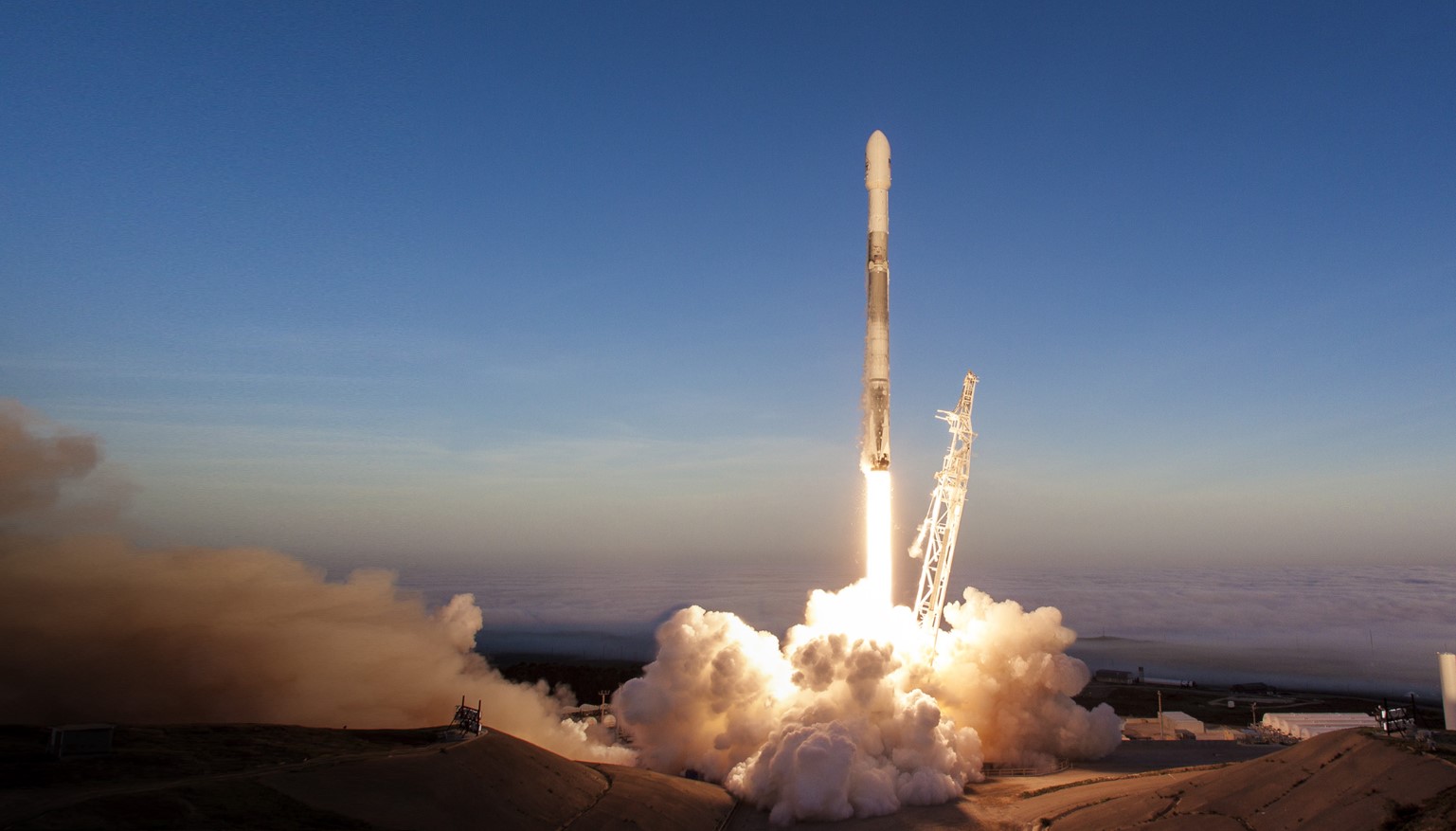
Somewhere between Earth and the Moon, a five-story chunk of spent rocket has been tumbling through space for over a year with nowhere to go. On August 5, 2026, it finally arrives — slamming into the lunar surface near the Einstein crater at roughly 5,400 mph. No parachute. No atmosphere to slow it down. Just several tonnes of dead Falcon 9 upper stage meeting ancient regolith at seven times the speed of sound. Independent astronomer Bill Gray, tracking this orbital flotsam through his Project Pluto software, pins impact at around 2:35–2:44 a.m. Eastern Time, based on his published orbital solutions.
How a Rocket Becomes the Moon’s Problem
After delivering its payload, the Falcon 9 upper stage got stuck in orbital limbo — too high to fall, too slow to leave.
Back in January 2025, this stage did its job: it launched Firefly Aerospace’s Blue Ghost Mission 2 toward the Moon. Then it became orphaned. Stranded in a chaotic 26-day elliptical orbit around Earth, it lacked the fuel to deorbit and the velocity to escape. Gravitational pulls from Earth, the Moon, and the Sun — plus the gentle shove of solar radiation pressure — spent the next eighteen months walking it into a lunar collision course, like the world’s slowest game of cosmic pinball.
Here’s what you need to know:
- Impact date: August 5, 2026, approximately 06:35–06:44 UTC (2:35–2:44 a.m. ET)
- Speed at impact: ~5,400 mph (roughly 2.4 km/s, ~7x the speed of sound)
- Location: Near Einstein crater, ~19°N, 267°E, lunar near side
- Size: Roughly five stories tall, several tonnes
- Tracked by: Bill Gray, Project Pluto orbital tracking software
“We now have another upper stage due to hit the moon, this one on Aug. 5 and (just barely) on the near side of the moon,” Gray noted, according to Space.com.
Scientists Are Thrilled. Your Telescope Isn’t Invited.
The impact doubles as a free experiment — but catching it visually from Earth demands serious hardware and realistic expectations.
Planetary scientists aren’t grieving this one. They’re treating it like an unannounced bonus episode dropping at 3 a.m. — unexpected, but absolutely worth staying up for. The ejecta plume and resulting crater will yield real data on lunar subsurface structure and crater formation. That echoes NASA’s intentional LCROSS impact and the 2022 mystery rocket strike — later attributed to China’s Chang’e 5-T1 mission — that left a surprising double crater on the far side. Researchers are already planning observational campaigns using professional telescopes and spacecraft sensors to capture the aftermath. Scientists also confirm the event poses no danger to Earth or ongoing lunar operations.
The visibility reality check, though, is sobering. The impact hits sunlit terrain near the Moon’s eastern limb — a bright background that makes any flash faint and fleeting. Professional-grade instruments pointed at the predicted site have a legitimate shot. Your backyard reflector almost certainly does not. Naked eye? Not a chance.
SpaceX lands its Falcon 9 boosters with balletic precision. Upper stages on high-energy lunar trajectories, however, are an entirely different problem. As commercial missions to the Moon multiply, the question of what happens to hardware left drifting in cislunar space is getting harder to ignore — and this August, that question crashes into the lunar surface at 5,400 mph.