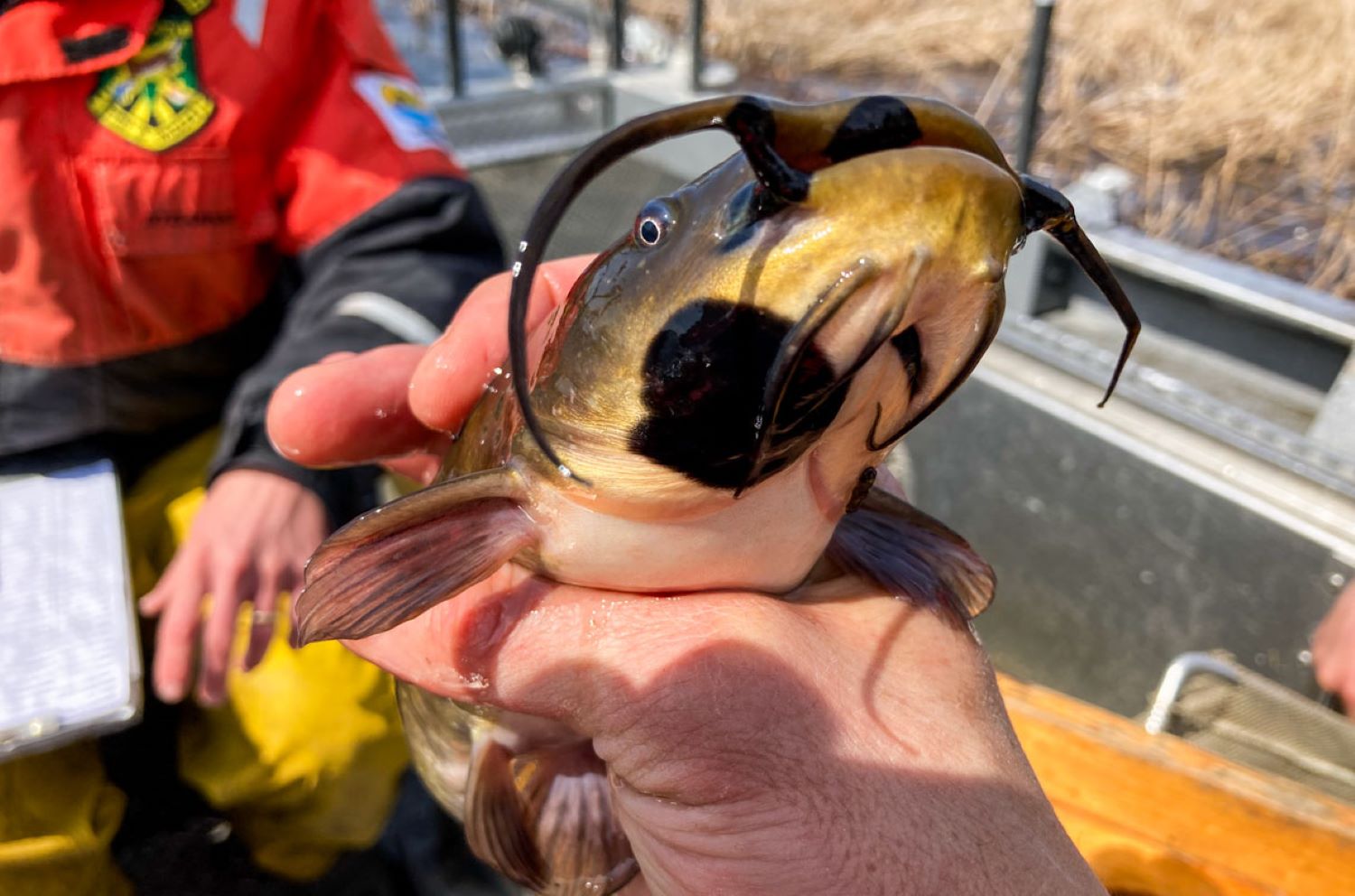
Researchers studying brown bullhead catfish in Lake Memphremagog, straddling the Vermont–Quebec border, have identified a melanoma that moves from fish to fish as a single clonal cancer lineage, not as a mutation each animal develops independently. This makes it the first known transmissible cancer in any fish species, the first documented in any freshwater animal, and only the fourth naturally occurring transmissible cancer ever confirmed in the animal kingdom. The others belong to Tasmanian devils, dogs, and bivalve shellfish. No evidence suggests any risk to humans.
A Cancer That Acts Like a Parasite
The tumor isn’t arising fresh in each fish — it’s the same cancer, traveling.
When researchers first noticed black lesions on catfish skin back in 2012, the obvious suspects were environmental damage or a virus. Genetic sequencing told a stranger story. Tumors pulled from entirely different fish were far more similar to each other than to their own hosts — a signature of a single cancer cell line replicating and spreading between animals, not independent tumors arising separately in each one. Think of it less like a disease each fish catches and more like a single rogue organism hitching rides across an entire population.
Key findings from the research:
- By 2014, surveys found roughly one-third of catfish in the affected area carried visible lesions
- Tumors contained high levels of arsenic, though the significance remains under investigation
- Spawning season — when fish crowd together and make physical contact — is the leading transmission hypothesis, though lab confirmation hasn’t happened yet
- Toxin exposure and a nearby landfill were considered and largely ruled out by water-quality testing
- The fish population is widely distributed across the lake, making a single localized environmental trigger unlikely
Experts reviewing the genetic evidence called it “totally compelling” support for a transmissible cancer interpretation, while also noting that direct experimental transmission still needs to be demonstrated in a controlled setting.
What Comes Next
The research ahead will determine whether this cancer is a curiosity or a crisis.
The comparison that looms largest is Tasmanian devil facial tumor disease — probably the most pop-science-famous transmissible cancer on the books — where the condition has devastated populations with brutal efficiency. Whether this catfish melanoma follows a similarly destructive trajectory remains genuinely unknown. Scientists still need to answer fundamental questions: how the cancer evades fish immune systems, how long it has circulated undetected, and whether catfish populations across broader New England waterways carry the same lineage.
While toxin and environmental hypotheses have largely been set aside, upcoming research priorities include:
- Controlled lab transmission experiments
- Immune-response studies
- Expanded regional surveillance
If transmissible cancers are appearing in freshwater vertebrates, the number of species worth screening just grew considerably — and the urgency of understanding how these cancers persist and spread becomes harder to ignore.
Four transmissible cancers confirmed across all of animal life, and the newest one lives in a lake you could drive past on a weekend road trip. No human risk, no immediate cure required — but the discovery quietly expands the map of how cancer can behave across species in ways biology textbooks haven’t caught up to yet. Nature, it turns out, still has rules nobody thought to write down.