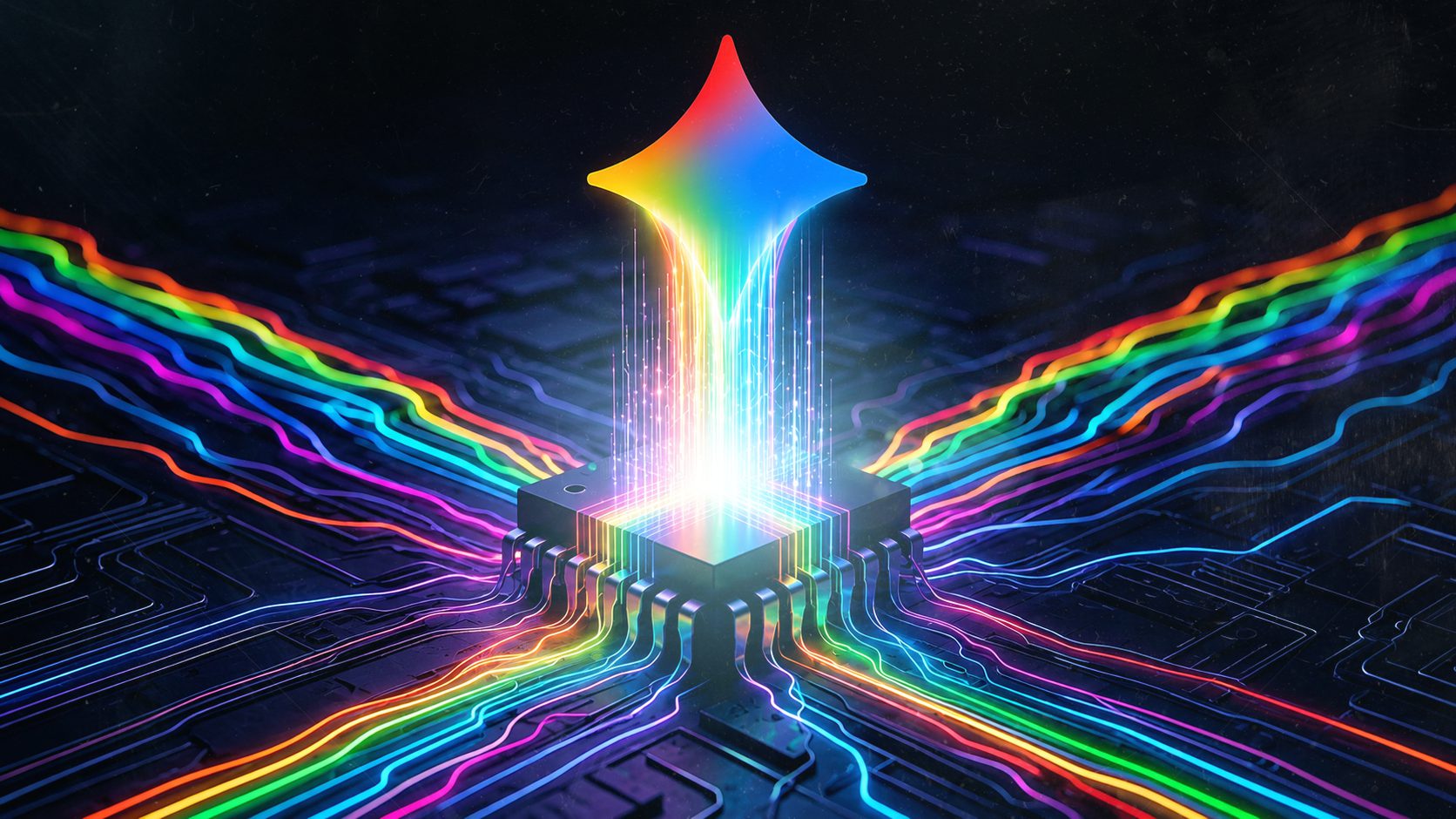
The chip is codenamed Frozen v2, according to reporting by The Information, and it would hardwire portions of Google’s Gemini model architecture directly into silicon. The motivation is blunt: Google is reportedly facing a severe internal compute crunch, with Gemini demand straining capacity so hard that some external cloud workloads have been throttled. Google has not officially confirmed the project. A spokesperson told reporters only that teams experiment with high-efficiency ideas and not every lab project ships.
What “Frozen” Actually Means
Instead of loading a model into generic hardware, Frozen v2 etches Gemini’s logic into the chip itself.
Right now, running an AI model on a GPU or TPU looks like this: the chip loads the model into memory, then executes it through flexible, general-purpose circuits that constantly shuffle data and make branching decisions at runtime. Frozen v2 reportedly eliminates much of that overhead by baking Gemini’s neural-network structure — its computational graph and dataflow patterns — into the physical circuitry. The weights, those numerical parameters that shape how the model actually responds, can still be updated. But the architecture stays locked in metal.
Key reported details include:
- Efficiency gains of 6–10x over current TPUs, measured in tokens served per watt during inference only — not training
- Target deployment around 2028, designed to complement Google’s existing TPUs rather than replace them
- How much of Gemini’s architecture to pre-embed remains undecided, with the flexibility-versus-efficiency trade-off still unresolved
- All details come from anonymous sources; nothing is officially confirmed
Think of it like the difference between a general-purpose kitchen and a dedicated pizza oven. The oven only makes one thing — but it makes that one thing extraordinarily well. Alphabet shares rose after the report surfaced. Google isn’t alone in this approach either: startup Taalas already sells a chip called Hardcore that prints model weights onto silicon, claiming 17,000 tokens per second versus roughly 150 on top Nvidia GPUs. Those are company figures worth treating cautiously, but the trend clearly has momentum beyond Google.
The Bet That Could Backfire
Hardcoding today’s Gemini architecture is a wager that tomorrow’s Gemini won’t look radically different.
AI architectures evolve fast. A chip physically tuned to 2026-era Gemini could be badly misaligned with whatever Gemini looks like by 2028. Even updatable weights can’t fix a fundamental structural mismatch — that requires entirely new silicon. Frozen v2’s roadmap implicitly bets on architectural continuity across Gemini generations. Trading flexibility for speed is the oldest bargain in computing, and it works right up until the world changes underneath you. That’s an expensive assumption to get wrong, and independent chip analysts have noted that fixed-function AI infrastructure carries real obsolescence risk when model architectures shift faster than production cycles allow.
If Frozen v2 ships on schedule, you probably won’t hear its name. But you’ll feel it in API pricing, service availability, and what Gemini can actually do at scale. The intelligence and the metal are converging. Whether they converge on time is the only question that matters.