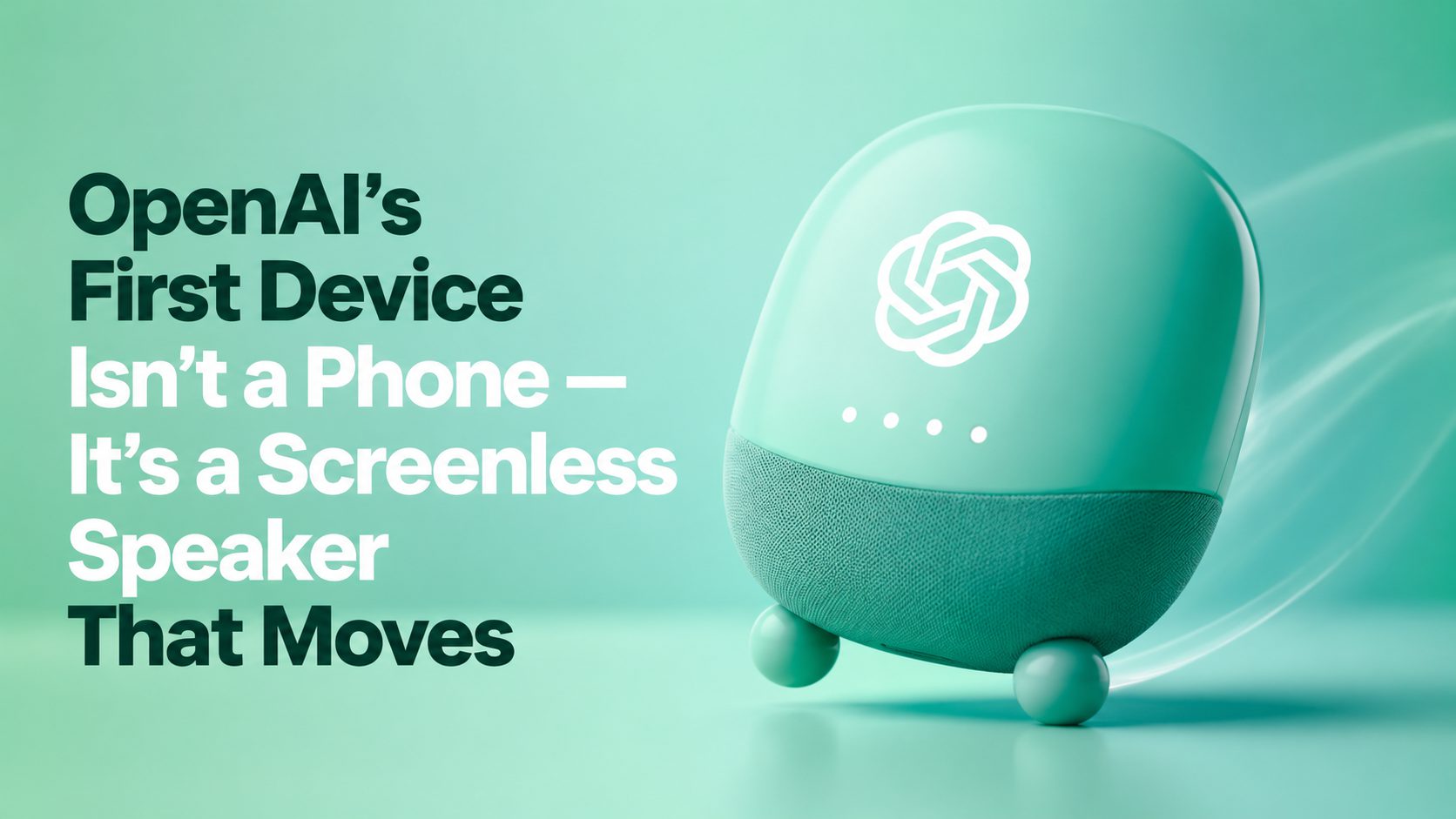
Everyone assumed OpenAI‘s first hardware play would be a phone. Instead, the company is building a portable, screenless smart speaker with a camera, environmental sensors, and mechanical parts that move on their own.OpenAI internally calls it “a new kind of computer built for the AI era.” Think less Amazon Echo, more the operating system from Her — except it sits next to your coffee maker and follows you to the laundry room. Its mechanical elements reportedly move autonomously, designed to make the device feel present rather than inert.
The device runs on a rechargeable battery, so you carry it between rooms rather than tethering it to an outlet. Core functions span:
- Smart-home control
- Music playback
- Messaging
- Proactive habit-based suggestions powered by advanced ChatGPT models
Talking Without the Parking-Meter Problem
Full-duplex voice means this speaker listens and talks simultaneously — no more waiting your turn.
What makes this speaker different from every voice assistant already on the market? GPT-Live, OpenAI’s officially launched full-duplex voice engine. That awkward pause when Alexa processes your sentence like a fax machine receiving data? GPT-Live eliminates it. The system listens and responds simultaneously, handles mid-sentence interruptions, and adapts in real time. OpenAI says the defining feature isn’t raw functionality — it’s personality and humanlike connection. The speaker will also reportedly draw on personal data like emails to anticipate your needs proactively. If you’re eager for AI-powered websites that can supercharge your productivity in the meantime, those are already available today.
Apple’s Alumni Association Has a Legal Problem
The team that built the iPhone is now building OpenAI’s speaker — and Apple wants an injunction.
The irony here is industrial-strength. OpenAI spent $6.5 billion acquiring io Products, co-founded by Tang Tan, Apple’s former iPhone product design lead and now OpenAI’s Chief Hardware Officer. Key personnel shaping the effort include:
- Jony Ive’s studio LoveFrom, shaping the device lineup
- Evans Hankey, Apple’s former head of industrial design, leading development
- Paul Meade, who worked on Apple’s Vision Pro program, recently joined the team
Apple’s response was a lawsuit alleging trade-secret theft — citing Tang Tan’s alleged role specifically — and seeking an injunction that could delay commercial release. Apple’s suit claims OpenAI has hired more than 400 people from Apple, even as the company continues developing its own AI chips. OpenAI denies wrongdoing, stating it has “no interest in other companies’ trade secrets” and that the device “differs significantly from anything Apple currently sells.” Apple itself acknowledges that discovery is still needed to prove the case.
What This Means for Your Living Room
A 2027 release target and a sub-$300 price point put this squarely in Amazon and Google’s territory.
Reportedly priced between $200 and $300 — per leak-based industry reporting, not official OpenAI figures — the speaker targets a 2027 consumer release, with an unveiling expected later this year. For shoppers already eyeing smart gadgets to make life easier, this could be a compelling addition to that list. Sonos stock dropped over 10% on the news before partially recovering; Apple’s stock barely flinched, dipping less than 1%. Whether this becomes a genuine new category or a very expensive Echo with a personality disorder depends on whether GPT-Live delivers — and whether Apple’s lawyers don’t kill it first.