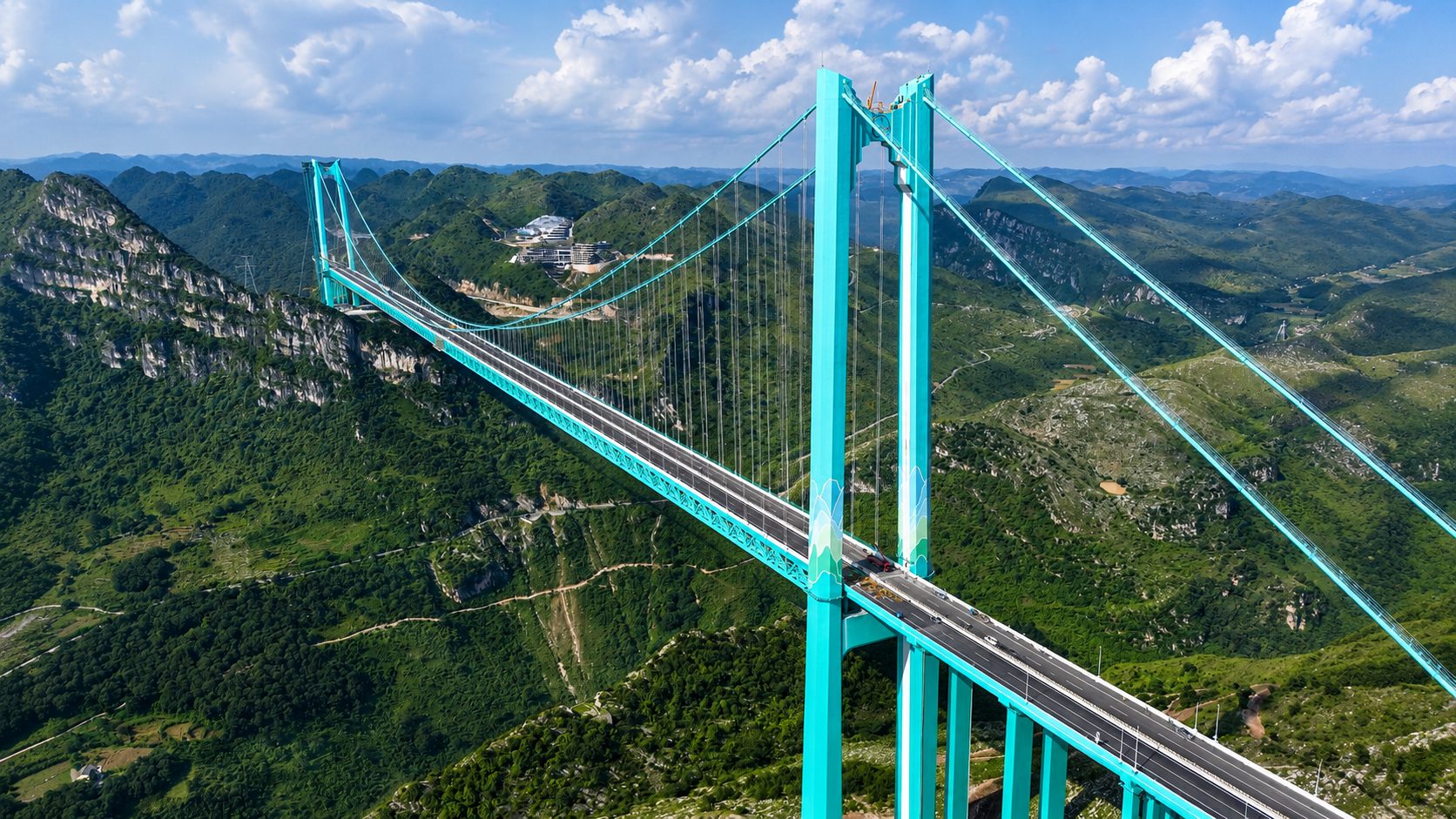
Standing 625 meters above the Beipan River — taller than the Burj Khalifa with room to spare — a new suspension bridge in Guizhou, China opened to traffic on 28 September 2025. It is now the world’s highest bridge by vertical clearance. Calling it just a bridge, though, undersells what’s actually happening here. China attached a reportedly 300-meter-wide artificial waterfall and a glass walkway to a working expressway, then added laser lights for atmosphere. This is infrastructure designed to be witnessed, not just used.
Engineering the Extreme
The confirmed numbers alone make a compelling case — before you even get to the waterfall.
- Bridge deck height above canyon floor: 625 meters
- Total length: 2,890 meters
- Main span: 1,420 meters
- Twin towers: approximately 262 meters tall
- Carries the Liuzhi-Anlong Expressway through karst mountain terrain
- Canyon crossing time: cut from roughly 70 minutes to about 2 minutes, according to multiple reports
Driving across the canyon used to mean white-knuckling mountain switchbacks for over an hour. Now you cross in the time it takes to skip a podcast ad.
The Waterfall Nobody Expected
Guizhou treated an engineering constraint as an invitation — and the result is unlike anything attached to a highway.
Pull over at this particular stretch of expressway and you’re staring down at a waterfall reportedly cascading 600 meters into the canyon below. During construction, engineers hit underground karst water flow. Rather than quietly diverting it, they engineered a spectacle — a waterfall whose spray height can reportedly be adjusted via water pressure. At night, laser lighting transforms the cascade into something resembling an arena concert backdrop strapped to a cliff face. According to secondary reports, the collected water also serves irrigation and facility operations on-site, though those claims haven’t been independently verified.
What This Means Beyond the Record
The bridge’s ambition extends well past its record-setting height — and that’s the part worth paying attention to.
Traditional infrastructure gets you from here to there. Guizhou treated that as a starting point. The site reportedly includes a glass elevator rising to a café viewpoint, with bungee jumping, paragliding, and possibly base jumping planned for the future. Think of it as Dubai’s approach to architecture — spectacle as strategy — applied to a mountain highway. Guizhou has long built extreme bridges across this rugged karst terrain, and this one surpassed the previous world record holder on the same river system.
Beyond the Crossing
If infrastructure ambition has a new benchmark, this bridge just set it.
The practical win is real: residents and freight operators shaved a significant chunk off their daily commute. But the larger signal is harder to ignore. Difficult terrain stopped being a problem to solve and became a canvas. Your expressway now comes with a waterfall, a glass elevator, and a light show. Nobody apologized for any of it — and that says everything about what infrastructure ambition looks like right now.