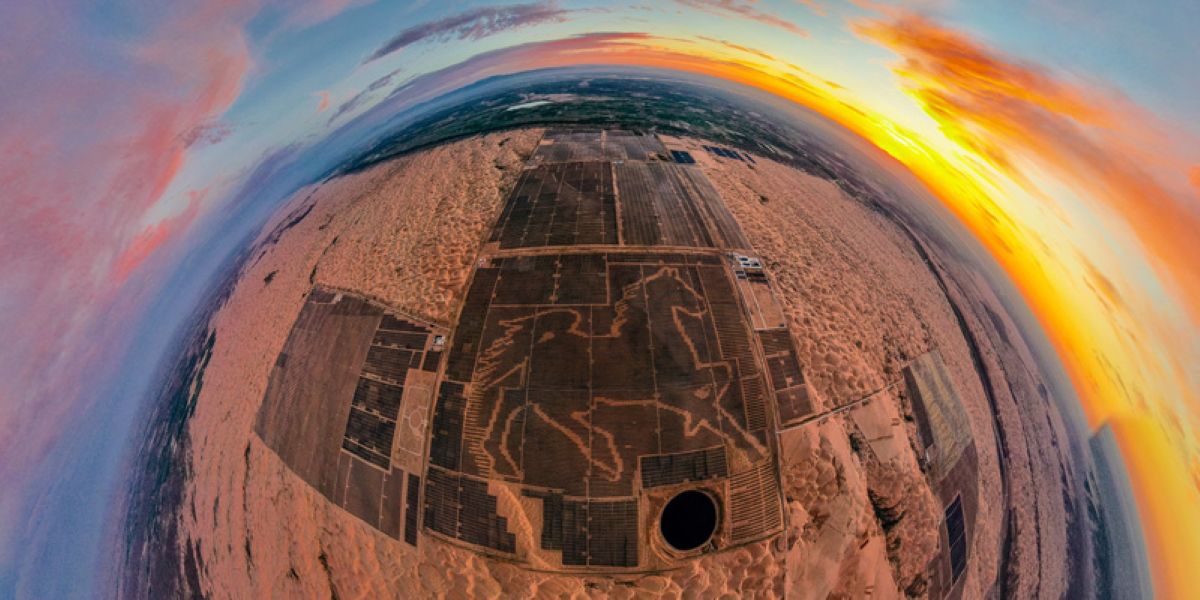
Somewhere in Inner Mongolia’s Kubuqi Desert, 196,320 solar panels form the shape of a galloping horse. You can see it from space. The Junma Solar Power Station earned the Guinness World Record for largest solar panel image on July 9, 2019 — nearly 1.4 million square meters of photovoltaic mosaic, built by SPIC Nei Mongol Energy Co., Ltd. But the horse is just one brushstroke inside something far bigger: a 250-mile-long, up to 3-mile-wide solar corridor targeting 100 GW of capacity by 2030. Think of it as China’s answer to the Great Wall, except this one generates electricity.
The Horse Is Real. So Is the Scale.
The numbers behind the Kubuqi corridor make most national energy grids look modest.
The 196,320 panels covering 1,398,421 square meters produce roughly 500,000 kWh daily, aimed at around 2 billion kWh annually — feeding the Beijing–Tianjin–Hebei grid roughly 800 miles away. The full corridor stretches 400 km, targets 100 GW by 2030, and already had approximately 5.4 GW installed as of 2024, with the Three Gorges Kubuqi base contributing 2 GW of that recently.
That Three Gorges Kubuqi base is designed for 16 GW total:
- 8 GW solar
- 4 GW wind
- 4 GW coal
The coal is a grid-stability backstop, included to keep power flowing when renewable output fluctuates. It complicates the clean-energy narrative, but it reflects the practical architecture of integrating massive volumes of variable power into a live grid. NASA’s Landsat imagery from 2017 to 2024 documents the corridor’s rapid expansion across the desert floor.
“NASA’s Earth Observatory notes that Landsat imagery helps ‘document the rapid expansion of solar farms’ as the Great Solar Wall takes shape.”
Solar Panels as Desert Medicine
Elevated arrays are quietly turning barren sand into something surprisingly green.
Unlike standard low-mounted installations, these panels are raised higher to let wind and diffused light pass underneath — grasses and crops grow in the shade below. The structures function as windbreaks, reducing erosion and slowing evaporation at ground level. NASA satellite imagery confirms visible greening in areas where panels have operated for several years. Whether this microclimate shift influences local rainfall patterns remains an open research question, not a confirmed effect.
Turns out the most effective anti-desertification tool China has found is a solar panel.
The horse shape is not incidental. Guinness specifically notes horses carry deep cultural ties to Inner Mongolia’s nomadic heritage, making the installation equal parts power plant and monument. For scale on China’s current pace: in May 2025 alone, the country added 93 GW of solar capacity nationally, according to EcoWatch. At that velocity, the Kubuqi corridor’s 100 GW target starts to look less like an ambition and more like a scheduled delivery. The galloping horse visible from space isn’t decoration — it’s a signal of just how fast this transition is moving, and a preview of what desert land can become when energy infrastructure doubles as ecological engineering.