A crane taller than a 30-storey building. A boiler the weight of a blue whale dangling through a hole cut in a nuclear station’s roof. That was the scene at Bruce Power’s Unit 3 on Lake Huron, where crews completed the fastest nuclear refurbishment in Ontario history — seven months ahead of schedule, under budget, and good for 35 more years of clean baseload power. In a province where nuclear already generates roughly half the electricity, and demand could nearly double by 2050, this is the kind of unglamorous engineering that actually keeps the lights on.
The Work Nobody Films
Replacing a reactor’s core components meant opening the building like a tin can.
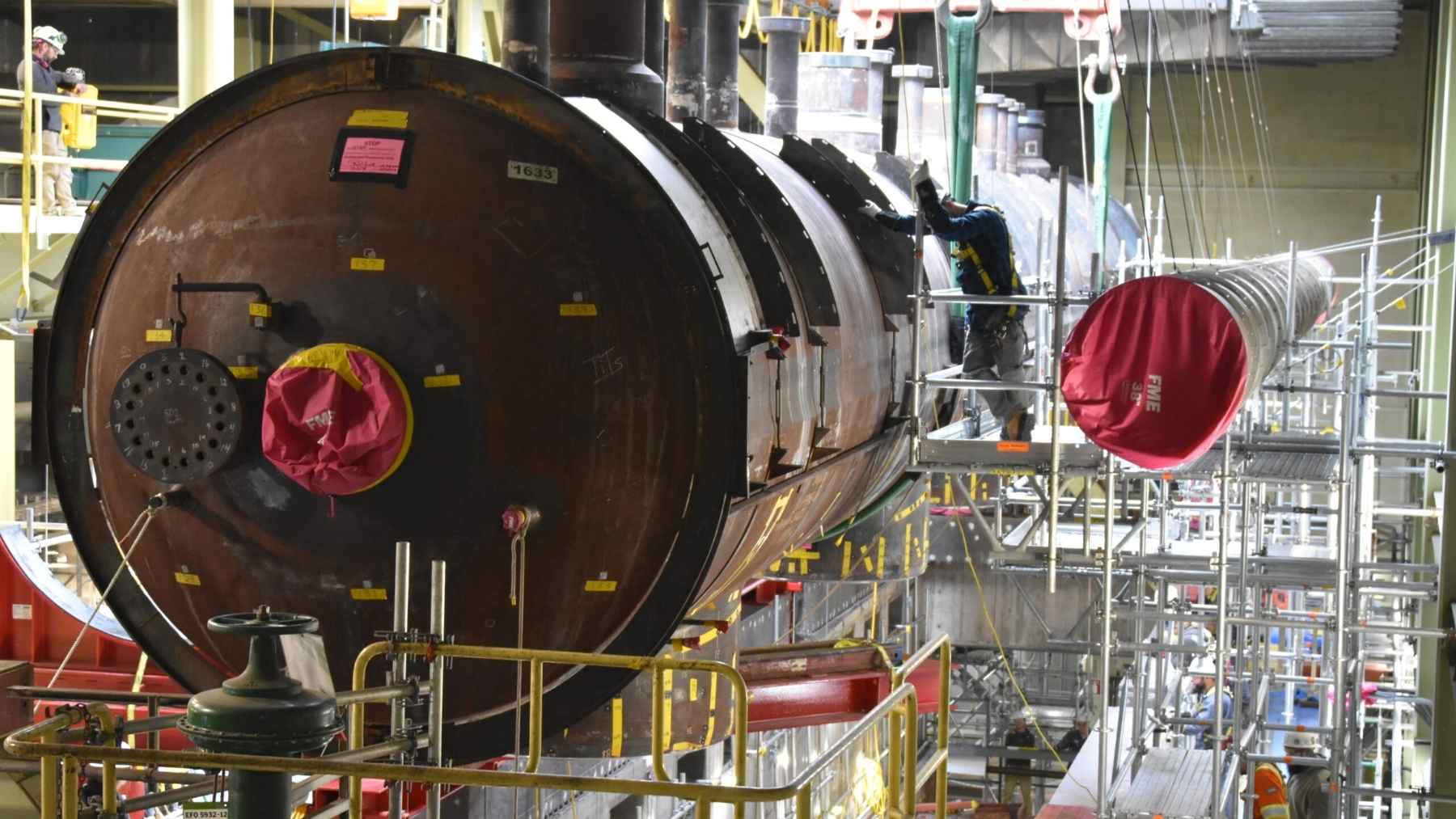
Eight steam generators — each 12 metres tall, roughly 100 metric tons — needed to come out. The station’s original layout made conventional removal impossible, so the team cut through the roof. Mammoet’s PTC-35 ring crane, standing over 100 metres high, hoisted the old units out and lowered replacements in. Those replacements weren’t freshly manufactured. BWXT Canada built them in Cambridge, Ontario, about two decades ago and stored them on-site, waiting their turn in the refurbishment schedule.
The boilers were just the headline act. Shoreline Power Group — a joint venture of Aecon, AtkinsRéalis, and United Engineers and Constructors — also replaced:
- 480 fuel channels
- 960 end fittings
- the feeder tubes routing heavy-water coolant through the reactor core
The crew set a CANDU record for calandria tube removal, finishing that phase 11 days early. They also deployed robotic tools on a CANDU reactor face for the first time in the design’s history. That combination of precision and pace is where “seven months ahead of schedule” actually came from.
Ontario Energy Minister Stephen Lecce called it “the most successful completion and return to service of a nuclear unit in Ontario history,” according to a provincial government release — a pointed answer to critics who argued Darlington’s refurbishment “couldn’t be done again.”
What Seven Months Early Looks Like in Dollars
CAD $150 million flows back to ratepayers — not to Bruce Power.
Unit 3 went offline in March 2023, originally due back in January 2027. It returned mid-2026. That seven-month gap translates to roughly CAD $150 million in savings routed to ratepayers through Ontario’s Independent Electricity System Operator — not retained by Bruce Power. That contractual structure matters: it’s a mechanism, not a talking point. Bruce Power CEO Eric Chassard framed the outcome as proof that large nuclear projects can deliver “real benefits for ratepayers,” according to the same provincial release. Worth noting: this is a privately financed project executed by Bruce Power and Shoreline Power Group, not a government build, even if the announcement leaned heavily on provincial framing.
- 800 MW restored capacity
- More than 800,000 homes served
- Extended operation past 2060
Bruce’s eight CANDU reactors make it one of the largest nuclear generating sites on Earth. The CAD $13 billion refurbishment program covers Units 3 through 8, running through 2033. Unit 4 is already underway, with Unit 5 scheduled to follow in November 2026.
If Ontario’s demand projections hold — electrification, EV adoption, and data centers pushing consumption up roughly 90% by 2050 — every one of these units carries real weight. Meanwhile, Bruce C, a proposed 4,800 MW expansion on the same site, has entered pre-development at CAD $300 million. The unglamorous, load-bearing work that nobody films just made the ambitious next chapter look a great deal more credible.