FlexBase’s underground battery matches nuclear output while responding in milliseconds to grid chaos. You know how your phone battery dies at the worst possible moment? Europe’s power grid faces the same problem, except the stakes involve keeping the lights on for millions of people. Enter FlexBase’s solution: a massive underground battery in Laufenburg, Switzerland, that reportedly delivers up to 1.2 GW of power—matching the output of the nearby Leibstadt nuclear plant—while storing over 2.1 GWh of energy.
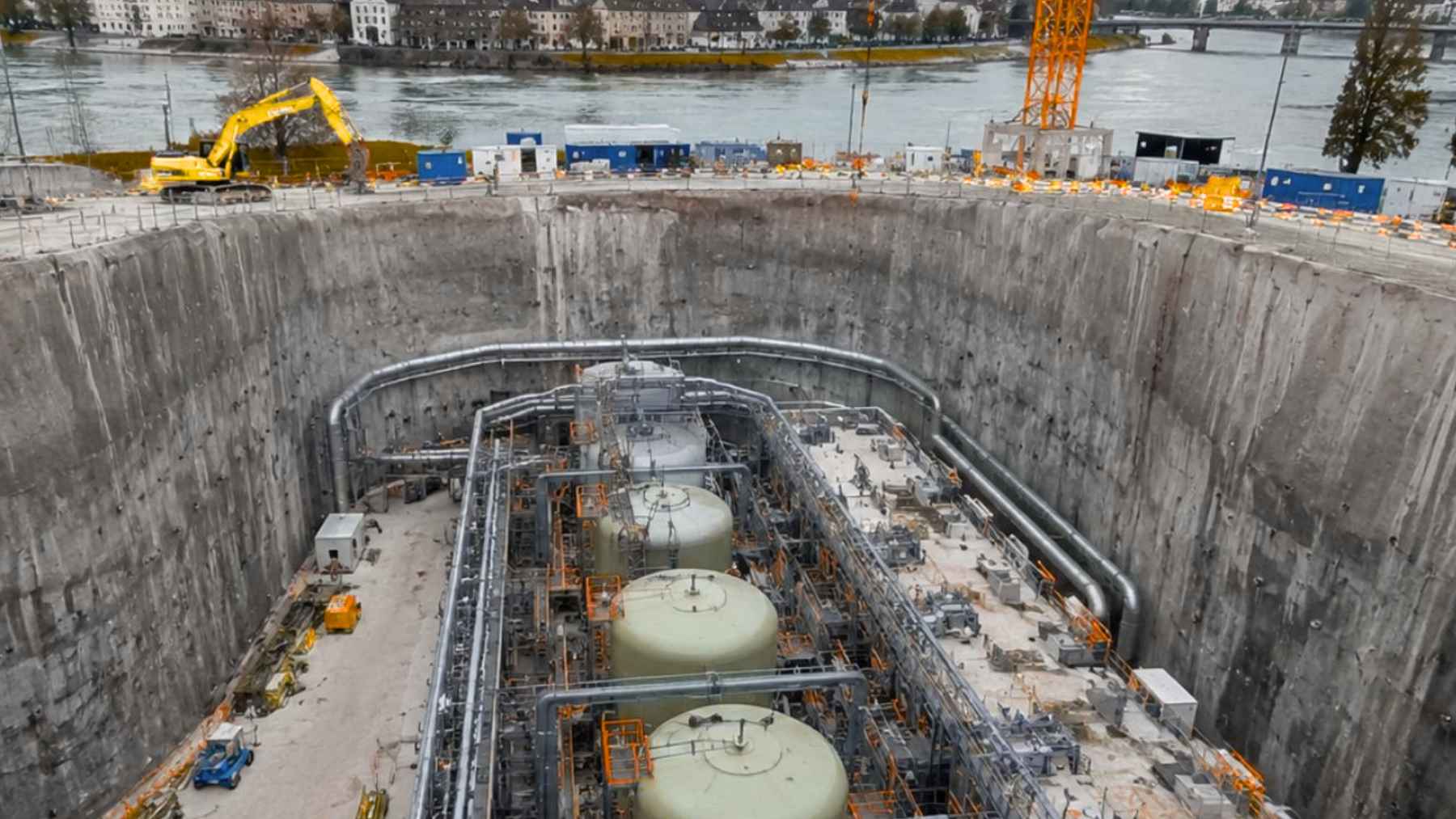
This isn’t your typical battery project. FlexBase allegedly hollowed out an 89-foot-deep pit longer than two soccer fields to house what they’re calling the world’s most powerful underground battery. The excavation supposedly covers 215,000 square feet, making it look more like a Marvel villain’s lair than traditional energy infrastructure.
Why Bury a Battery the Size of Football Fields?
Vanadium flow batteries prioritize safety and longevity over Instagram-worthy aesthetics.
Unlike lithium-ion batteries that can turn into expensive fireworks, this system reportedly uses vanadium redox flow technology with water-based electrolytes. Think of it as the Volvo of grid storage—boring but virtually indestructible. The liquid electrolytes supposedly live in massive tanks and get pumped through electrochemical cells, creating a system that’s non-flammable and responds to grid fluctuations in milliseconds.
FlexBase CEO Marcel Aumer reportedly chose Invinity Energy Systems as the battery partner specifically for safety, cycle stability, and application flexibility. When you’re storing enough energy to power 210,000 households for 24 hours, playing it safe makes sense.
More Than Just Europe’s Biggest Battery
The complex combines AI computing, waste heat recovery, and district heating in a multibillion-dollar experiment.
The real innovation lies in what else they’re building above ground. The Technology Center Laufenburg reportedly pairs the battery with a water-cooled AI data center, turning waste heat into district heating for nearby communities. This setup could prevent roughly 82,700 tons of CO₂ emissions over 30 years—basically turning data center cooling problems into neighborhood heating solutions.
Construction allegedly began in spring 2025, with Swissgrid approving an initial 800 MW grid connection. The full system should go online by 2029, creating about 300 jobs and potentially reshaping how Europe handles renewable energy’s mood swings. Whether this underground giant becomes the future of grid storage or an expensive science experiment remains to be seen.