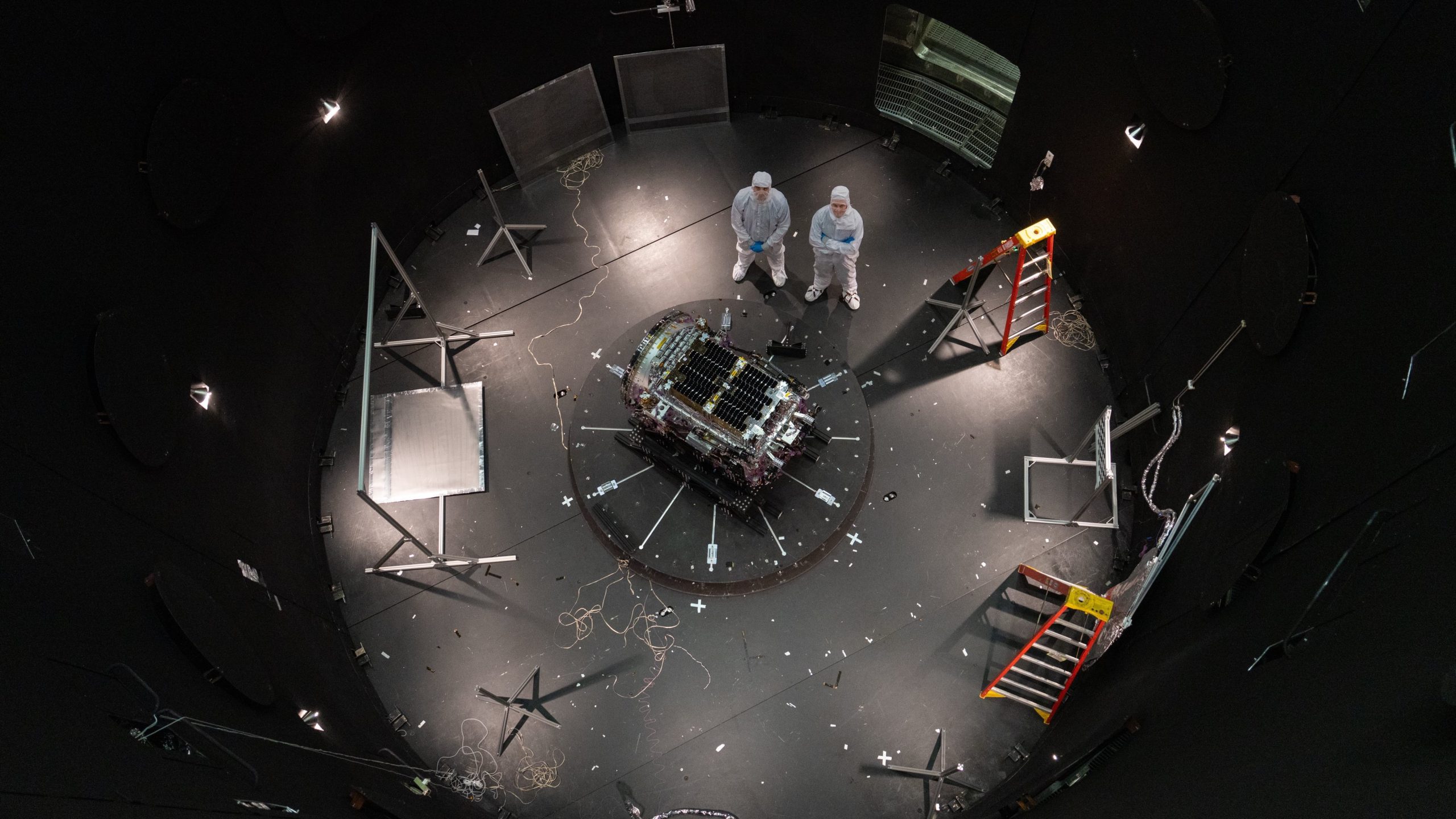
Since 2004, the Swift Observatory has been hunting gamma-ray bursts — the universe’s most explosive explosions. Now the telescope itself faces destruction. Swift has plummeted from 363 miles in altitude to roughly 225 miles, dragged down by solar activity swelling Earth’s upper atmosphere. Without intervention, NASA analyses put the probability of uncontrolled reentry at 90% by year’s end. The point of no return sits at about 185 miles, projected for October 2026. No replacement is funded. The clock is absurdly loud.
A Robot With Three Arms and One Shot
An Arizona startup built a rescue spacecraft in under seven months.
Arizona-based Katalyst Space Technologies accepted a $30 million NASA contract in September 2025 and delivered a finished spacecraft by May 2026. LINK is roughly refrigerator-sized, weighing about 425 kilograms, and equipped with three multi-jointed robotic arms. The catch — literally — is that Swift was never designed to be grabbed. No docking ports. No grappling fixtures. LINK has to latch onto structural features without damaging sensitive instruments: picture performing surgery with oven mitts in zero gravity. Launch is planned for late June aboard Northrop Grumman’s Pegasus XL rocket, air-dropped from an L-1011 aircraft over Kwajalein Atoll.
Here’s what’s actually riding on this:
- Swift has been NASA’s cosmic first responder for 22 years, rapidly pivoting to observe transient events other telescopes can’t catch in time
- NASA paused Swift’s science operations on February 11, 2026, just to slow the orbital bleed
- After capture, LINK will spend four to six weeks gradually pushing Swift back toward 600 kilometers altitude
- Success means resumed science by fall 2026 and potentially five to ten more years of operational life
- Only China has flown anything comparable — this would be the first American robotic rescue of an uncooperative satellite
“No one thought it was going to be possible,” NASA astrophysics director Shawn Domagal-Goldman told Space.com. NASA’s two instructions to Katalyst were brutally simple: go fast, and don’t make things worse. Science mission chief Nicky Fox told Space.com the math is straightforward — Swift is worth hundreds of millions, and the agency has no budget for a successor.
If This Works, Hubble Gets the Same Call
The Swift mission is a dress rehearsal for saving the telescopes you actually have a poster of.
Katalyst CEO Ghonhee Lee frames LINK as “the first American space robot” to attempt this kind of rescue. “All these big senior observatories…can benefit from a service like this,” he told Space.com. Hubble — also slowly losing altitude — is reportedly under discussion for a similar robotic boost around 2028. Think of it as a 400-kilogram firmware update that keeps aging hardware relevant for another decade.
NASA offers no guarantees LINK will work. But the alternative is watching a still-vital telescope burn up while the window quietly closes. The era of robotic space rescue either starts this summer — or waits for the next telescope to fall.