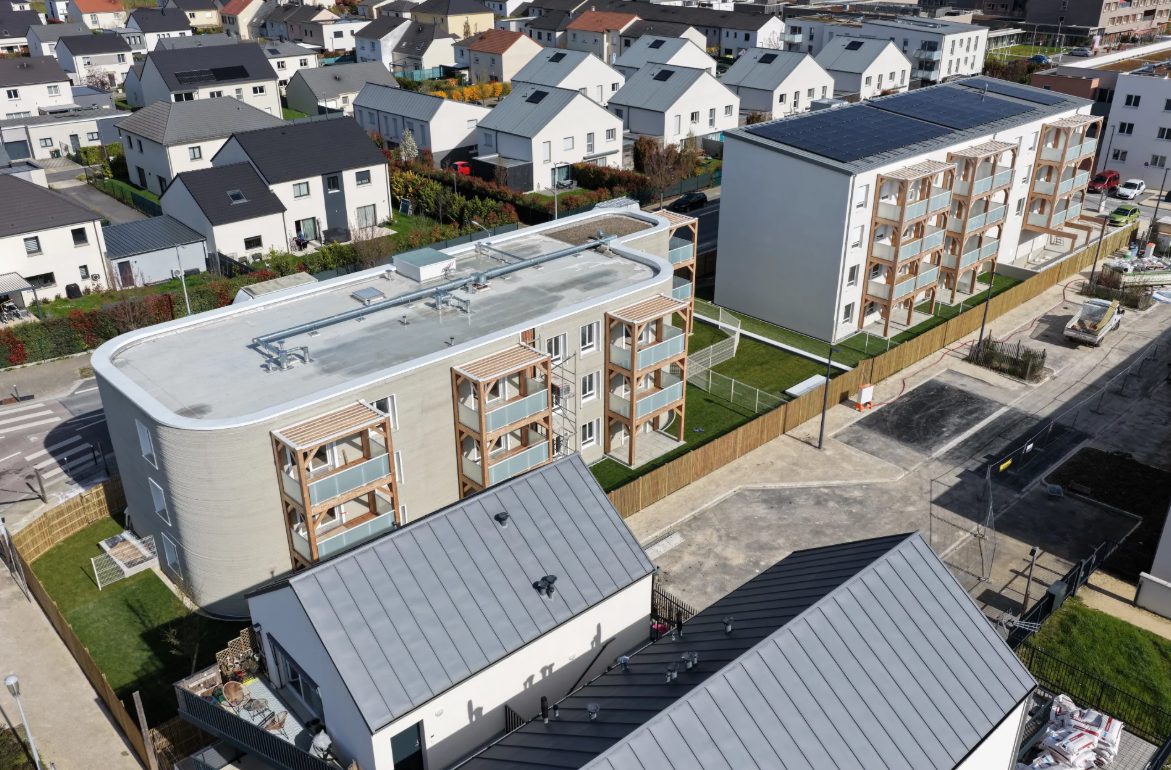
Housing construction crawls at a glacial pace while demand skyrockets, but ViliaSprint² in northeastern France just shattered that timeline. This three-story, 12-unit social housing block completed its shell structure in just 34 effective printing days—roughly three months faster than the identical conventional building constructed right next to it.
Robot Precision Meets Real Housing Needs
The massive COBOD BOD2 gantry printer operated by PERI 3D Construction extruded layers of Holcim’s specialized concrete mixture directly on-site in Bezannes, near Reims. This wasn’t prefab assembly—every load-bearing wall and partition emerged from the printer’s nozzle, creating curved architectural forms that would require expensive custom formwork in traditional construction. The building measures 11 meters wide by 34 meters long, housing 12 apartments across three floors with individual balconies supported by timber structures.
The Numbers Don’t Lie About Labor and Waste
You’d spot the difference immediately on this construction site: the 3D-printed structure required only three workers versus six for the conventional twin building. Material waste dropped from the typical 10% to just 5%, while concrete usage fell by 10% thanks to optimized curved designs impossible with traditional formwork. Like watching chess versus speed-running Tetris, the conventional building plodded through standard timelines while the printer methodically built its neighbor in record time.
Energy Performance Meets Future Housing Standards
ViliaSprint² isn’t just fast—it’s smart. The building integrates 500 square meters of photovoltaic panels with a hybrid gas-heat pump system, achieving roughly 60% energy self-sufficiency while meeting France’s stringent RE2020 2025 environmental regulations. The macro-fiber-reinforced concrete includes perlite insulation for thermal performance and fire resistance, proving that printed buildings can match conventional structures on every metric that matters to residents.
Scaling Up for Mainstream Housing Development
If you’re a developer watching construction labor costs spiral upward, Plurial Novilia’s next move should grab your attention. Their planned 40-apartment follow-up will deploy two BOD2 printers simultaneously, targeting a four-fold reduction in print time and cost parity with conventional methods. This progression from experimental showcase to practical housing solution suggests 3D printing has evolved beyond novelty into a legitimate tool for addressing Europe’s housing supply constraints.