Travel hacks flood social media feeds with promises of free upgrades and empty seats, but many of these tricks carry serious risks that could leave you banned from airlines or facing fraud allegations. The internet loves a shortcut, yet the gap between clever strategy and contract violation is thinner than most realize. This guide separates legitimate travel tactics from the schemes that can cost you far more than any baggage fee.
Six widely shared “hacks” get scrutinized here, revealing which ones work within airline rules and which ones might earn you a permanent spot on a no-fly list. The selection process prioritized viral techniques with measurable consequences, backed by documented airline responses and traveler experiences. Anyone who’s ever envied an empty middle seat or cursed a checked-bag fee will recognize these methods, but knowing the real fallout changes everything.
6. Poor Man’s First Class: The Refundable Seat Scam
Airlines cancel and reassign seats faster than you can say “refund confirmation.”
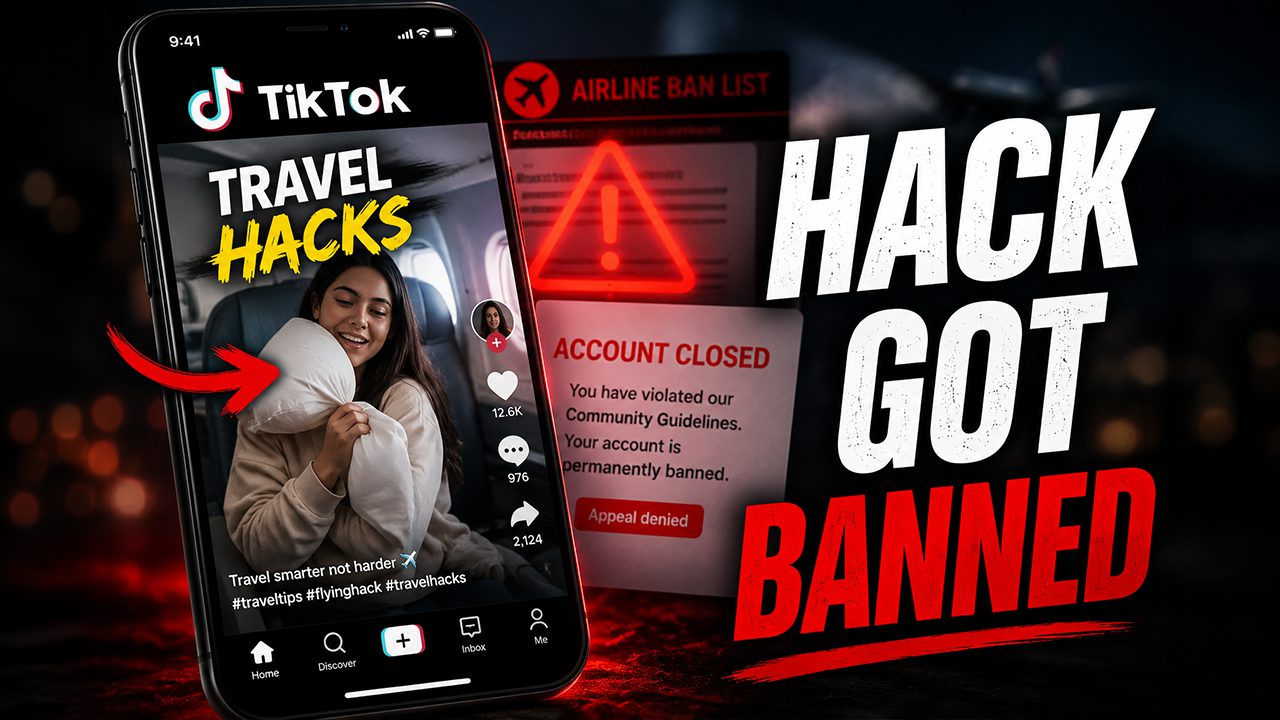
The viral TikTok hack promises luxury space by booking an entire row of refundable tickets, then canceling the extras roughly 30-45 minutes before departure. Airlines oversell most flights and quickly reassign those newly freed seats to standby passengers or upgrade-hungry frequent flyers.
You end up paying for three seats, refunding two, and still landing next to someone who reclines into your lap the second the seatbelt sign clicks off. The math never works in your favor. The illusion of gaming the system evaporates when the gate agent calls another passenger to fill that carefully curated empty middle seat.
Consequences extend beyond a cramped flight. Airlines treat booking tickets under fictitious names and canceling them solely to block seats as fraud—a clear violation of terms of service. Frequent-flyer accounts get closed, miles vanish, and repeat offenders face outright bans from carriers who track these patterns with casino-level precision.
If you legitimately need extra space, most major airlines let you purchase additional seats by calling and booking them correctly. No scheming required. The refundable seat scam delivers broken promises, wasted effort, and the very real risk of losing your entire travel privileges over a middle seat.
5. The Window and Aisle Strategy

Most travelers avoid middle seats when possible, so the odds tilt in your favor.
Couples traveling together frequently book the window and aisle seats in a three-seat row, banking on the middle seat staying empty. Airlines allow this standard seat-selection approach without issue since all tickets are paid and used. The logic holds: when the flight fills up and someone lands in that dreaded center spot, couples typically ask if the new arrival wants to swap for either the window or aisle.
Most people happily trade up, everyone wins, and you’re sitting together within seconds. Worst-case scenario plays out with you ending up in window-middle or aisle-middle instead of side-by-side, which still beats being scattered across different rows.
This tactic carries minimal risk compared to aggressive hacks involving fake names or fraudulent cancellations. Success rates run considerably higher than schemes that flirt with airline bans. You’re simply playing the odds with legitimate bookings—no violations, no drama, just a smart use of seat maps and human psychology.
4. The Pillowcase Packing Ploy
Gate agents receive training to spot overstuffed “pillows” that clearly function as luggage.
Travelers who stuff clothes into a pillowcase, hoping to pass it off as a neck pillow and dodge carry-on fees, discover staff aren’t easily fooled. Airlines earn billions from baggage fees annually, so agents watch for workarounds. The illusion crumbles when someone asks you to demonstrate the pillow’s actual comfort or notices your “pillow” weighs more than a bowling ball.
At that point, you’re forced to check the item at the gate or purchase an additional bag on the spot. Fees often run around $35 or more on some carriers, which exceeds what a pre-purchased checked bag would have cost.
Purpose-built travel pillows with compression compartments offer legitimate clothing storage without the confrontation risk. They actually cradle your neck during red-eyes instead of embarrassing you at boarding.
3. Skiplagging: The Hidden-City Ticket Gamble
Skip any segment of your itinerary and the entire remaining ticket vaporizes instantly, including your return flight home.
Skiplagged, founded in 2013 by Aktarer Zaman, helps travelers find hidden-city routes that can approach savings of nearly 50% on select itineraries. The premise sounds brilliant until you understand how airline reservation systems actually work. Book a flight from New York to Los Angeles via Atlanta, disembark in Atlanta (your real destination), and pocket the savings because direct Atlanta flights cost more.
Airlines hate this move intensely, and their automated systems are ruthlessly efficient at enforcement. When you no-show any flight segment, the rest of the itinerary gets canceled. Checked bags are equally doomed since they route to the ticketed final destination. Skiplagging only works if you pack light and never plan to use the rest of your booking.
Repeat offenders face voided frequent-flyer miles, surprise bills for “lost revenue,” or outright bans from the carrier. One well-publicized case involved a teenager barred from flying a major airline after getting caught. Saving money on the outbound leg can cost you far more than a direct ticket ever would.
2. The ‘Fat Suit’ Baggage Bypass

Security officers screen thousands of travelers daily and recognize bulky clothing patterns immediately.
That desperate moment at the gate when your carry-on won’t zip shut might tempt you to stuff jackets into your waistband or wrap sweaters around your torso, but this so-called “fat suit” hack creates more problems than it solves. Security officers flag unusual bulk patterns, especially when someone boards a flight to Mallorca in August wearing what appears to be an entire winter wardrobe.
The discomfort alone should be a dealbreaker. Picture shuffling through airport security in sweltering heat, sweating through multiple shirts while TSA agents pull you aside for additional screening because your silhouette looks like you’re smuggling contraband.
Gate agents possess the authority to classify your wearable baggage as unpaid luggage, forcing you to either check items or pay the fee you tried to dodge. The tactic fails because airline staff train specifically to spot these attempts. Modern security protocols flag unusual bulk as potential concealment. Anyone who thinks they can outsmart professionals who process millions of passengers annually is setting themselves up for embarrassment, delays, and the exact fees they hoped to avoid.
1. Abusing Disability Accommodations

When someone healthy siphons off mobility resources, a person with a legitimate condition faces delays, exhaustion, or outright denial of service.
Some travelers fake disabilities to skip security lines and board early, treating wheelchair services like a Fast Pass cheat code. Theme parks like Walt Disney World have documented widespread abuse of disability access, prompting policy overhauls that now require more detailed verification processes.
The allure of cutting a two-hour queue might seem harmless until you consider the traveler with severe arthritis who arrives at the gate only to find all wheelchairs already claimed by fraudsters. Airlines and attractions maintain limited fleets of mobility devices.
Beyond the moral bankruptcy, this stunt can trigger legal penalties for misrepresentation or fraud in several jurisdictions, plus permanent bans from airlines and parks. The convenience stolen costs someone else their dignity and independence. Fraudulently claiming disability status violates service-provider policies and may expose individuals to penalties or facility bans in various jurisdictions.