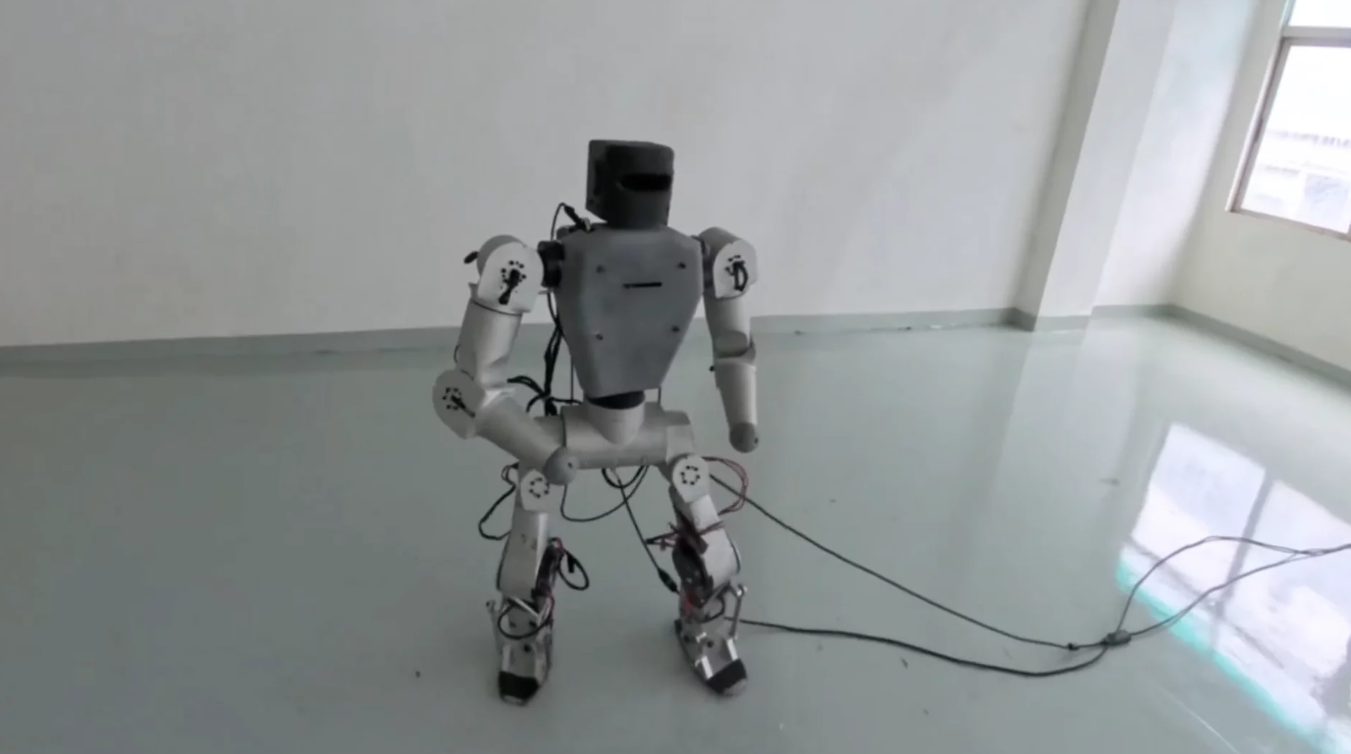
Most robotics researchers face a brutal choice: spend tens of thousands on enterprise humanoids or settle for desktop toys that can’t walk. Rotaku’s new Domo platform splits this difference at $2,999, delivering a full-body humanoid with serious AI capabilities that won’t bankrupt your lab budget.
Two Sizes, Same Ambition
Domo ships in developer and plus versions, both built for whole-body policy learning.
The base Domo Developer stands 90cm tall, weighs 20kg, and packs 23 degrees of freedom with 70 Nm peak torque per actuator. Think desktop-friendly size with enough grunt for coordinated walking and manipulation. The Domo Plus scales up to 130cm and 35kg with 25 DoF and 110 Nm torque—nearly half-scale humanoid territory.
Both models feature:
- Integrated aluminum chassis
- Cable-free operation
- Hot-swappable battery packs delivering two hours of continuous use
According to Rotaku, the platform supports whole-body policy learning where the robot learns coordinated tasks through demonstration rather than explicit programming for each behavior.
Developer Tools That Actually Matter
Rotaku built Domo for researchers who want to deploy AI models, not just remote-control a robot.
While other humanoids treat developers as afterthoughts, Domo centers on research workflows. VR teleoperation lets you capture natural motion data using two-arm motion capture—crucial for training imitation learning models. SSH access means deploying your trained policies directly onto the robot’s onboard compute, no tethering required.
The platform includes gesture recognition and an LLM-powered voice assistant, though you’ll need genuine technical chops to leverage these features effectively. This isn’t drag-and-drop programming; it’s a platform for teams comfortable with command lines and machine learning pipelines.
Pricing Reality Check
Significantly cheaper than Unitree options, more research-capable than budget alternatives.
| Model | Price | Notes |
|---|---|---|
| Unitree R1 | ~$5,000 | |
| Unitree G1 | $13,500 | Agile model |
| Domo | <$3,000 | Sub-3K entry |
| Noetix Bumi | ~$1,370 | Home users, simplified programming |
Rotaku occupies the sweet spot between educational toys and enterprise platforms, though you’re betting on a Bay Area startup against established robotics companies with longer track records.
Domo represents something rare: a genuine attempt to democratize advanced robotics without dumbing down the capabilities that matter for research. Reservations are open now for initial production batches, positioning early adopters to explore embodied AI without enterprise budgets—if Rotaku can execute on manufacturing and support.