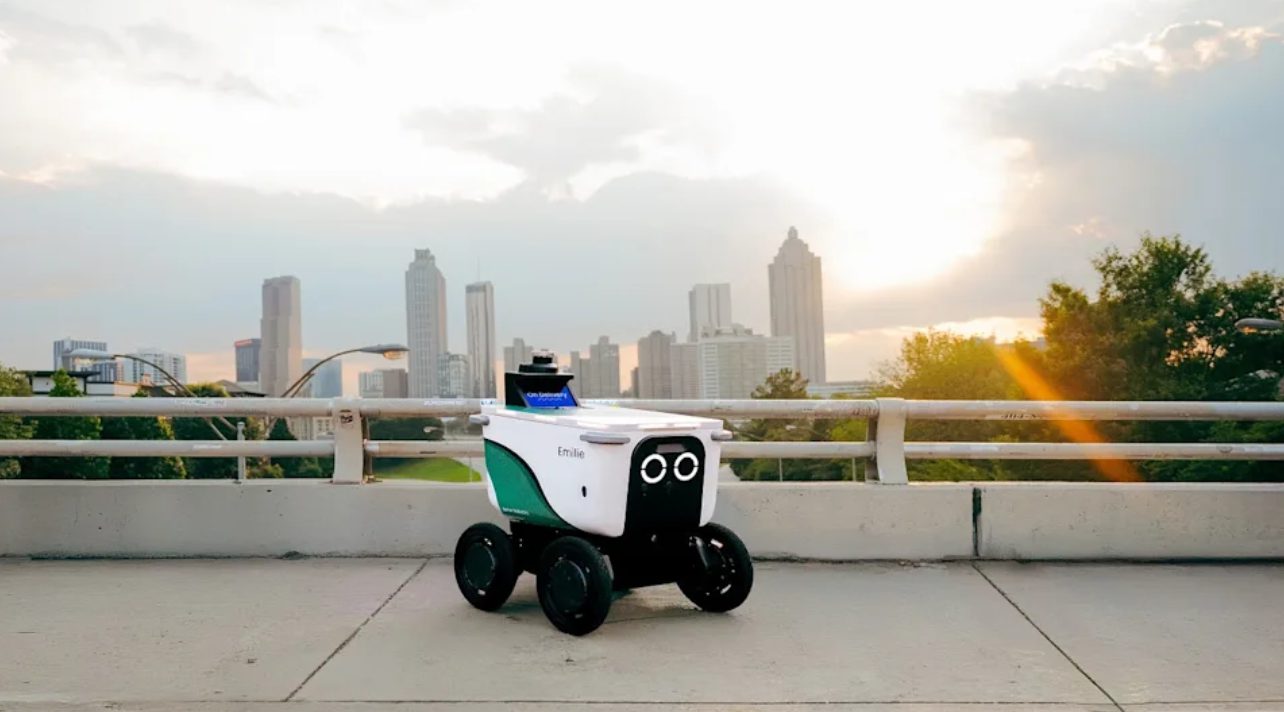
Cute machines designed to charm pedestrians are creating new barriers for wheelchair users and the visually impaired. You’ve probably seen them—little coolers on wheels with blinking “eyes” politely asking humans to press crosswalk buttons. They’re multiplying across Los Angeles sidewalks faster than food trucks during lunch rush, and the city’s already strained walkability is buckling under the weight of good intentions.
Corporate promises meet sidewalk reality
Companies claim near-perfect safety records while incidents pile up on LA streets.
Multiple companies now operate delivery robots across dozens of LA neighborhoods, each machine weighing up to 45 kilograms and cruising at 7 kilometers per hour. These aren’t just prototypes anymore. They’re infrastructure. The robots use sophisticated sensors and can be remotely monitored when needed.
Research reveals a different story than corporate marketing suggests. Studies document dangerous near-misses and moderate-risk interactions between pedestrians and sidewalk robots in controlled environments. When incidents occur, researchers often find the machines at fault rather than humans.
A widely publicized incident showed a delivery robot colliding with a wheelchair user in LA. While companies emphasize their safety features and testing procedures, disability advocates point out that such collisions highlight predictable risks in real-world deployment.
When convenience collides with accessibility
Los Angeles sidewalks weren’t built for robot traffic, and vulnerable pedestrians pay the price.
The robots face the same infrastructure problems as pedestrians—broken pavement, narrow walkways, conflicts with vehicle traffic—but they also create new competition for scarce sidewalk space. Research confirms that autonomous delivery robots can negatively impact urban mobility and pedestrian flow.
Visually impaired pedestrians face additional navigation challenges when robots occupy sidewalk space or create unexpected obstacles. Wheelchair users encounter fresh barriers in a city where only 6.8 percent of the U.S. population lives in truly walkable areas.
The irony cuts deep. Robots designed to reduce car trips by handling short deliveries may instead make walking—the most sustainable transport mode—harder for the people who need sidewalks most.
Cities have taken different approaches to this challenge. Some have restricted sidewalk robots entirely, citing safety and accessibility concerns. LA chose a different path, allowing pilots to expand. Researchers now study how robot deployment might disrupt existing pedestrian flows, developing new frameworks for managing this technology.
The question isn’t whether delivery robots work. It’s whether cities exist primarily for app-based convenience or for the humans who actually live there.