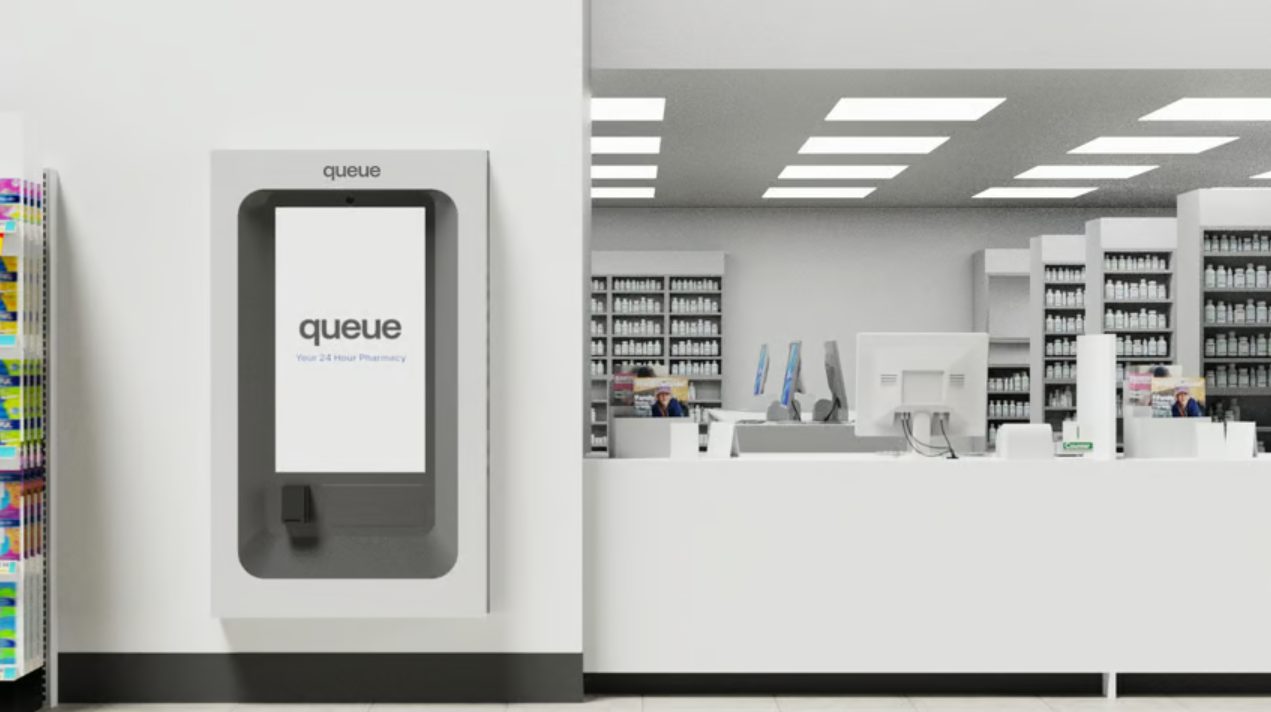
In a Palo Alto pilot site, a machine now takes sealed wholesale pill bottles and produces verified, labeled prescription vials with no on-site staff anywhere in the loop. Queue, the startup behind this autonomous pharmacy kiosk, just emerged from stealth with $12.6 million in seed funding — and the timing reflects a system already under strain. Thousands of U.S. pharmacies have shuttered in recent years. Staffing shortages persist across retail and rural locations alike. Your nearest pharmacy might already be running on fumes. Queue is betting a robot can fill the gap, literally.
The workflow is straightforward:
- A technician loads sealed manufacturer bottles into the kiosk.
- Computer vision identifies every pill down to the National Drug Code level.
- The system counts, dispenses, labels, and seals each vial automatically.
- You walk up, scan a QR code, and collect your prescription in roughly 60 seconds.
Queue says it can fill a 60-pill vial every 30 seconds — roughly 600 pills per minute at full configuration — and currently supports around 250 commonly prescribed medications, according to the company’s website.
What “Fully Autonomous” Actually Means
Existing pharmacy robots still need staff hovering nearby — Queue removes the on-site pharmacist entirely.
Most pharmacy automation today — dispensing cabinets, centralized fill systems — still requires a pharmacist to supervise and close the loop. Queue eliminates that on-site presence, which is where the claim gets genuinely interesting and the regulatory friction begins. Investors say Queue has already navigated initial state pharmacy board requirements, according to Ubiquity Ventures. An unnamed major national pharmacy chain is reportedly running a commercial prototype. Nationwide deployment, however, demands state-by-state approvals, and that road is long. Independent pharmacy and regulatory voices have yet to weigh in publicly on whether autonomous verification can fully substitute for on-site clinical judgment — particularly for complex regimens or counseling situations the kiosk isn’t designed to handle.
Queue claims up to 96% lower fulfillment costs versus traditional operations, according to its announcement on BusinessWire. The company frames this as freeing pharmacists for clinical work — the same pitch every automation company makes. Think ATMs: they didn’t kill banking, but they absolutely reshaped which banking jobs survived. That analogy cuts both ways here.
$18.6 Million and a Roadmap to Your Grocery Store
Queue’s total funding and early 2027 deployment targets hint at how fast this could scale.
Backed by $18.6 million total — a $6 million pre-seed from Riot Ventures plus the new round led by AlleyCorp, with House Capital, Ubiquity Ventures, Grep Ventures, and Banter Capital participating — Queue plans to grow its engineering team and expand deployments. Broader commercial rollout reportedly targets early 2027, with intended environments spanning:
- retail pharmacies
- hospitals
- clinics
- rural communities where staffing makes traditional pharmacies unviable
The unresolved question isn’t whether the robot works. It’s whether regulators and patients will trust a machine as the final checkpoint on their medication — the same trust leap cashierless stores like Amazon Go demanded, but with stakes measured in health outcomes, not grocery receipts. Queue’s sharpest argument? Human error already costs lives in pharmacy. The robot just makes that harder to ignore.