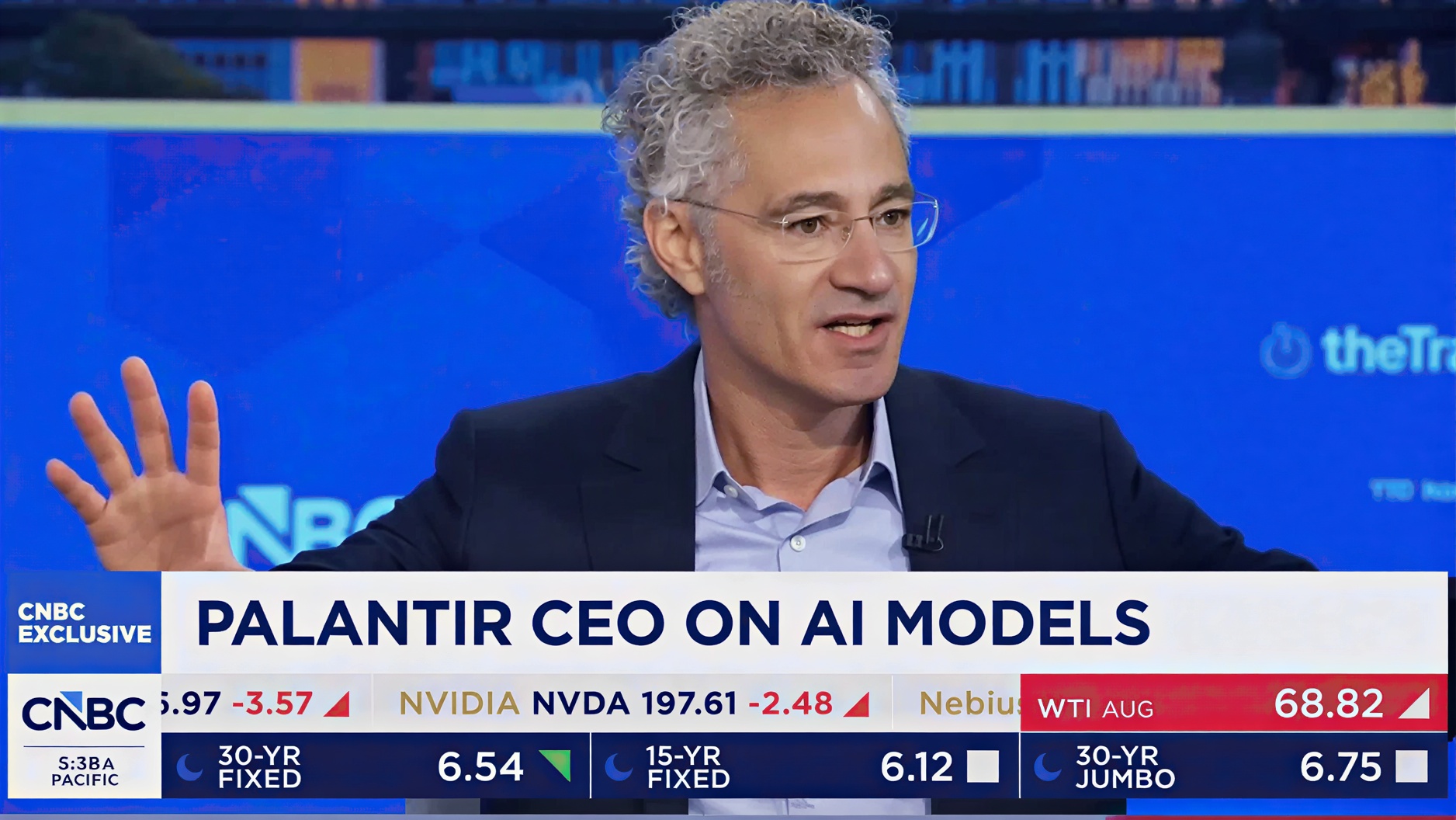
Seven minutes into what was supposed to be a routine segment about Palantir‘s new Nvidia partnership, CNBC anchor Becky Quick cut through the noise: “You sound pretty angry.” Alex Karp didn’t flinch. “No, this is the voice of American business that is being channeled through me,” he fired back, according to Mediaite. The segment had already gone sideways – digressions about UC Berkeley faculty jobs, stuttering monologues, anchors exchanging glances like parents at a school play gone wrong. Strip away the performance art, and Karp was making an argument worth hearing.
Tokens, Weights, and Anger
Karp’s target is the pay-per-word pricing model that dominates enterprise AI – and the data risks hiding inside it.
Token-based pricing – essentially paying per unit of text processed – is how OpenAI and Anthropic charge most enterprise customers. Karp’s claim, framed as reported speech from frustrated CEOs he speaks with privately, was blunt: “These people are stealing the weights and alpha of my business, and they’re creating a wealth tax that does not help the poor; it just punishes,” according to Mediaite. Translated from CEO-speak: “weights” are trained model parameters, “alpha” is competitive advantage. He argues that companies pay premium rates for generic AI while surrendering proprietary data to vendors who might eventually compete against them – a pattern not unlike other tech scandals where customers bore the cost.
He also accused labs of “tokenmaxxing” – chasing raw usage volume over real business outcomes – and framed the whole pricing structure as a national security threat, claiming frontier labs sell to adversaries while restricting equivalent access for the “Department of War.” He named Sam Altman and Dario Amodei directly, while insisting he wasn’t “throwing shade” at either.
“No, this is the voice of American business that is being channeled through me.” – Alex Karp, CNBC Squawk Box, July 1, 2026
Futurism called the whole thing a “televised nervous breakdown.” That characterization has merit – the digressions were real, the anchors looked genuinely befuddled. But a digitalapplied.com analysis argues the meltdown framing buried a legitimate enterprise grievance about data ownership and IP exposure. Both readings can coexist, like a TikTok rant that’s simultaneously unhinged and correct. Whether enterprise buyers were already primed to hear the signal, analysts suggest, may determine how much the delivery actually costs Karp’s argument.
Palantir’s stock closed up roughly 8–9% that day, per digitalapplied.com.
Palantir’s Play
The rant doubled as a live pitch for Palantir’s sovereign AI alternative – and investors appeared to get the memo.
Days before the interview, Palantir announced an open-weight AI infrastructure deal with Nvidia targeting governments and enterprises. The value proposition:
- You own the model; the data ownership is unambiguous.
- No black-box API.
- No ambiguity about who keeps your information.
Karp’s CNBC appearance – equal parts Succession boardroom and impromptu TED Talk – was effectively a live infomercial for that offering, however chaotic the delivery looked.
When a CEO calls token pricing a “wealth tax” on national television and the stock jumps nearly nine points, something real is shifting in enterprise AI economics. The argument may need a cleaner runway – but it doesn’t stop being relevant just because the messenger veered into Berkeley job complaints along the way.