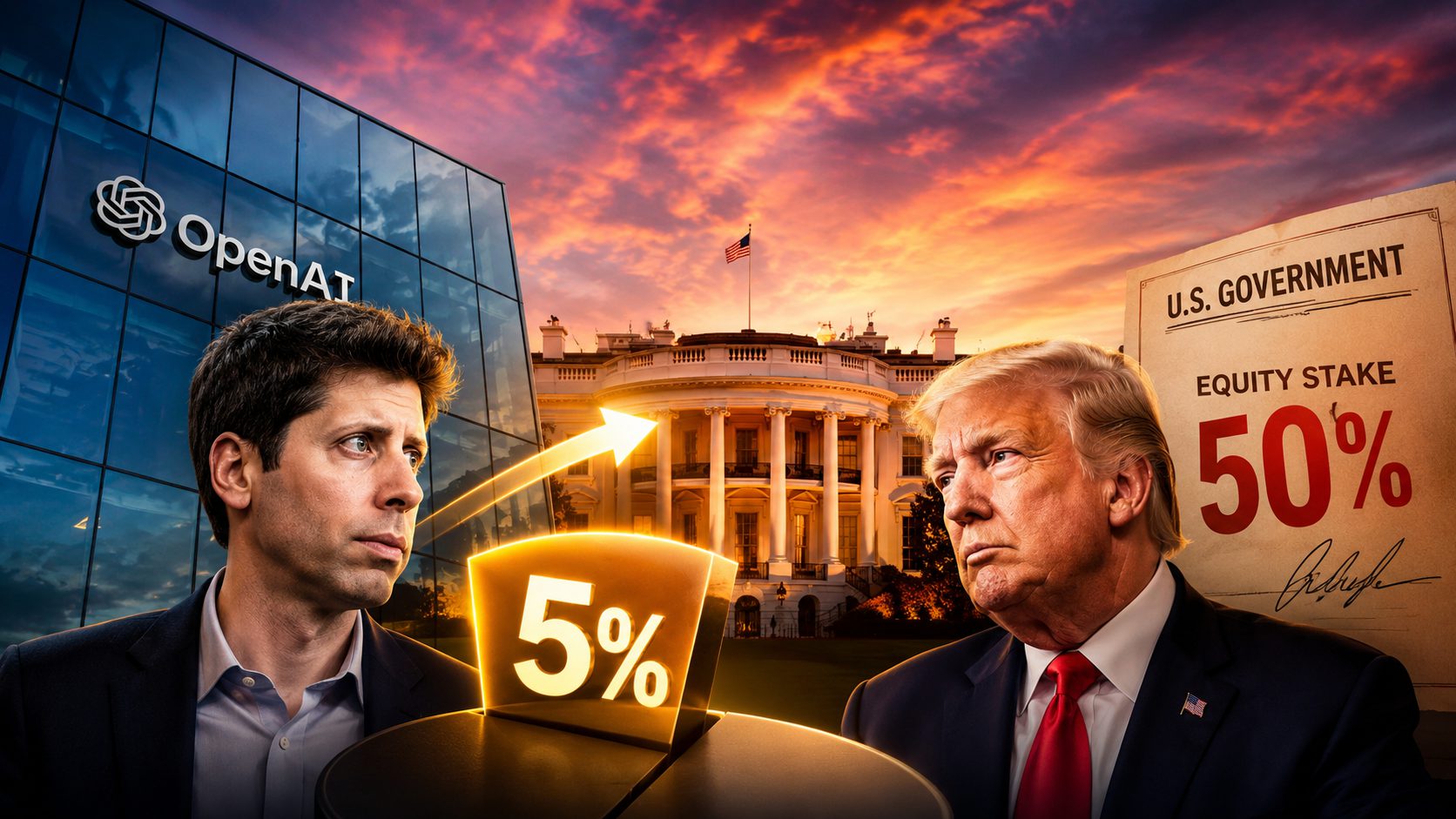
Sam Altman has been pitching the White House for over a year. The offer: donate roughly 5% of OpenAI’s equity into a government-run “Public Wealth Fund,” seeding it alongside contributions from other AI firms. The fund would invest in diversified assets, then pass returns directly to American citizens. Think Norway’s oil fund — except the oil is artificial intelligence, and the drilling rig is a data center in Texas that anchors ambitions like the Stargate Project.
The Proposal: What’s Actually on the Table
A voluntary equity transfer sounds generous until you see the competing bill that demands ten times more.
OpenAI’s April 2026 policy paper frames this as letting people “participate directly in the upside of AI-driven growth, regardless of their starting wealth,” according to the Financial Times. Trump described the concept as Americans becoming “a partner with the companies,” per CNBC.
Five details shape the proposal’s real contours:
- Altman first raised the equity-transfer idea with the Trump administration in 2025, according to CNBC
- Trump’s sovereign wealth fund planning dates to a February 2025 executive order
- Anthropic has also endorsed sovereign-wealth-style arrangements, per Tangle News
- Altman himself holds no direct equity in OpenAI — making the “donation” somewhat easier to propose
- No binding terms exist — stake size, governance rights, and payout mechanics remain undefined
- Whether contributions stay voluntary is also unresolved; any formal arrangement requires congressional action
Meanwhile, Sen. Bernie Sanders has introduced the American AI Sovereign Wealth Fund Act — a one-time 50% stock tax on AI firms generating over $200 million annually from AI-related activities. Sanders wrote in a New York Times op-ed that creative work has been “essentially been stolen by some of the wealthiest people in the world.” His bill envisions roughly $7 trillion in fund assets, disbursing approximately $1,000 per person annually, according to Forbes.
The Real Stakes: Goodwill vs. Reckoning
Between 5% and 50% lives the entire argument over who owns America’s AI future.
The Wall Street Journal editorial board called Sanders’s plan effectively seizing half of every major AI company, per Forbes — a radical redefinition of property rights dressed up as a tax. The bill hasn’t advanced from committee, and analysts expect steep political headwinds.
The dynamic worth tracking: Altman’s voluntary model may quietly normalize the very concept Sanders wants to mandate. Today’s friendly 5% donation establishes a floor, not a ceiling. A 5% gesture and a 50% seizure are separated by one congressional session and enough public anger. The transformative power of artificial intelligence is the very concept Sanders wants to mandate a public share of.
The governance question — whether citizens receive a cash dividend or actual democratic control over AI assets — remains completely unanswered. That gap matters more than any percentage. Whoever designs the fund’s structure decides whether the public becomes a true stakeholder or just another line item on a quarterly report.