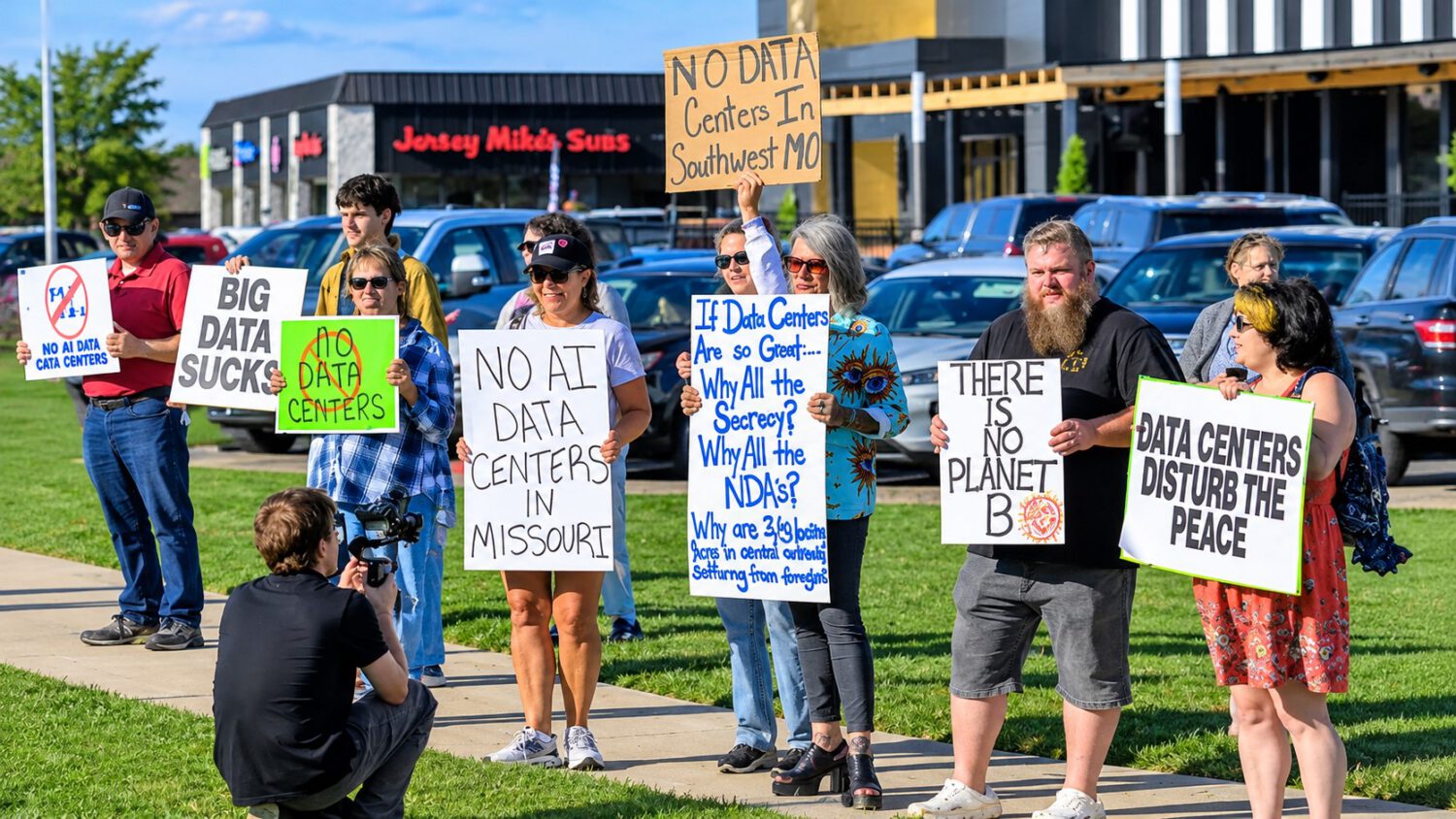
Imagine spending billions on AI infrastructure only to watch an 80% vote in a small Ohio town kill your rezoning application. That scene played out repeatedly on November 3, 2026. Voters across California, Florida, Illinois, Kansas, Maine, Nevada, New Jersey, North Dakota, Ohio, and Wisconsin weighed 41 data-center-related ballot measures, and by the following morning, 38 had been called: 37 limited or blocked development, and one supported it. As Chris Teale of Route Fifty summarized:
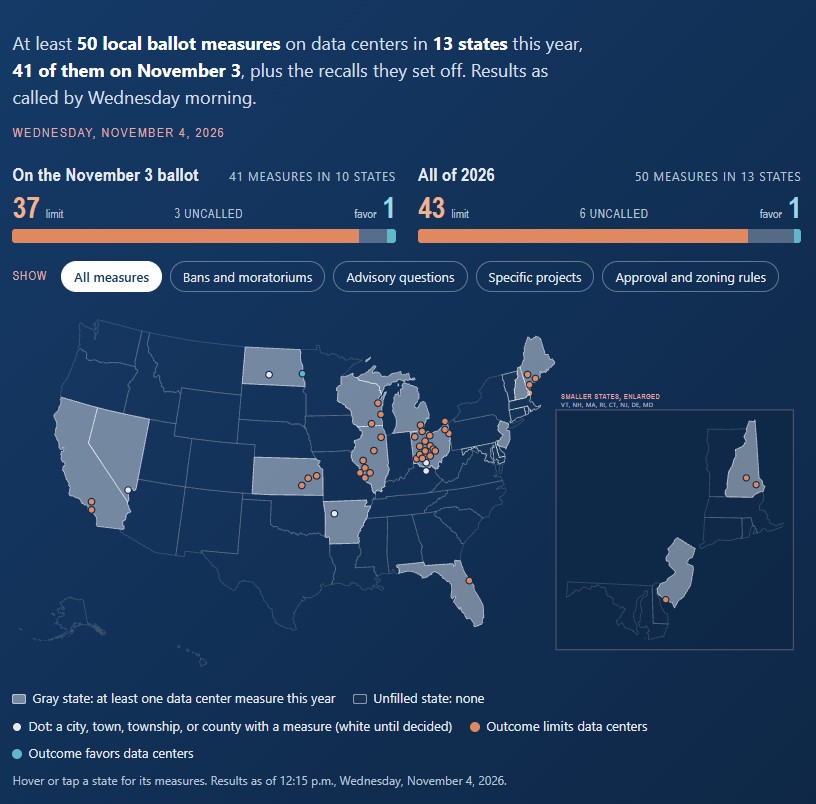
“It was a bad election night for data centers as opponents of their development were successful in virtually all 40 ballot measures across 10 states, according to preliminary results.” Chris Teale, Route Fifty.
The Bill Always Lands Somewhere
Public opposition to nearby data centers has grown from an even split to an overwhelming majority in roughly one year.
An August 2026 Embold Research poll of 2,045 registered voters found that 75% opposed a new data center near their home, per Heatmap. More than six in 10 said they strongly opposed it. That survey carried a reported margin of sampling error of plus or minus 2.3 percentage points, and opposition had shifted sharply from the previous year, when respondents were roughly evenly divided.
The grievances are concrete. Kansas defined “high-impact” facilities as those requiring more than 10 megawatts of peak electricity or more than 100,000 gallons of water use per day. That threshold clarifies precisely what communities are being asked to absorb: significant power draws, heavy water consumption, and land use, often in exchange for tax incentives whose benefits flow primarily to developers.
Ohio and Kansas: Ground Zero
Ohio produced the largest concentration of local resistance, while Kansas demonstrated how resource-based thresholds can serve as a precise regulatory tool.
Ohio accounted for 21 of the 41 measures across 18 jurisdictions. Every one of the 19 jurisdictions with reported results voted against development. In Wilmington, four rezoning proposals connected to data-center projects were rejected by roughly 80% to 20%. In Ashville, more than 83% of voters backed a measure challenging the village’s negotiated terms with an EdgeConneX facility; available reporting indicates the vote did not necessarily halt construction already under way, but the margin signals deep community opposition. Ohio’s relatively inexpensive land and substantial electricity-generating capacity made it an important target for AI infrastructure investment, and those same qualities concentrated the backlash.
Kansas demonstrated a more surgical approach. El Dorado approved a 10-year ban on high-impact data centers and certain battery-storage facilities, 71% to 29%. Emporia passed a prohibition on the construction, installation, operation, and maintenance of high-impact facilities, 60% to 40%. Ottawa prohibited facilities drawing more than 25 megawatts, 69% to 31%. Resource-threshold regulation is emerging as a viable approach in these measures: it doesn’t target every server facility, only the projects whose footprint outpaces what a community can absorb.
What the Industry Must Do Differently
The Ashville result, in particular, signals that community opposition will not wait for a groundbreaking ceremony.
The pattern across these measures points to specific changes the industry should make. Community-benefit agreements that share economic upside with host municipalities are not a radical demand. Neither is transparent disclosure of water and power consumption before any zoning application, nor genuine engagement with local officials before construction begins.
Smaller facilities, co-location near existing industrial power infrastructure, and honest negotiation on tax incentives are all achievable. Additional votes were expected in Arkansas and North Dakota in December 2026, meaning November represented an early phase of a broader national dispute over who controls AI data centers siting and how communities share its costs.
The Signal Is Not Optional
One Tuesday’s results reframed a question the industry had been avoiding.
Communities spent one election night demonstrating that data-center costs are neither invisible nor evenly distributed. The question now is whether developers treat that result as a signal worth acting on, or as a problem to route around through lobbying and litigation. One of those paths leads to workable civic relationships. The other leads to more ballot measures.