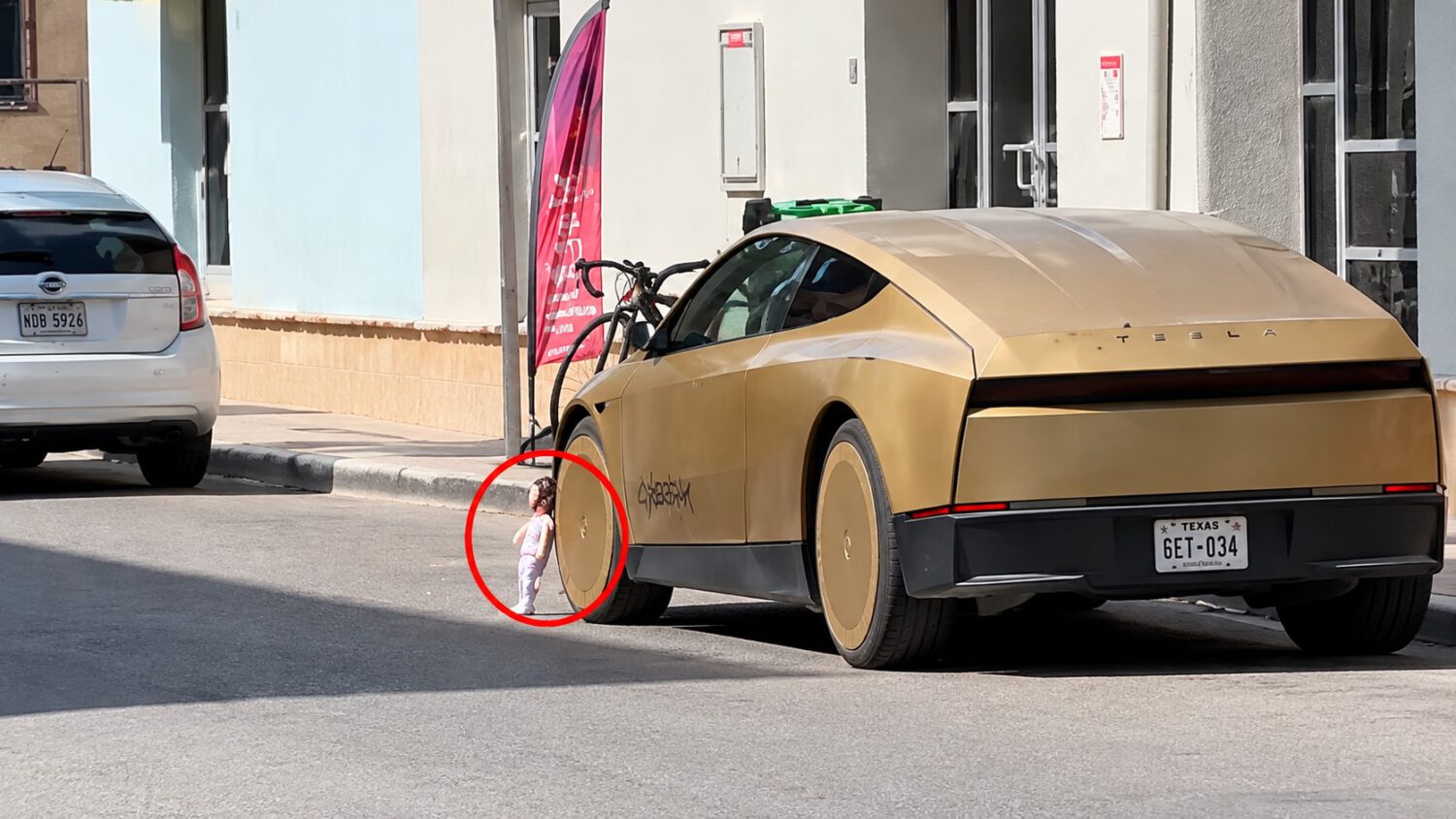
A viral video appears to show a Tesla Cybercab rolling over a small doll placed near its front tire on a downtown Austin street. No original post, timestamp, location metadata, or corroborating report has been independently confirmed.
That caveat matters, but it does not make the underlying question disappear. No publicly available, independently audited edge-case performance data for Tesla’s camera-based autonomy strategy has been identified, and one unsettling clip is enough to put that gap back in the spotlight.
What the Video Shows (and What It Doesn’t)
A single clip raises the question; it cannot answer it.
Based on the apparent footage, a person placed a doll close to the vehicle’s front tire before the Cybercab moved forward over it. What the video cannot establish is whether the system perceived the doll or classified it as harmless. It also cannot confirm whether the camera view was partially blocked by the tire or whether a remote supervisor was active at the time.
Object detection is not a simple pass-or-fail switch. A doll’s size, surface reflectivity, position relative to the camera field of view, and absence of movement may all affect how a neural network classifies what it sees.
A single uncontrolled video, filmed by a bystander under unknown conditions, is not a safety test.
The Bigger Detection Question
The real problem isn’t the clip; it’s the missing data.
Tesla’s official Cybercab FAQ describes the vehicle as using “camera vision and sensors” to navigate city streets, complicated intersections, highways, and parking lots, all without a steering wheel. Many competitors in the autonomous-vehicle space pair cameras with lidar or radar, adding sensing modalities that do not depend solely on visible light or image contrast.
A doll sitting still on pavement in daylight and a gray kitten crouched on gray asphalt at midnight are related problems, not the same problem. Musk’s public acknowledgment of the nighttime small-object challenge is relevant context, but it does not map directly onto what appears to have happened in Austin.
The sharper criticism concerns missing transparency. No publicly available, independently verified performance data has been identified showing how the Cybercab handles small, unusual, partially occluded, or low-contrast obstacles. That gap spans varying speeds, lighting conditions, and road surfaces.
Without that data, neither defenders nor critics can make a credible case from a single video.
What Meaningful Evaluation Would Actually Require
Trust is built on data, not on reassurances.
Answering the detection question properly requires controlled testing across a range of object sizes, positions, lighting conditions, and approach speeds. Published results must then be subject to independent review across varying degrees of occlusion. Telemetry from the Austin incident, if an official record exists with agencies such as NHTSA, would be a reasonable starting point for that kind of accountability.
Until that transparency exists, viral clips will continue to fill the space that audited safety data should occupy.