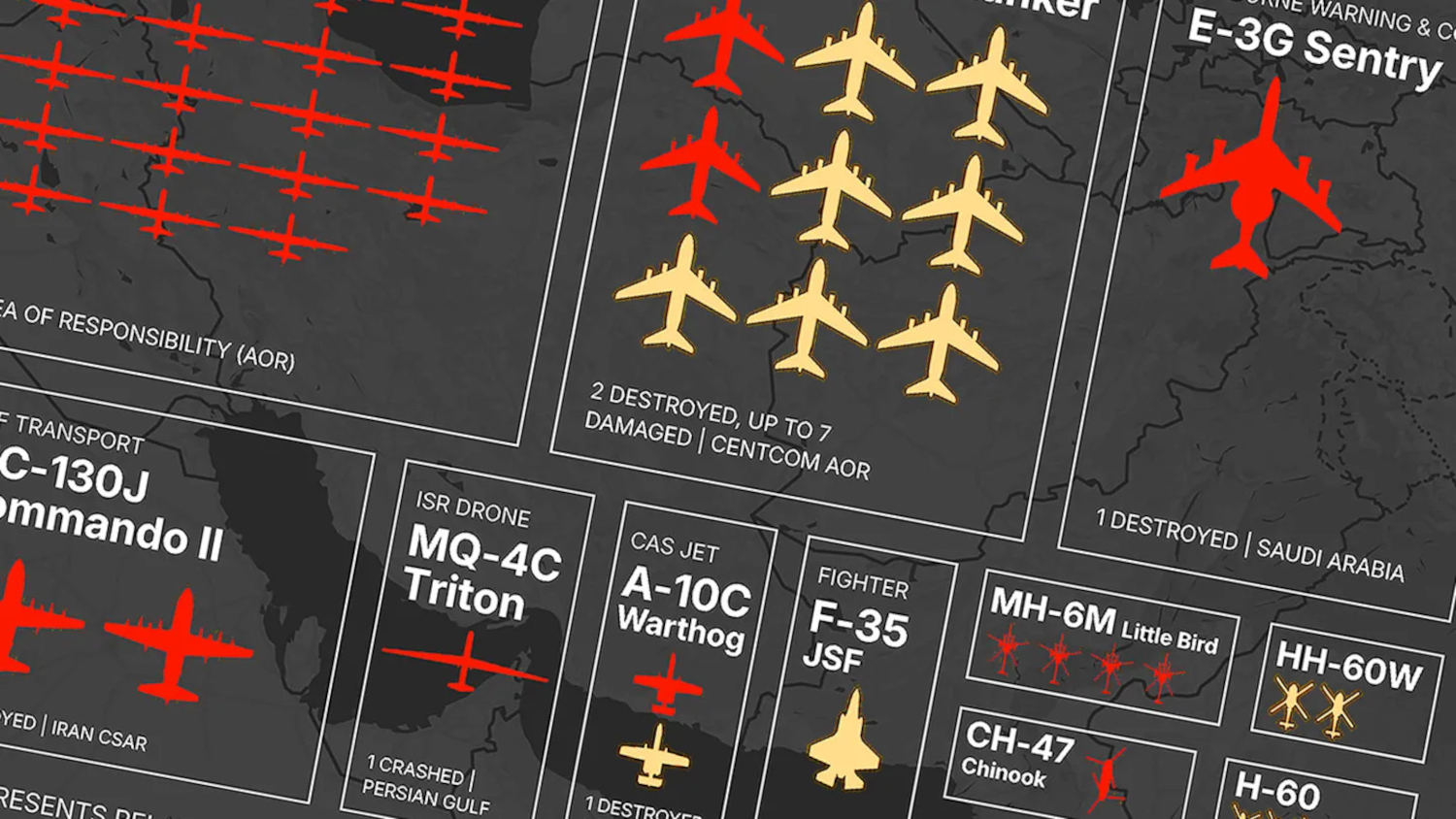
Three separate accountings now cover U.S. aircraft losses during Operation Epic Fury: the Pentagon Lead Inspector General’s quarterly report through June 30, 2026, the Congressional Budget Office assessment through August 1, and open-source intelligence tracking extending through September 18. Each uses different cutoff dates and definitions, so the headline number shifts depending on which document you read. The direction, however, stays consistent across all three: the losses are larger, more expensive, and more consequential for future readiness than any single report captures on its own.
Drones Took the Hardest Hit
The MQ-9A Reaper accounts for the largest single category of aircraft losses by unit count. CBO counted 24 destroyed at approximately $30 million each, producing a roughly $720 million equipment loss. The Lead IG’s report said “as many as 30,” pushing the upper bound toward $900 million. Later reporting by the Washington Post and OSINT analysis raised the total to at least 45, possibly 47 aircraft; at CBO’s unit-cost basis, 47 Reapers represent more than $1.4 billion in equipment alone.
The Air Force’s Reaper inventory reportedly fell from 165 airframes at the start of fiscal year 2026 to 135 by May, though the decline cannot be attributed entirely to combat losses. The platform is no longer in production. The Air Force’s Massed Modular Aircraft initiative targets a roughly $10 million replacement drone before sensors, but the program remains in development and is not expected to replicate the Reaper’s endurance, sensors, or weapons capacity.
Other unmanned losses added to the tally:
- One MQ-4C Triton, valued between $150 million and $238 million depending on the accounting basis, was lost over the Persian Gulf in a Class A mishap of unknown cause; the Triton fleet numbers roughly 20 aircraft total.
- One MQ-1 variant was shot down by Iran over international waters, per CENTCOM; public reporting did not establish whether the aircraft was an Air Force Predator or an Army Gray Eagle.
Crewed Aircraft: Collisions, Friendly Fire, and a Rescue Gone Wrong
Four F-15Es were destroyed during the conflict. Three were lost to friendly fire over Kuwait early in the fighting; a fourth was shot down over Iran on April 3. All crew members were recovered.
Two KC-135 Stratotankers were destroyed and additional tankers were damaged, according to the Lead IG and CBO reports, which use differing counts; those figures should be treated as estimates pending a consolidated official accounting. A March 12 midair collision over western Iraq killed six airmen. CENTCOM said the cause was not hostile or friendly fire.
The most operationally significant losses came during the rescue of the two F-15E crew members who ejected inside Iran. Two MC-130J Commando II aircraft and helicopters involved in the operation were deliberately destroyed on a remote airstrip to prevent their capture. CBO valued the aircraft involved in that mission at approximately $422 million; the research notes a discrepancy between four MH-6 Little Birds named in operational reporting and five helicopters reflected in the CBO valuation, which has not been publicly resolved. An HH-60W Jolly Green II was struck during the same mission but remained flyable, illustrating the difference between damage and a total loss.
The single most expensive crewed-aircraft loss in the CBO accounting is an E-3G Sentry struck on the taxiway at Prince Sultan Air Base in Saudi Arabia on March 27. The Lead IG categorized it as damaged; CBO treated it as a battle loss. Photographs and satellite imagery, as reported by The War Zone, reportedly showed the rear fuselage destroyed and the airframe effectively beyond economical repair. CBO assigned a replacement value of approximately $500 million.
An F-35A took hostile fire in mid-March and made an emergency landing. The War Zone described the incident as the first known instance of an F-35 being struck in combat, though that characterization relies on available reporting rather than a comprehensive official record. Two A-10C Warthogs sustained damage: one pilot ejected over friendly territory after his aircraft was hit during the F-15E recovery mission, and a second was reportedly left with a missing wing during the Jordan attack, according to Reuters.
Approximately eight F-15s were reportedly damaged in an Iranian ballistic-missile strike on Muwaffaq Salti Air Base in Jordan, with Reuters attributing the claim to a U.S. official and reporting the aircraft returned to service. President Trump publicly denied that aircraft damage occurred. The conflict between those two accounts remains unresolved in public reporting.
Several additional losses remain unconfirmed or are based solely on open-source analysis. An AH-64 Apache was reportedly shot down near the Strait of Hormuz in June, per The War Zone, with no primary official confirmation. A U.S. Army Black Hawk was reportedly damaged or destroyed on the ground by a short-range first-person-view kamikaze drone near Baghdad, though the extent of damage was not established by an official source. Iranian state media circulated images of a CH-47F Chinook wrecked at Camp Buehring in Kuwait; The War Zone could not independently verify those images, and they should be treated as an unconfirmed visual claim. Four additional aircraft identified by OSINT analysis as probable H-60 variants were reportedly damaged after September 10; that attribution has not been confirmed by any official inventory.
The Real Cost Is What Comes Next
CBO’s base replacement estimate for all equipment losses is approximately $1.9 billion, covering what the Pentagon currently plans to replace. That figure covers equipment losses broadly and is not limited to aircraft alone. Replacing all battle losses with currently available platforms raises the estimate to approximately $3.3 billion, because several destroyed aircraft are no longer in production.
The War Zone’s later projection, incorporating post-August losses and repair costs, suggests the effective aircraft-related bill could exceed $4 billion. That figure is a projection rather than a final government estimate. Replacing a lost A-10C with an F-35A adds roughly $120 million; replacing four destroyed F-15Es with F-15EX aircraft could cost approximately $400 million.
Aircraft replacement costs, substantial as they are, do not dominate the overall bill. CBO estimated munitions replacement at approximately $21.7 billion through August 1. That figure includes $7.3 billion for land-attack cruise missiles and $13.1 billion for missile-defense interceptors.
CBO assessed that the United States had probably expended between one-half and two-thirds of its Patriot, THAAD, SM-3, and SM-6 inventory since June 2025. Replenishment will likely take at least five years even with the production agreements the Pentagon has announced with Lockheed Martin and Northrop Grumman.
The strategic implication is direct. As CBO’s assessment stated: “Having used a large portion of its missile defense inventory in combat operations against Iran, DoD now has fewer interceptors on hand to use in a potential conflict with the PRC.” CBO also noted that China possesses substantially more ballistic and cruise missiles than Iran had at the conflict’s start, paired with a larger industrial base capable of producing them faster. Depleted interceptor stocks, production-line backlogs measured in years, and an unchanged Pacific deterrence requirement form a combination that the CBO assessment does not project a near-term timeline for resolving.