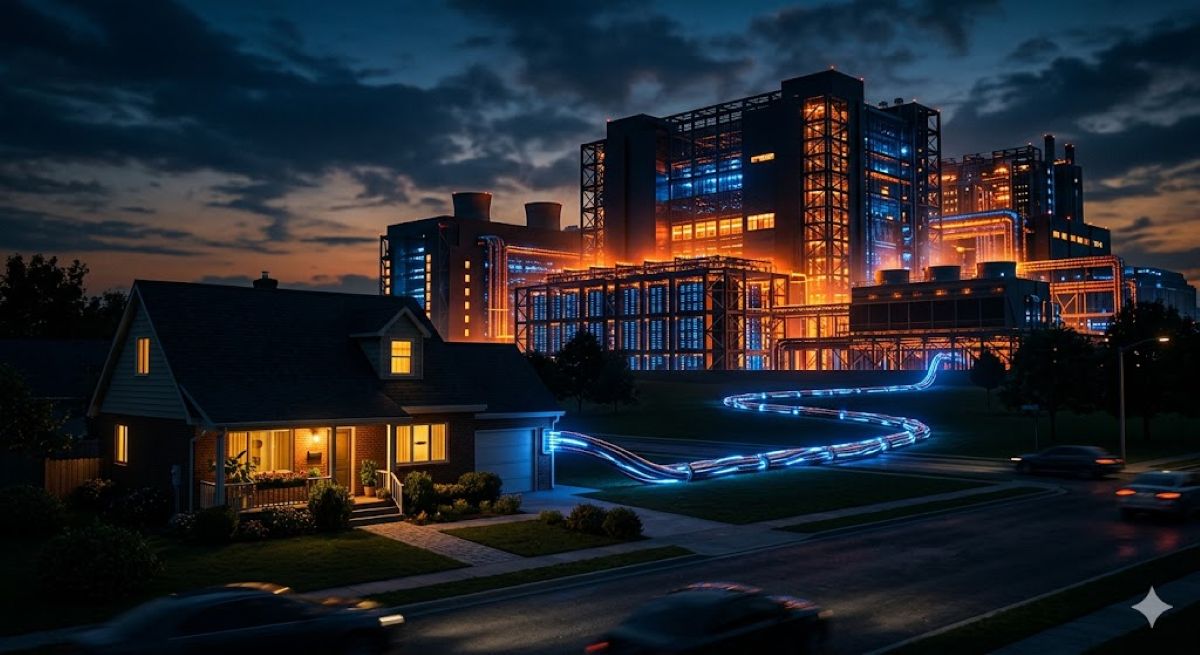
Racing to quiet your baby at 3 AM when that industrial hum from the new data center cuts through your walls like a bass note that won’t quit? Welcome to America’s emerging “AI Exclusion Zones”—suburban and rural communities transformed into power backplanes for distant tech elites. Your neighborhood didn’t vote to become infrastructure, but here you are anyway.
AI’s Power Appetite Is Reshaping the Grid
Data centers will more than double electricity use to 945 TWh by 2030, equivalent to building 200+ new power plants.
AI data centers are projected to drive 3% annual electricity demand growth through 2030, according to Goldman Sachs Research. One AI chatbot query burns roughly 10 times the electricity of a normal web search. At peak load, a single server rack consumes power equivalent to 42-83 American households combined. That ChatGPT conversation about weekend plans? It’s drawing juice like running your entire block’s air conditioning.
Industrial Noise Becomes Your New Roommate
Low-frequency hums from cooling systems penetrate buildings and disrupt sleep across surprising distances.
Those massive cooling fans and backup generators produce low-frequency noise in the 20-200 Hz range—the kind that travels miles and turns your house into a resonating chamber. The UK Institute of Acoustics documents how this persistent industrial hum disrupts sleep, causes stress, and makes people uncomfortable in their own homes. Sound dampening won’t help much; the wavelengths are too long to block with simple insulation.
Ratepayers Subsidize Corporate AI Dreams
Electricity prices could rise 7% annually as utilities build infrastructure for AI workloads.
Here’s the kicker: you’re financing this transformation whether you use AI or not. Utilities need roughly 10% revenue increases per year to fund grid upgrades, translating to about 7% annual real electricity price growth through 2030. Meanwhile, companies like Emporia Energy pitch your home as “the power plant AI needs”—installing batteries and smart meters to turn your garage into a flexible energy reservoir for distant data centers.
Siting Deals Happen Behind Closed Doors
Corporate-utility negotiations shape local land use while residents absorb the externalities.
These facilities get approved through opaque processes involving NDAs, tax abatements, and utility contracts negotiated years before neighbors understand what’s coming. The result feels like digital colonization: your community provides the land, power, and tolerance for industrial noise while the primary beneficiaries are global tech firms and their users. It’s infrastructure designed to serve everyone except the people living closest to it.
Communities aren’t powerless here. Stricter low-frequency noise limits, binding benefit agreements, and transparency requirements for tax incentives represent leverage points. The question becomes: who gets to decide how your neighborhood powers the AI economy?