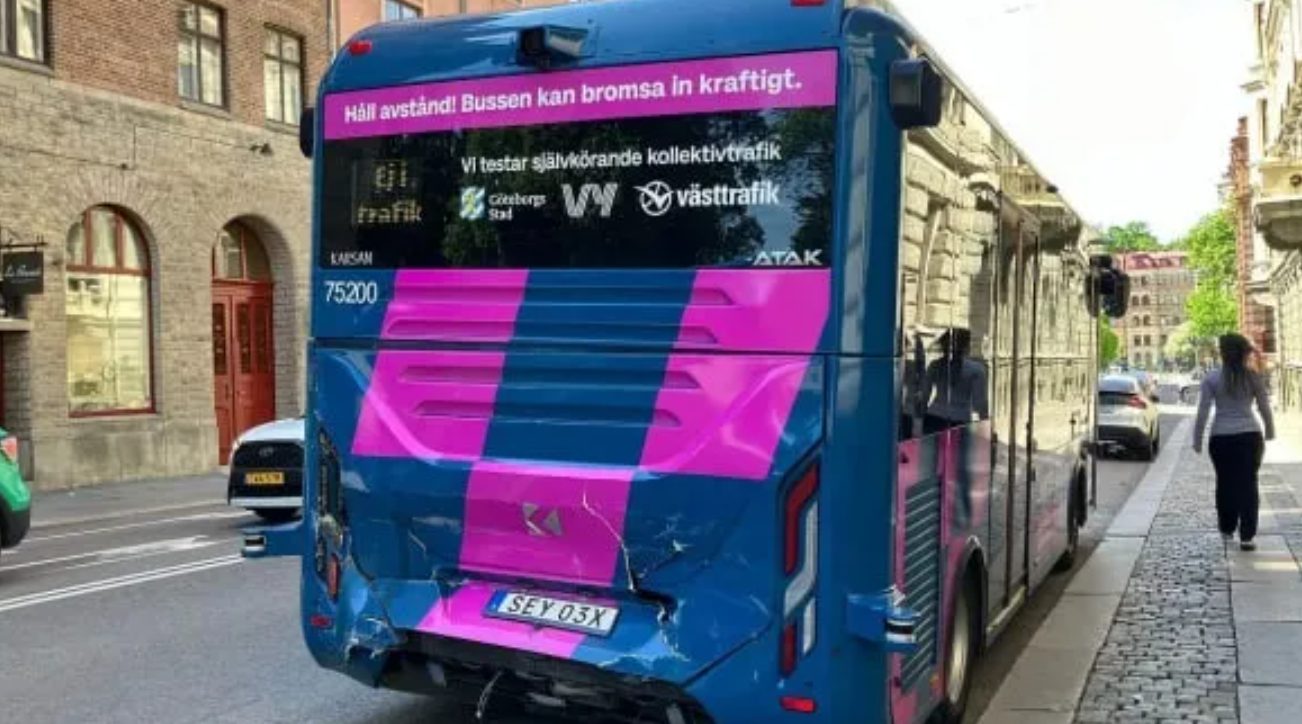
Sweden’s ambitious autonomous bus experiment hit reality faster than expected. The Gothenburg pilot’s second passenger-carrying trip on May 25 ended with a tram rear-ending the self-driving vehicle after it braked sharply in mixed traffic. Nobody got hurt, but the incident perfectly captures the gap between boardroom presentations and actual streets filled with unpredictable metal boxes.
The collision wasn’t exactly shocking. Västtrafik had plastered warnings on the bus reading “Keep your distance! The bus can brake sharply!” Yet the following tram couldn’t stop in time when the Karsan vehicle’s ADASTEC software decided to hit the brakes. Your typical human driver might have eased into a stop—autonomous systems tend toward dramatic responses to perceived threats.
The 8-meter bus, operating as line 169 “Gårda autonom” between Polhemsplatsen and Liseberg Station, had been running empty since March. May 25 marked the first day actual passengers climbed aboard the 52-capacity vehicle, which operates at normal traffic speeds with a required safety driver present.
European AV Reality Check
Europe’s cautious approach treats autonomous buses as research projects rather than immediate transport solutions.
This crash illuminates how Europe approaches autonomous vehicles differently than Silicon Valley’s move-fast-and-break-things mentality. The Gothenberg bus operates with a safety driver onboard, runs predetermined routes, and exists under explicit government authorization from Sweden’s Transportstyrelsen through July 2027. Compare that to Tesla’s promises of steering-wheel-free Cybercabs or Waymo’s expanding robotaxi networks.
The European model treats these deployments as research projects first, transport solutions second. Scotland launched a similar 14-mile autonomous bus route in 2023, only to wind it down in 2025 due to—wait for it—lack of passengers. Turns out people need convincing that robot buses won’t strand them somewhere awkward.
Even Waymo, the supposed gold standard, recently recalled 3,800 robotaxis after software issues around unusual road hazards. If the industry leaders are still debugging edge cases, Gothenberg’s tram encounter feels almost inevitable. The EU still lacks bloc-wide approval for commercial self-driving public transport, forcing each route to secure local authorization.
Learning by Crashing
Real-world incidents generate the data autonomous systems need to improve safety algorithms.
Västtrafik’s response revealed the real purpose here: “We are conducting a thorough analysis of the incident to better understand what happened.” This wasn’t a product launch—it was an experiment that generated exactly the data it was designed to collect.
The bus now sits in inspection while engineers dissect what went wrong. Did the braking algorithm overreact? Should tram proximity trigger different responses? These questions only get answered through real-world testing, not lab simulations.
You’re watching the awkward adolescence of autonomous public transport. Today’s incidents become tomorrow’s training data, assuming the public stays patient with robots learning to drive on their commute. The project’s goal of gathering knowledge about how autonomous mobility works in practice just got very practical indeed.