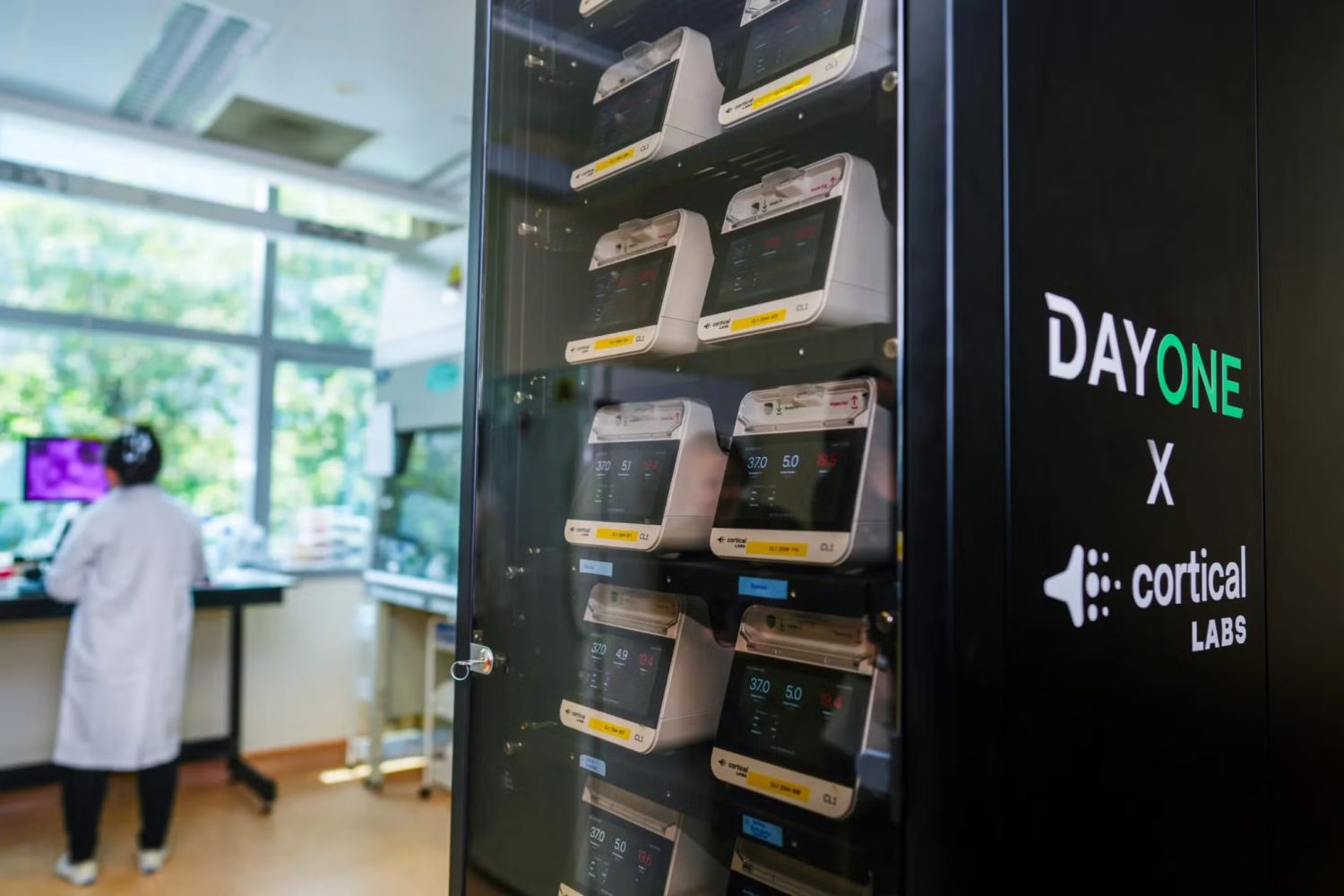
Somewhere in Singapore, a server rack requires feeding. The 20-unit CL1 installation at the National University of Singapore’s Life Sciences Institute runs on approximately 16 million living human neurons — lab-grown, nutrient-fed, temperature-regulated, and doing actual computational work. NUS Medicine calls it “the first independently operated biologically integrated server rack in the world.” That claim is hard to dispute, mostly because nothing else like it exists — though it’s worth noting that Cortical Labs has previously deployed CL1 clusters in Melbourne and elsewhere; the “independently operated” framing is specific to this Singapore deployment.
The timing isn’t accidental. AI hardware’s energy appetite has become impossible to ignore, and this is one genuinely unusual answer to the question of what comes after the GPU arms race.
What’s Actually Inside
The hardware is stranger than the headline suggests — silicon chips, living neurons, and a built-in life-support system sharing the same rack.
Each CL1 unit — built by Australian biotech firm Cortical Labs — houses neurons grown from stem cells and mounted on silicon-based microelectrode chips. Published neuron counts vary by source: some reports imply up to 800,000 neurons per unit (derived from a stated total of 16 million across 20 units), while others specify at least 200,000 per CL1. Treat the per-unit figure as an approximate range rather than a fixed spec. Those electrodes pass electrical signals in both directions: biology talks to software, software talks back. A built-in life-support system manages temperature, fluid balance, and nutrients, with the cells reportedly staying viable for up to six months — a window that brain tissue preservation research continues to push further.
- 20-unit CL1 rack installed at NUS Life Sciences Institute
- ~16 million neurons total; approximately 200,000–800,000 neurons per unit depending on source
- Neurons grown from stem cells; viable up to six months
- Life-support system regulates temperature, fluid, and nutrients
- Microelectrode interface links biological cells to software
NUS provides biological expertise and research infrastructure. DayOne designed and supports the data-center hosting environment. Cortical Labs supplies the CL1 technology itself — each role distinct, all three necessary to make the system functional.
One reported figure is worth pausing on. Project representatives, as quoted by the Straits Times, say a single CL1 unit draws around 25–30 watts including life support. An Nvidia H100 pulls up to 700 watts. That contrast is striking — but handle it carefully. Some coverage back-calculates rack-wide draws of 850–1,000 watts across 20–30 units, which creates real ambiguity when scaled. No independent primary spec sheet has been verified. The efficiency advantage appears directionally significant. The precise numbers are not settled.
What It’s For – And What It Isn’t
The practical target is deliberately narrow — drug discovery, fraud detection, adaptive robotics — not a replacement for the GPU clusters powering mainstream AI.
Think of this less like the next iPhone and more like the first ARPANET node: proof that a different kind of substrate can carry a signal, not a product ready to ship. The target workloads — drug discovery, fraud detection, adaptive robotics, according to project partners and coverage by TechRepublic and The Next Web — favor adaptability and low power over raw throughput. Scalability remains unproven. Operational complexity is real. The researchers aren’t pretending otherwise.
What this actually signals is quieter but more interesting: the definition of “computing substrate” is expanding. Silicon has company now — and it needs lunch.