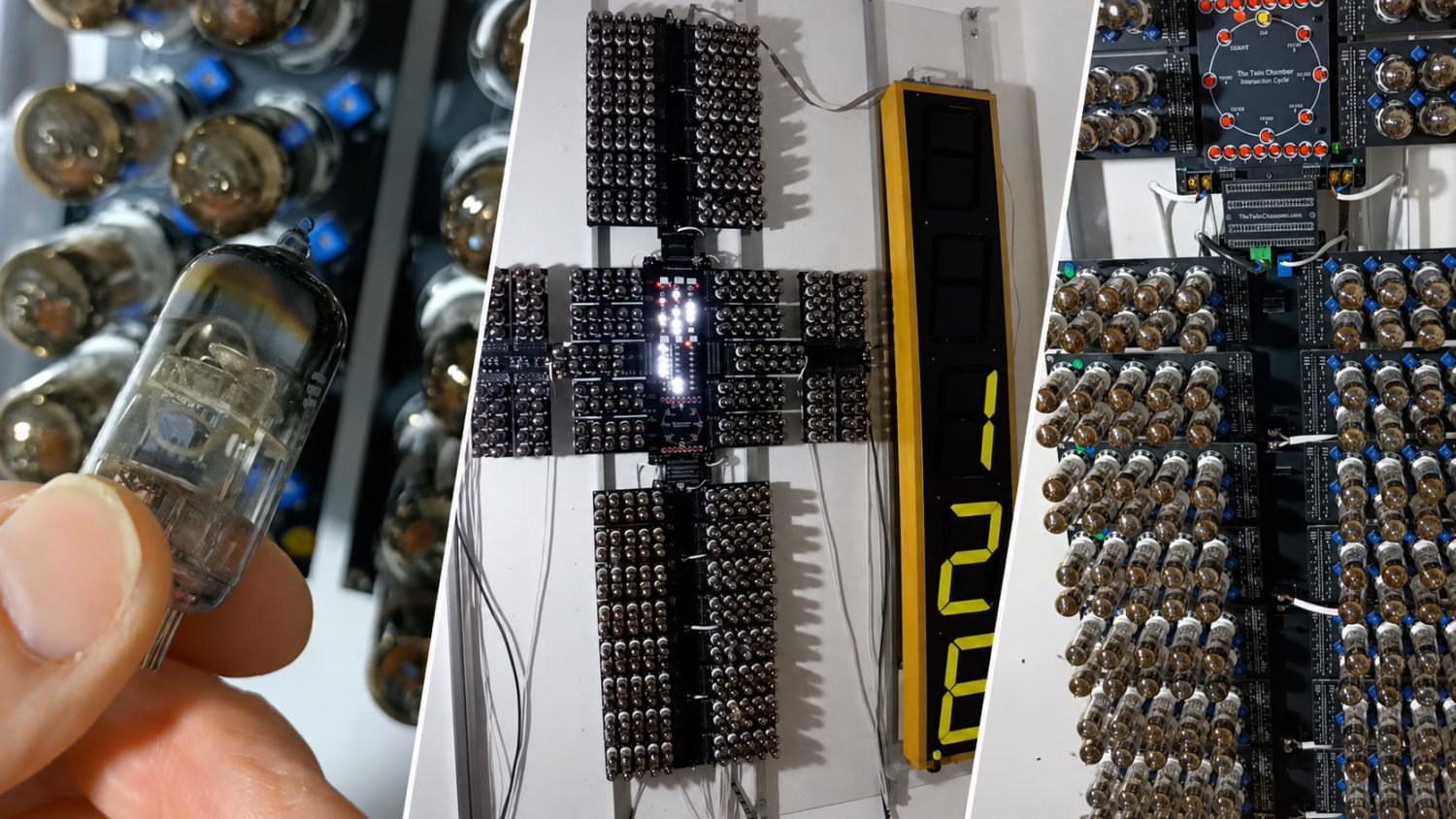
Walk into Mike’s spare room and your senses register something’s wrong. It’s warm. It smells like hot metal and old glass. Along the wall, 460 Soviet vacuum tubes glow amber across 46 hand-built disco-era gadgets PCBs. A fire extinguisher sits nearby. This isn’t ambient lighting or a steampunk art installation. It’s a functioning 8-bit computer — and it takes 10 to 15 minutes just to wake up.
Cold War Surplus, Von Neumann Architecture
How NOR gates, recycled triodes, and Apollo-era logic became a working home computer.
Mike — a retired UK builder identified only by first name — sourced his 6N3P double-triode tubes cheaply from Eastern Europe. Each tube becomes a single NOR gate. Five NOR gates build a flip-flop. Flip-flops build registers. Registers build a computer. Hackaday notes the resulting block diagram would look instantly familiar to anyone who’s cracked open a 1970s microcomputer textbook — just implemented in glowing glass. NASA used this same NOR-gate approach in the Apollo guidance computers. Mike used it in his spare room.
The specs, stripped bare:
- 460 Soviet 6N3P dual-triodes = 920 thermionic triodes total
- 46 tube modules across five backplane PCBs, mounted on acrylic
- 8-bit von Neumann architecture with 16 machine-code instructions
- Capable of 16-bit arithmetic; demonstrated a 64-bit Fibonacci sequence generator
- Output: a mechanical flip-digit display salvaged from a British Rail station clock
An Airship Simulator That Requires Imagination
The flagship demo runs on rescued history — and demands you meet it halfway.
Building with 75-year-old Soviet hardware isn’t romantic. The tubes were rated for roughly 500 hours new, but these arrived used and stored for 50-plus years. As Mike told The Register: “In many cases the theory did not accurately match the practice.” He built a dedicated test rig just to find component ranges that worked across most tubes. This is his third such machine. The previous one “went BANG twice.” He describes tube computing as “an addiction.” The machine smells like it’s running.
The flagship demo is a flight simulator for the British R80 airship — managing ballast, gas release, rudder, engine power, and mooring gear. Output arrives via that salvaged British Rail flip-digit display, capable of showing numbers up to 99,999. No graphics. Mike acknowledges users need “a bit of vision” to picture themselves at the helm. The machine was, in his words, “designed to show itself working at the most fundamental level of computing.” It isn’t competing with anything modern — it’s making computer problems visible.
Mike’s inspiration was a visit to Colossus at Bletchley Park. That single afternoon produced three machines, a step-ladder for maintenance, and a spare room full of glowing Soviet glass. Computing, before it vanished into a chip the size of a fingernail, looked exactly like this.