Measure wrong, and the chlorine doesn’t kill the cholera. Measure too much, and the water tastes like a swimming pool — so families skip treatment entirely. Across sub-Saharan Africa, where more than 400 million people lack reliable access to safe drinking water, manual chlorine dosing is the fragile last line of defense. Tadala Mtimuni, a Malawian chemical and biomedical engineer, built a device to make that guesswork structurally impossible.
Pour Water In. Safe Water Comes Out.
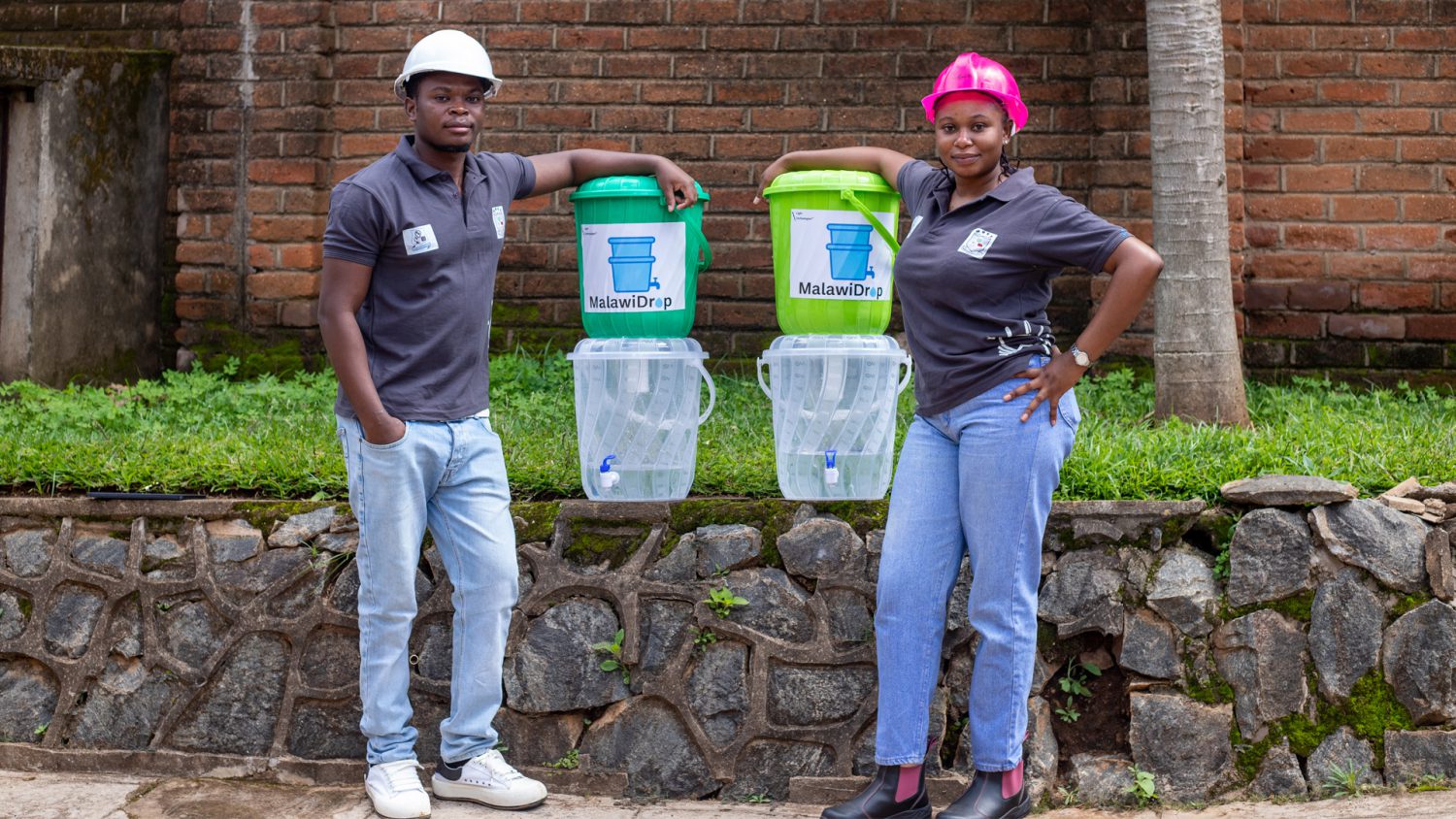
MalawiDrop’s two-bucket design aims to dramatically reduce dosing errors through chemistry, not instructions.
Think of it like a Brita filter running in reverse — instead of stripping chlorine out, MalawiDrop adds exactly the right amount in. Untreated water pours into the top bucket and flows through a refillable cartridge packed with Merrifield resin impregnated with NaDCC. NaDCC (sodium dichloroisocyanurate) is a shelf-stable solid chlorine compound that releases a precise dose as water passes through. The treated water arrives in the bottom bucket, disinfected. Gravity does the work. No electricity. No measuring cups. Lab modelling puts pathogen inactivation above 99.99% in under one second per litre.
Key specs:
- Device cost: ~£7; refill cartridge: ~£4; target annual household cost: ≤£11
- Cartridge lifespan: 6 months to 2 years depending on usage
- Pathogen inactivation: >99.99% in less than one second per litre (lab-modelled)
- Pilot scale: ~50,000-person township; rollout target: 5,000 units across Malawi and Rwanda
- Distribution: community “water champions” and kiosks modelled on mobile money points
Mtimuni started developing MalawiDrop in 2018 as an undergraduate, working from a small government grant and deliberately contaminated water samples in a lab. She later expanded the research into a master’s at Stellenbosch University focused on disinfection chemistry and resin systems. The device has since moved into real households. The Royal Academy of Engineering shortlisted MalawiDrop among 16 innovations across 11 African countries for the 2026 Africa Prize — the continent’s largest engineering innovation award.
What Comes Next Is the Harder Part
Smart sensors and a Rwanda expansion will test whether the refill network can hold at scale.
An $88,000 commercialisation grant is backing the current pilot and a planned 5,000-unit rollout across Malawi and Rwanda. A smart-sensor version — capable of monitoring cartridge status remotely — is in development through a Rwanda partnership. Distribution runs through water kiosks deliberately designed to resemble mobile money points, borrowing the same adoption logic that made M-Pesa work in markets that never had traditional banks.
Field data on diarrheal disease reduction isn’t published yet — that gap matters. The chemistry is sound. The real test is whether the refill network holds when it scales beyond a single township. If it does, a two-bucket gadget costing less than a streaming subscription could quietly redefine how rural Africa treats water at home.