Building a conventional data center takes months, and AI demand does not wait. Announced at GTC Berlin, Nvidia’s DSX POD is its answer: a fully integrated AI factory shipped inside a modular container, pre-wired, pre-plumbed, and validated before it ever reaches your site.
Nvidia says the approach cuts deployment at a prepared location from roughly six months down to as little as 14 days. That qualifier, “prepared location,” carries more weight than the headline number suggests.
What’s Actually in the Box
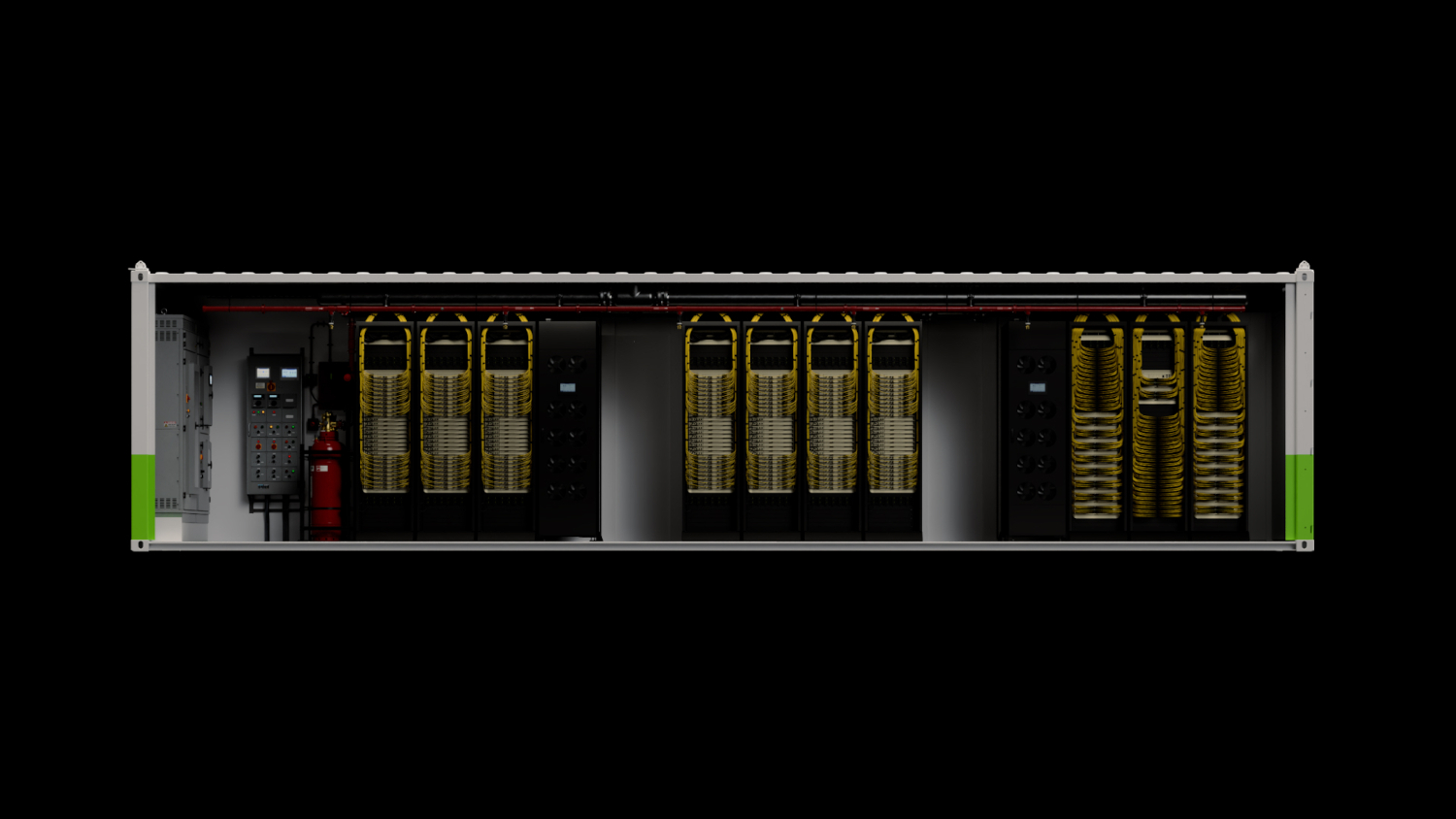
Seven Vera Rubin NVL72 racks, 504 GPUs, and 252 Vera CPUs arrive as a single integrated unit weighing approximately 28 metric tons, according to secondary reporting on Nvidia’s announcement.
Factory-finished and ready to connect, DSX POD ships with compute, interconnects, cabling, plumbing, and liquid-cooling infrastructure already assembled. Unlike standard rack deliveries that require on-site assembly, DSX POD completes integration at the manufacturing stage.
Customers scale capacity by adding pods rather than re-engineering entire rack halls, creating a more repeatable expansion model. Nvidia supplies the reference architecture; partners handle servers, power equipment, cooling systems, and integration services.
Manufacturing and delivery partners cover most major infrastructure names. They include Dell Technologies, HPE, Schneider Electric, Eaton, Vertiv, Foxconn, Lenovo, Gigabyte, Quanta Cloud Technology, Wistron, Crusoe, Armada, Anduril, Bull, DayOne, Delta, and Pegatron, among others.
The Fine Print on “14 Days”
Nvidia’s two-week deployment figure applies specifically to a site that already has power, cooling, networking, and civil infrastructure in place.
Land acquisition, permitting, substation construction, fiber deployment, and grid interconnection are not part of that clock. In many markets, securing adequate electrical capacity alone can extend a datacenter project well beyond any two-week window, a challenge familiar to anyone tracking the rise of AI data centers and their demands on local grids.
Transporting a roughly 28-ton module and positioning it on site requires specialized logistics and crane equipment, adding complexity that conventional rack shipments do not.
On cooling, Nvidia says DSX POD supports dry-cooler, closed-loop configurations. At a 2-gigawatt scale, the company claims the design could save up to 54 million liters of water per day compared with conventional cooling-tower systems. Treat that figure as a vendor estimate; it has not been independently verified and will vary based on climate, workload, and site configuration.
DSX POD is a future-oriented platform, with shipping targeted for early 2027. Real-world performance, power efficiency, and serviceability should be assessed once production systems are deployed.
Why Nvidia Is Doing This
Deployment speed has become a competitive advantage in AI infrastructure, and factory integration is Nvidia’s primary lever.
Catching wiring errors, defective parts, and plumbing problems before equipment reaches a customer site reduces on-site labor and makes timelines more predictable. The model also extends Nvidia’s influence beyond GPU silicon into rack architecture, cooling, power systems, and deployment workflows. It is a platform play as much as a logistics one.
Target customers include cloud providers, neocloud operators, enterprises, and sovereign-computing projects that need capacity quickly while larger facilities are still under construction. DSX POD is not a replacement for large conventional datacenters; it is better understood as a modular unit for incremental expansion or for bridging gaps while permanent infrastructure is still being built.
Nvidia is industrializing the most repeatable parts of AI datacenter construction. DSX POD does not eliminate the need for power access, permitting, site preparation, or grid interconnection; those requirements remain fully in place. With delivery targeting early 2027, how well that industrial model holds up in practice is still an open question.