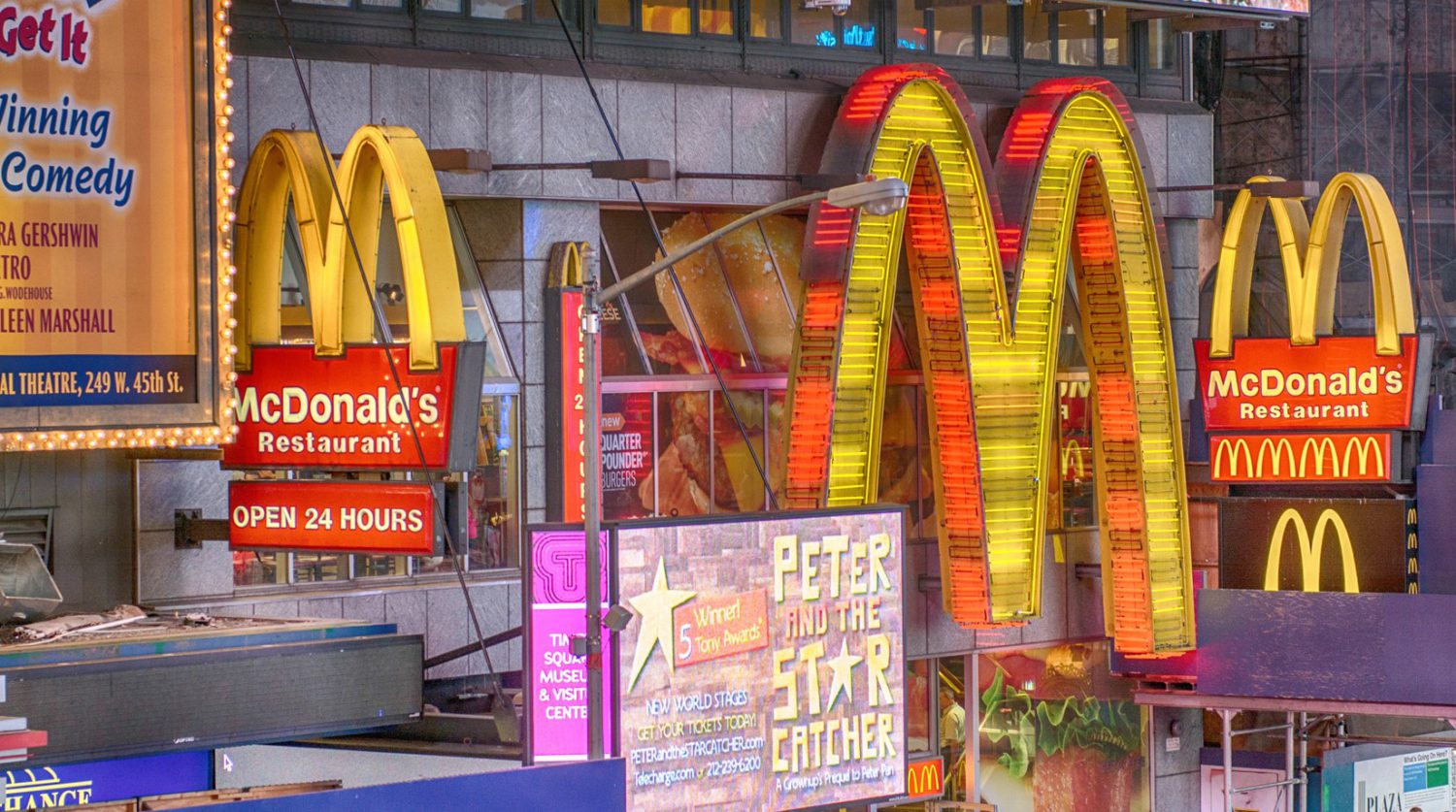
McDonald’s announced roughly $8.5 billion in franchisee support at its investor day in Chicago on September 23, 2026. The company will commit approximately $5 billion through 2030 and the remainder through 2036, delivered as rent relief and capital assistance rather than a standalone technology budget, under a program called McDonald’s > NEXT.
The scale of the commitment reflects how serious the underlying problem has become. U.S. same-store sales grew only 0.8% in the second quarter, down from 2.5% in the comparable period a year earlier, while domestic guest counts declined, according to CNBC.
What the Technology Actually Does
The centerpiece of McDonald’s operational overhaul is ArchIQ, a generative-AI restaurant platform the company plans to expand across the U.S. and its international operated markets.
Central to the plan is ArchIQ, McDonald’s generative-AI restaurant operating platform. The system is designed to support drive-thru order-taking and simplify kitchen workflows, with the broader NEXT initiative aiming to standardize execution across the chain’s operated markets.
McDonald’s projects the combined NEXT program will generate roughly 250 basis points of gross restaurant-level efficiency gains. That translates to approximately $100,000 in additional annual cash flow for the average U.S. location, though these are company targets, not independently verified results.
CEO Chris Kempczinski framed the strategy at the investor day: “The winners will be the companies that create more demand and deliver it more efficiently,” according to Reuters.
The broader NEXT rollout pairs ArchIQ with physical restaurant modernization, updated employee training, and menu changes. McDonald’s presents the combination as a way to create customer demand and fulfill it more efficiently.
The Franchisee Problem
Remodeling costs and uneven participation across McDonald’s predominantly franchised system remain the plan’s most significant practical obstacles.
Remodeling an average U.S. location could cost at least $1.2 million, according to Reuters, and McDonald’s rent relief will not cover all of that.
Franchisee participation has already proven uneven. McDonald’s recent under-$3 value menu reached only about two-thirds of U.S. franchisees, according to CNBC, illustrating how difficult consistent execution is across a predominantly franchised system.
McDonald’s USA president Skye Anderson addressed the gap directly at the investor day: “McDonald’s has fallen short on consistent execution,” according to CNBC. Rolling out a centralized AI platform across that system is not a simple software deployment; uneven participation has already undermined at least one recent value initiative.
Market Reaction
Investors reacted negatively after McDonald’s paired a large spending commitment with a warning about persistently weak traffic.
McDonald’s shares fell as much as 6.5% during trading following the announcement. Reuters reported the stock was down roughly 5% in the immediate aftermath.
The company paired its large spending commitment with a warning that customer traffic in key markets could remain flat while inflation stays elevated. That combination unsettled the market.
Menu Changes and Growth Targets
McDonald’s is supplementing its technology push with menu additions and restaurant-opening targets designed to rebuild systemwide sales momentum.
Beyond technology, McDonald’s is considering menu additions such as bowls, grilled chicken, and egg bites to respond to consumer interest in protein-forward eating. New restaurant openings are projected by management to contribute roughly 2.5% to systemwide sales growth in 2027, tapering to about 2% by 2030, alongside a 2030 operating-margin target in the low- to mid-50% range.
ArchIQ and the rest of the NEXT program can standardize processes and reduce operational friction at scale. What no platform can resolve on its own is franchisee participation gaps, pricing pressure, or the more fundamental question of whether customers find enough reason to visit more often.