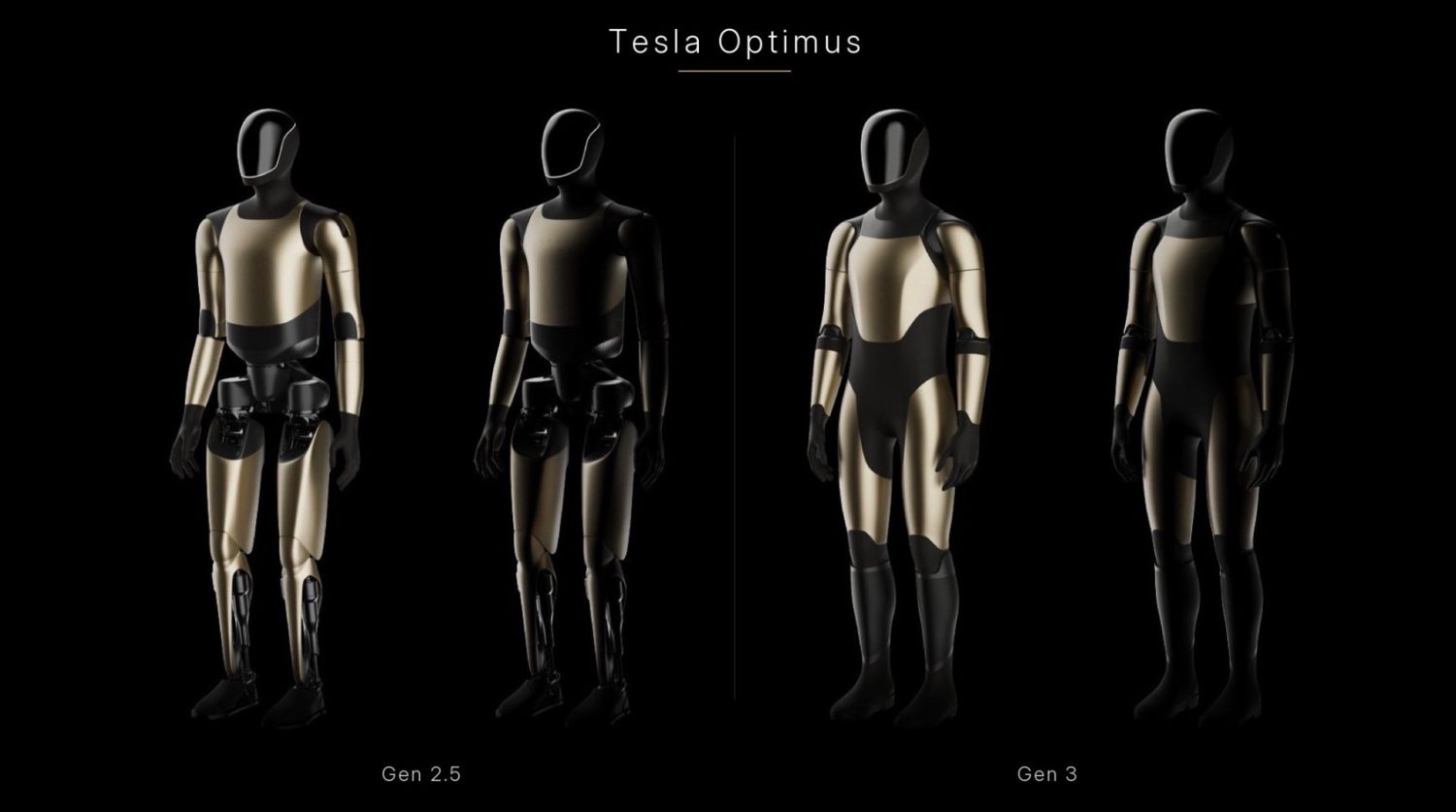
Tesla enthusiast @WholeMars reportedly extracted 3D assets labeled “gen3” from a recent Tesla Android app update, then deleted the original post. The Tesla Newswire reposted a side-by-side comparison of Gen 3 and Gen 2.5 assets that has continued circulating since, though Tesla has not publicly confirmed those renders represent the robot’s final production configuration.
Cleaner Body, Darker Legs, More Finished Hands
Compared with Gen 2.5, the reported renders show a notably more enclosed lower body and more refined hands.
The reported Gen 3 renders show a more enclosed lower body, with visible gold-toned mechanical structures around the hips, knees, and lower legs appearing to give way to matte-black fairings. Integrated flexible covers appear to conceal joints in the hip and upper-thigh area; that is a visual observation from the renders, not a confirmed specification.
The hands look more refined than those of earlier prototypes. Twenty-two degrees of freedom has been reported as a Gen 3 hand specification, but that figure is unconfirmed and should be treated as reported until Tesla publishes an official spec sheet.
What an App Asset Actually Tells You
Finding these files inside Tesla-distributed software is meaningful, but it is not the same as confirmed hardware.
App assets can serve as placeholders, internal visualization files, or early-stage models. Their presence in a publicly distributed APK does not establish commercial availability, final design approval, or manufacturing readiness.
What the files do suggest is that Tesla’s app is being built to display Optimus-related content through a mobile interface. No public documentation currently confirms what that functionality will look like for customers, or whether it will extend beyond visualization.
The Tesla Newswire’s X post remains the primary surviving social record of the Gen 3 versus Gen 2.5 comparison after the original @WholeMars post was deleted. The Tesla Newswire is a Tesla-focused news account, not an official Tesla channel, and the images have not been verified by Tesla.
Fremont Conversions and Capacity Targets
Tesla has reportedly been repurposing factory space for Optimus production, though stated capacity figures are targets, not current output.
Tesla has reportedly been converting former Model S and Model X production space at its Fremont facility toward Optimus manufacturing, with a stated capacity target of up to 1 million robots annually. A separate Texas production line reportedly carries a longer-term designed capacity of 10 million Optimus units annually.
Both figures are planned targets, not current output. No confirmed launch date, customer price, or delivery schedule exists in the publicly available material.
Why the Design Shift Is Worth Watching
The apparent move toward a more enclosed exterior is consistent with production-oriented hardware, though that remains an inference from the renders alone.
The shift from exposed engineering prototype toward a fairing-covered exterior is consistent with designing hardware for repeatable factory-scale deployment rather than demonstration events. That inference comes from the renders; it is not a Tesla confirmation.
The next real verification point is an official Tesla presentation of physical Gen 3 hardware, with confirmed specifications and a production timeline to match.