Your home’s Wi-Fi network is drowning. Between your laptop’s 4K streams, your partner’s VR workout, and the kids’ simultaneous gaming sessions, even the latest Wi-Fi 6 router feels like it’s gasping for bandwidth. Enter laser-powered wireless communication, which just shattered speed records while solving your energy bill anxiety. Researchers achieved a staggering 362.7 gigabits per second using light beams instead of radio waves—speeds that make your current internet look like dial-up.
The Technical Breakthrough That Changes Everything
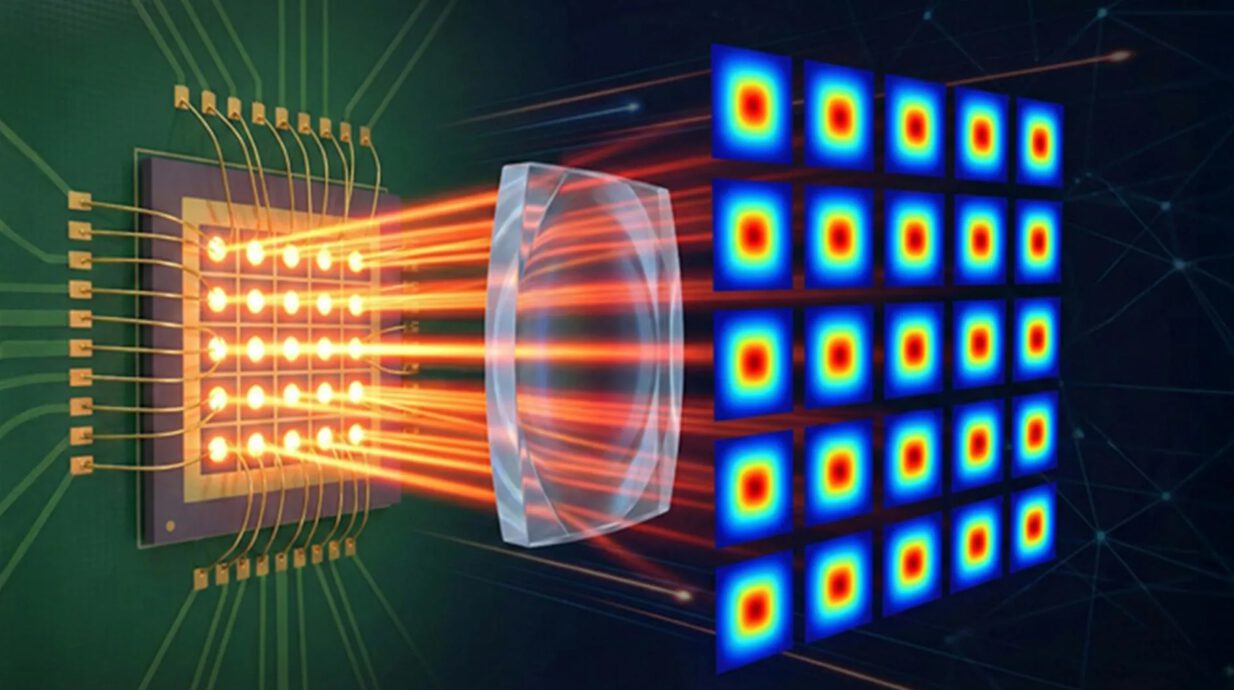
The breakthrough centers on a compact transmitter using a 5×5 array of VCSELs—vertical-cavity surface-emitting lasers that sound intimidating but work like tiny, incredibly precise flashlights. Each laser independently streams data at 13-19 Gbps over a 2-meter distance, with 21 of the 25 lasers active simultaneously. More impressive than raw speed: this system consumes just 1.4 nanojoules per bit, about half what Wi-Fi requires under similar conditions, according to research published in Advanced Photonics Nexus by Hossein Safi and his team.
Your Smart Home Gets Smarter (And Cheaper to Run)
Forget fighting over bandwidth like it’s the last slice of pizza. The optical system’s beam-shaping technology creates uniform coverage grids, enabling four simultaneous high-speed connections without interference—delivering a combined 22 Gbps total. Your teenage gamer won’t lag while you’re video-calling colleagues and streaming Netflix. Better yet, the energy efficiency means running this setup costs significantly less than powering multiple Wi-Fi access points throughout your home.
Light-Based Internet Has Limits (For Now)
Before you toss your router, understand the constraints. This laser-powered system requires direct sight lines, making it ideal for ceiling-mounted installations integrated with LED lighting but useless through walls. Think of it as Wi-Fi’s indoor cousin rather than its replacement. The researchers envision integration into office lighting fixtures and home ceiling systems, creating invisible gigabit networks overhead while your regular Wi-Fi handles mobile devices wandering between rooms.
The Future Streams in Light
As smart homes accumulate more bandwidth-hungry devices, this laser technology offers a sustainable path forward. The combination of massive speeds and energy efficiency addresses two growing consumer pain points: network congestion and rising electricity costs. While widespread adoption remains years away, the research proves that light-based wireless networks can deliver practical, scalable solutions for indoor connectivity without breaking your budget or the grid.