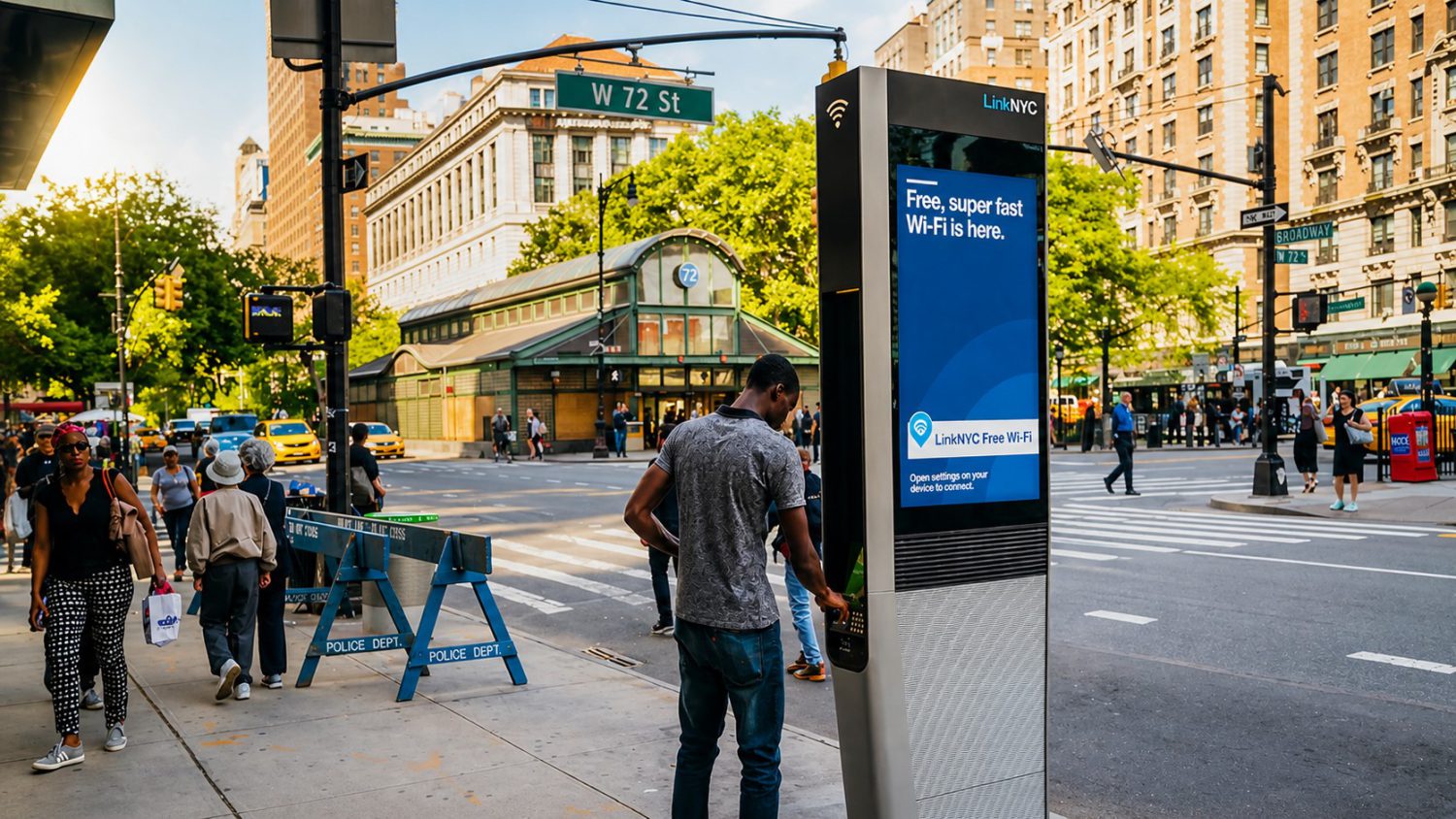
Walk past a LinkNYC kiosk. Don’t touch the screen. Don’t connect to the Wi-Fi. Your phone still broadcasts a probe request — a MAC address query your device fires automatically while scanning for known networks — and the kiosk logs it. CityBridge, the consortium led by Intersection and tied to Alphabet’s Sidewalk Labs, replaced New York’s payphone booths with these kiosks and sold the project as bridging the digital divide. The business model is digital out-of-home advertising. The data model is something considerably more ambitious — not unlike a surveillance app built to harvest location and device data without users realizing it.
The Hardware You Never Agreed To
A sensor grid at eye level is a different thing entirely from a camera mounted on a rooftop.
Each unit contains Wi-Fi, Bluetooth, NFC, cameras, and — according to NYCLU testimony — upwards of thirty total sensors. Full deployment could place roughly 15,000 cameras across city sidewalks, two per kiosk, positioned at eye level. Unlike rooftop cameras built for wide-area coverage, eye-level sensors optimize for faces. This is not a camera network with a Wi-Fi logo on it. It’s a sensor grid that happens to offer free browsing. The risks are not unlike those posed by a public USB charger — infrastructure that appears benign but operates as a data-collection endpoint.
According to NYCLU, EFF, the Surveillance Resistance Lab, and the 2022 NYC Office of Technology and Innovation audit, the system captures:
- MAC addresses and device IDs from passing devices whether or not users connect, storing them for up to 60 days
- IP addresses, device type, operating system, and full URL clickstreams during active sessions
- Longitude and latitude embedded in the data architecture, per Surveillance Resistance Lab’s technical analysis of LinkNYC’s code
The 2022 NYC OTI audit found CityBridge had not anonymized MAC addresses as required by its own privacy policy and franchise agreement. Privacy policy language also permits broad data-sharing with law enforcement agencies, with no robust user notification commitments attached.
“Anonymized” Is Doing a Lot of Work Here
A movement pattern detailed enough to reconstruct your daily routine doesn’t need your name to identify you.
“Anonymized” is the word CityBridge deploys like a legal airbag. Privacy advocates and basic data science push back hard on that framing. A unique identifier leaving the same apartment every morning, commuting the same corridor, arriving at the same office — that is not anonymous. That is a portrait. Think of it like a streaming service insisting it doesn’t track you while maintaining your exact watch history, pause points, and every rewatch pattern. The data profile exists whether or not your name is on it — a dynamic that echoes cases of apps secretly tracking users on a continuous basis without meaningful disclosure. NYCLU calls the program a “barely mitigated privacy disaster” after nine years of operation — a characterization the audit record makes difficult to contest.
One Software Update From a Dragnet
The legal and physical infrastructure for city-wide integration is already in position.
The physical architecture is already in place. New York’s Domain Awareness System, co-developed with Microsoft, integrates more than 15,000 surveillance cameras and sensors for NYPD counterterrorism and criminal investigation use, according to City & State NY reporting. NYCLU raised concerns as early as 2016 about LinkNYC feeding into DAS-adjacent systems. Repurposing the network wouldn’t require new hardware — technical and policy pathways for rapid integration already exist, requiring little more than a subpoena pipeline that is already operational.
The newer Link5G towers extend this footprint further. Standing significantly taller than the original kiosks and incorporating carrier-grade cellular infrastructure, they collect IP and MAC addresses with minimal public oversight of their deployment. Like a Starbucks anchoring itself to a block, once they’re wired into sidewalk fiber, they are effectively permanent. No opt-in was ever offered to the people walking past them. The question now is whether franchise agreements, audit processes, and council oversight are equal to the surveillance architecture they permitted — and the audit record suggests that answer remains, at best, unresolved.