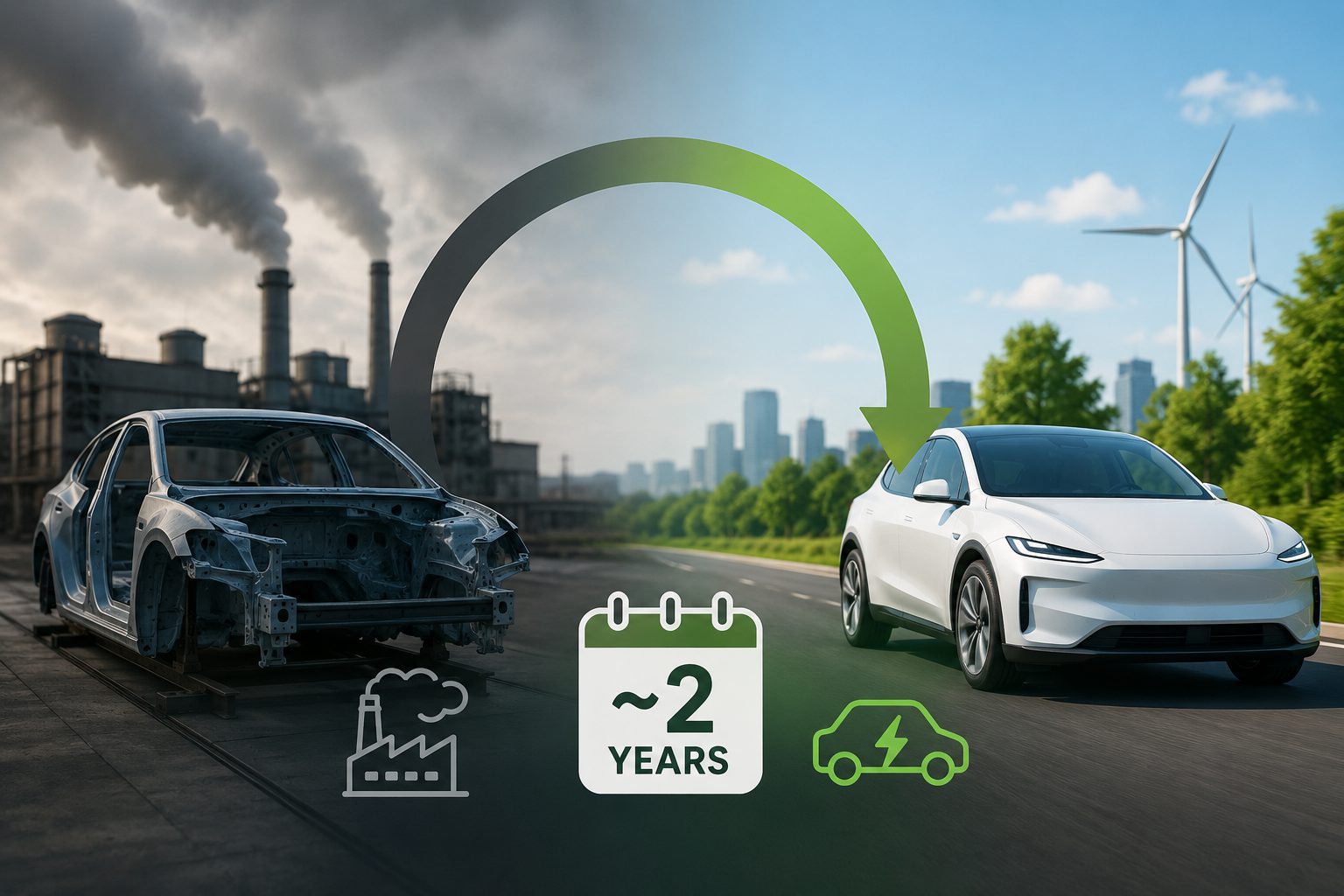
Building an EV battery is not clean. Nobody serious pretends otherwise. A single battery pack can emit anywhere from 2.4 to 16 metric tons of CO₂ during manufacturing, according to MIT Climate Lab. An electric vehicle rolls off the assembly line carrying roughly 1.3 to 2 times the embedded emissions of a comparable gas car. That figure surfaces frequently in critiques of EV adoption—often without accounting for what happens after the key turns. The carbon debt is real. It also gets paid off faster than most people expect.
The Carbon Debt Gets Paid—Fast
The break-even point arrives sooner than critics claim—and the lifetime advantage isn’t even close.
Here’s what the numbers actually say:
- The average U.S. driver hits break-even at roughly 21,000 miles—about 1.5 to 2 years of typical driving, per Green Energy Consumers Alliance data built on Union of Concerned Scientists research.
- Reuters and Argonne National Laboratory peg that number at 15,000 to 20,000 miles.
- European drivers get there even sooner—around 11,000 miles, according to Carbon Brief citing the ICCT.
- Over a full lifetime, EVs produce roughly 50 to 70 percent less CO₂ than comparable gas cars.
- EPA data from about 15,000 EVs shows battery failure rates under 1 percent for models built from 2016 onward. Most packs never need replacing.
The reason gasoline loses so badly in this comparison is simple arithmetic. Every gallon burned releases 8,887 grams of CO₂, per EPA figures. That compounds relentlessly across 100,000-plus miles. EVs are 2.6 to 4.8 times more energy-efficient per mile. Even on a coal-heavy grid, that efficiency gap is too wide for fossil-generated electricity to close. No matter where you live in the U.S., the break-even still lands under two years. Carbon Brief calls the claim that EVs need 50,000-plus miles to become cleaner “doubly false.”
“The greenhouse gas emissions associated with an electric vehicle over its lifetime are typically lower than those from an average gasoline-powered vehicle, even when accounting for manufacturing.” — U.S. EPA
The Real Problem—And Why It’s Fixable
Battery supply-chain damage is genuine, but it’s front-loaded and improvable in ways that tailpipe emissions simply aren’t.
Critics aren’t wrong about everything. Lithium mining emits roughly 15 tons of CO₂ per ton extracted, according to APM Research Lab, while consuming hundreds of millions of gallons of water annually. About 40 percent of a battery’s carbon footprint sits in mining and refining alone. Those harms are real and shouldn’t be dismissed.
They are also front-loaded and geographically concentrated—a one-time mortgage payment, while gasoline runs as an endless subscription fee leaking from billions of tailpipes every single day. Despite the footprint of battery manufacturing, this technology is “much less damaging to the climate than the alternatives.” — MIT Climate Lab
Today’s manufacturing emissions represent a floor, not a ceiling. Cleaner factory power, cobalt-free chemistries, and sodium-ion alternatives are already in development. As grids decarbonize and battery factories switch to renewable energy, the break-even point will arrive even sooner than current estimates suggest. The debate is quietly shifting from “are EVs better?” to “how clean is this specific EV’s supply chain?”—which signals that the baseline argument is already settled.