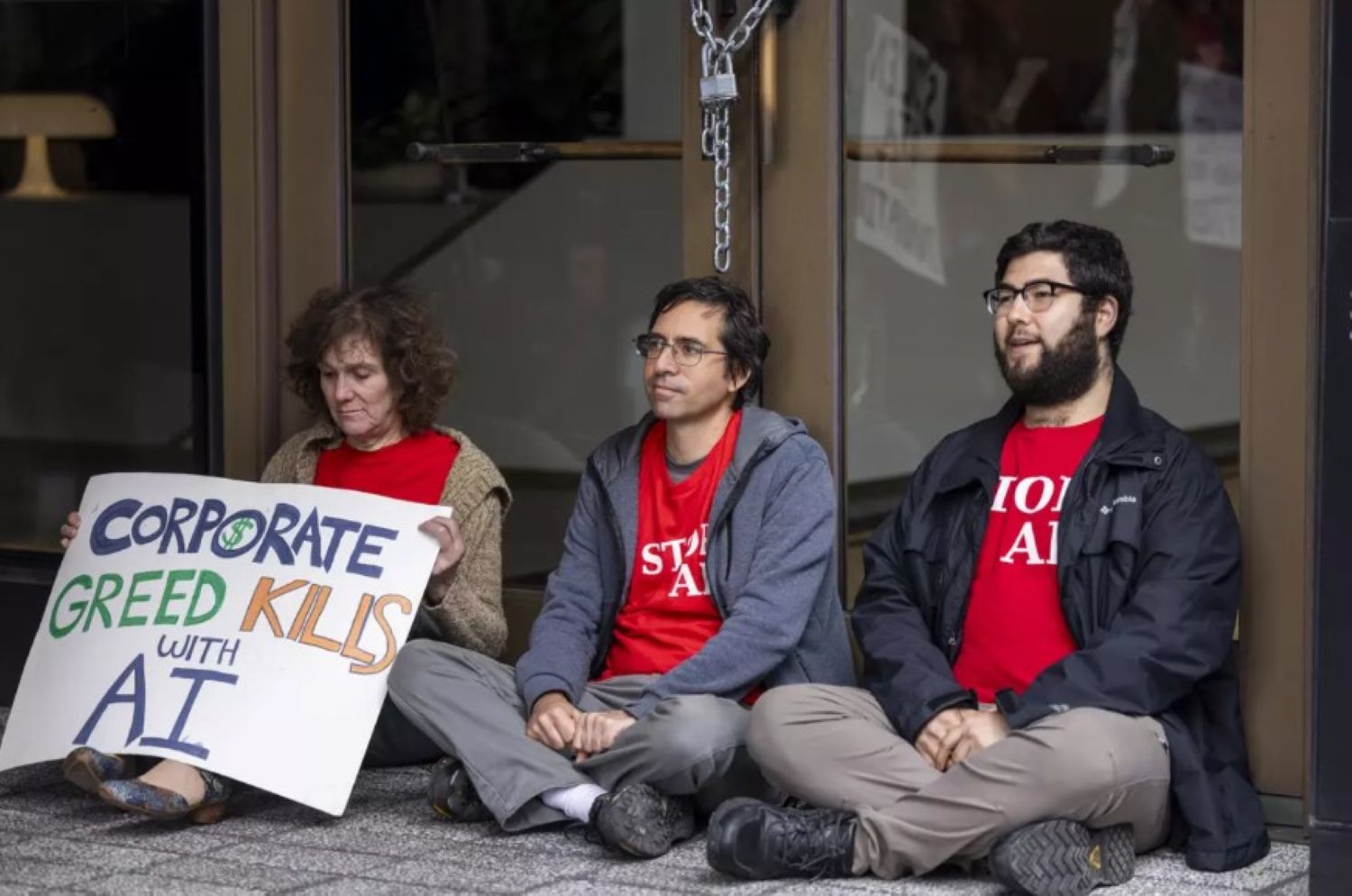
On her birthday, Wynd Kaufmyn ran some errands, had a send-off with friends, then turned herself in to serve jail time for protesting a tech company. She’s 69 years old. She says the wrong person is behind bars — and she’s not interested in walking that back. This may be possibly the first jail sentence handed down specifically for anti-AI protest activity, which means a local San Francisco misdemeanor case has quietly become something larger: proof that the AI debate has moved off social media and into courtrooms.
A San Francisco jury convicted Kaufmyn in June 2026 on four misdemeanor counts:
- trespassing with intent to interfere with a business
- unlawful assembly
- refusal to disperse at a riot
One charge was later dismissed on First Amendment grounds, according to the SF Gazetteer. The sentence is 14 days, though California custody-credit rules will likely cut that to roughly seven days served in practice.
The Protest That Started It All
A February 2025 blockade of OpenAI’s San Francisco headquarters set this legal saga in motion.
In February 2025, Kaufmyn and fellow StopAI members chained and locked OpenAI’s entrance. Deliberate, choreographed, unapologetic. Think Greenpeace chaining themselves to a whaling ship — except the ship is a trillion-dollar industry racing toward artificial general intelligence. StopAI’s specific target is artificial superintelligence, the kind of AI that surpasses human intelligence across every domain. Their method is old-school civil disobedience, the same playbook Kaufmyn has reportedly run through decades of activism: nuclear weapons, U.S. policy in Central America, Palestinian rights, according to the SF Standard and The Guardian.
“I’m not the one that should be in jail,” Kaufmyn told the SF Standard.
A Case Bigger Than One Protest
What happens in a San Francisco courtroom is now shaping how the world thinks about AI activism.
Outlets including The Guardian and CryptoBriefing describe this as possibly the first jail sentence tied directly to anti-AI protest activity — a framing most reporting carefully hedges as “believed to be” rather than confirmed legal fact. Still, the symbolism is hard to ignore. Climate activism traveled a similar road: fringe direct action, then arrests, then mainstream political force. Whether AI protest follows that arc is genuinely unclear.
StopAI itself isn’t monolithic. The group’s leader, Sam Kirchner, has not been publicly active in recent months, according to KQED, and concerns about activist rhetoric within the movement linger. OpenAI has argued, per reporting in The Guardian and CryptoBriefing, that disruptive tactics and heated rhetoric can damage legitimate debate. That perspective deserves space alongside Kaufmyn’s.
Kaufmyn walked into jail. The question of who actually bears responsibility for AI’s risks walked out with her — and legal observers note that future protest actions at AI labs will now unfold with a clearer picture of the potential consequences for everyone involved.