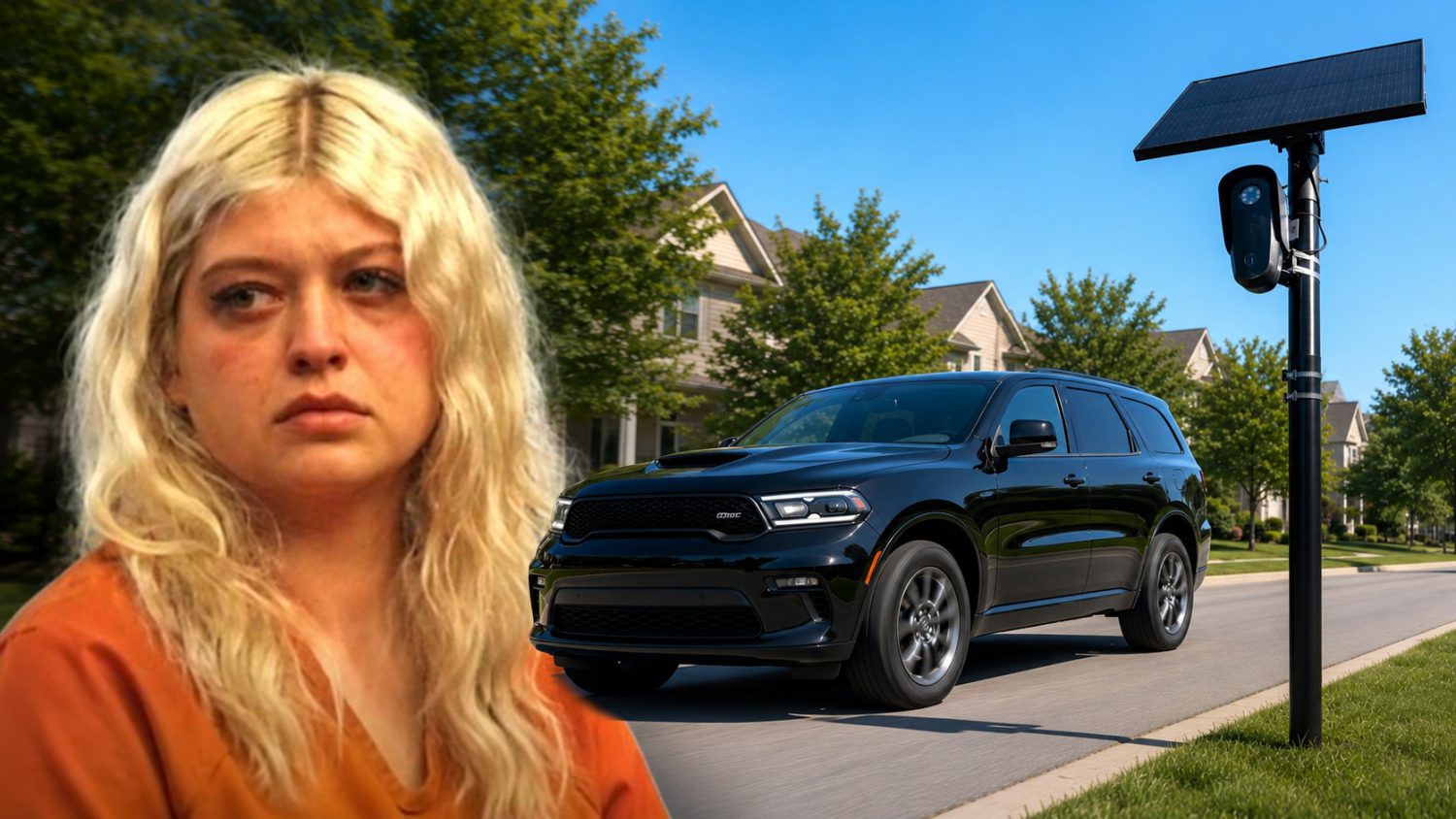
On October 4, 2025, a hit-and-run on eastbound I-4 near DeBary, Florida killed three people — motorcyclist Joaquin Deno, Flagler County deputy administrator Jorge Salinas, and his wife Nancy. A Flock Safety automated license plate reader (ALPR) — a networked camera that photographs passing vehicles and surfaces “hits” against law enforcement databases — had spotted a black Dodge Durango registered to 23-year-old Lindsey Brooke Isaacs roughly three miles from the crash. That single data point became the spine of the entire investigation, despite a stack of contradictory evidence sitting in plain sight from day one.
What the Camera Saw vs. What the Evidence Said
The contrast between the ALPR data and the physical evidence was immediate, stark, and ignored.
- ALPR flagged: black Durango, registered to Isaacs, near the scene
- A 911 caller described: a maroon Dodge Durango, with a partial plate that didn’t match Isaacs
- Forensic evidence found on a struck vehicle: maroon paint transfer
- Isaacs’ black Durango: no crash-consistent damage, per her federal lawsuit
- Time-distance analysis by her attorney: her vehicle could not have been at the crash site when the collision occurred
Tech and civil-liberties reporting, including Yahoo News coverage of the Flock system, frames this pattern — where an ALPR hit becomes the investigation’s center of gravity rather than its starting point — as a structural “guilty until proven innocent” pipeline. Direct verbatim attribution from investigators explaining their reasoning remains limited in available sourcing.
A 23-Year-Old Facing Life in Prison
Six months of investigative tunnel vision ended with handcuffs on the wrong person.
On April 17, 2026, Florida Highway Patrol arrested Isaacs on eight felonies — three counts of vehicular homicide among them. Potential sentence: life. She spent 13 days in jail before prosecutors acknowledged they lacked sufficient evidence to hold her pretrial.
On May 22, 2026, charges were dropped. That same day, investigators — finally acting on the maroon Durango description and partial plate available from day one — arrested 47-year-old Alisa Montalvo, whose maroon Durango showed crash damage matching the scene. Montalvo now faces nine charges including three vehicular homicide counts and is held without bond. She has not been convicted.
When the Algorithm Becomes the Detective
Flock’s cameras are fast and scalable — the problem is what happens when a probabilistic hit replaces actual investigation.
Flock Safety operates tens of thousands of networked cameras, sold to police departments and HOAs as frictionless crime-fighting infrastructure. The cameras photograph, read, and flag. It’s the policing equivalent of following GPS directions into a lake because the map said so and nobody looked out the window. ALPR supporters argue the technology works and that failures like this reflect human investigative error, not camera malfunction — and that’s not an unreasonable position. But as reported by Reason, a separate case involving a woman wrongly flagged by a Flock camera for theft — cleared only after she independently proved she was elsewhere — suggests the pattern of over-reliance is not isolated to one agency or one investigation.
Isaacs has filed a federal lawsuit against FHP and involved troopers, alleging they falsely claimed her vehicle showed crash-consistent damage. A retired officer has publicly called for an internal investigation, according to WFTV. Courts have yet to set clear boundaries on whether an ALPR hit alone can constitute probable cause for arrest — and that unanswered legal question is the one that determines whether your plate being in the wrong place at the wrong time can become the first chapter of a story you never wrote.