Over one trillion call records, history reaching back to 1987, and roughly four billion new records added every day. That is what AT&T’s surveillance app-era Data Analytical Services database reportedly holds, according to EPIC, the civil-liberties research organization.
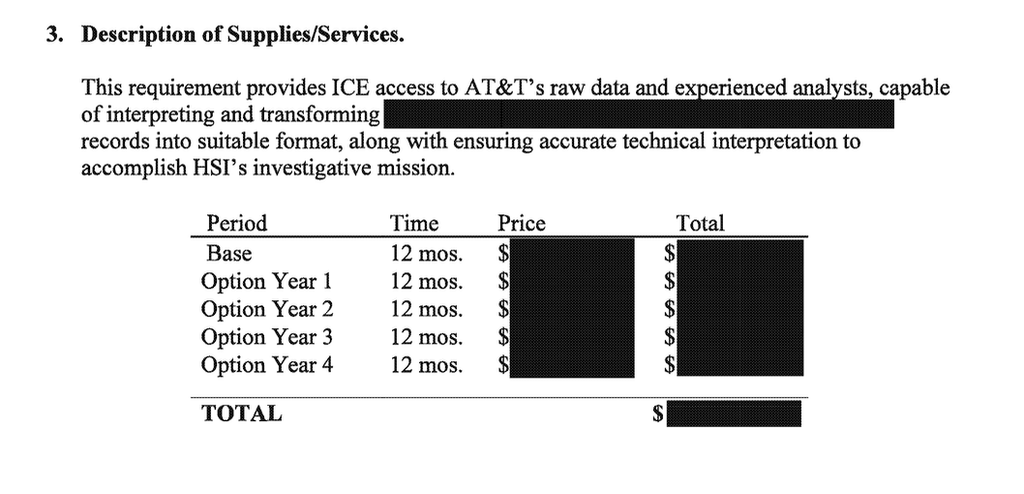
“This requirement provides ICE access to AT&T’s raw data and experienced analysts.” Internal ICE procurement document, obtained and published by 404 Media.
What ICE Actually Bought
The arrangement goes beyond pulling records; AT&T analysts interpret the data for investigators.
The DAS program lets investigators link multiple phone numbers or devices to a single target, identify devices associated with a target after a SIM-card replacement, determine whether a target’s phone entered the United States, and reconcile international numbers. Those capabilities are described in Senate materials from Senator Ron Wyden and in EPIC’s published fact sheets on the program.
The ICE procurement document identified Homeland Security Investigations as the beneficiary. The section describing specific investigations was redacted.
The Money Is Growing
ICE paid AT&T more than $2.1 million in fiscal 2025, with the contract potentially exceeding $10 million.
Public procurement records cited by 404 Media show ICE paid AT&T more than $2.1 million in fiscal 2025 and more than $2.2 million in August of that year. The procurement document indicates payments could exceed $10 million over subsequent years.
The document also says demand increased during fiscal 2025, with a further significant increase expected.
One Seller, One Buyer, No Competition
The sole-source structure gives AT&T a financial stake in a program only AT&T can provide.
ICE justified the contract as a sole-source acquisition. According to the internal ICE procurement document, AT&T controls the underlying data and the analytical capability would be lost if AT&T did not perform the work. The document says no other vendor could provide the same access because AT&T controls the underlying data.
The arrangement positions AT&T as data holder, analyst, and exclusive government contractor simultaneously. AT&T has a direct financial incentive to retain that database. Competitive procurement would at least create a check; neither independent oversight nor competition exists here, based on the available surveillance infrastructure documents.
The Program That Was Ended but Wasn’t
Federal funding for Hemisphere was reportedly cut in 2024; ICE appears to be paying for substantially similar access under a different name.
EPIC identifies DAS as formerly known as Hemisphere, the program the New York Times first reported in 2013 as a DEA-AT&T arrangement. Federal funding for Hemisphere was reportedly ended in 2024.
The ICE contract suggests agencies can purchase substantially similar access through direct procurement even after a program is publicly wound down. The available documents establish the connection between the ICE contract and DAS; they do not confirm every operational detail of how ICE queries the database.
Warrants, Subpoenas, and an Unresolved Legal Question
Civil-liberties experts say this surveillance may rely on administrative subpoenas rather than judicial approval.
A warrant requires judicial authorization. An administrative subpoena, by contrast, can be issued by the agency itself without prior court approval, though statutory limits and later legal challenges apply. Civil-liberties experts, as reported by 404 Media, argue the relevant process here may be the latter, raising concerns similar to those uncovered when a secretly tracking users scandal emerged around a government-linked application.
Senator Wyden has been direct about his concerns: “I have serious concerns about the legality of this surveillance program, and the materials provided by the DOJ contain troubling information that would justifiably outrage many Americans and other members of Congress.” He made that statement in a letter pressing for public disclosure of records about the program. EPIC also notes that DAS may include location information, and the Supreme Court’s Carpenter decision requires warrants for certain historical cellphone-location records, though the precise application depends on the data type, investigative circumstances, and governing legal authority. That question remains live and unresolved.
Switching Carriers Won’t Necessarily Help
AT&T routes calls for other carriers, so non-AT&T customers may still appear in the database.
AT&T provides wholesale network infrastructure for other telecommunications companies. EPIC reports that the system can include records of people whose communications were routed through an AT&T switch even when those people were not AT&T subscribers. This reflects expert interpretation of AT&T’s network role, not a complete public accounting of every affected carrier.
AT&T told 404 Media that it provides information when required by a lawful order, verifies requests, and responds in compliance with the law.
The Questions the Program’s Growth Doesn’t Answer
Rising demand and a growing budget reveal nothing about oversight, legal process, or audit trails.
What legal orders does ICE use to query the database? How many searches has the agency conducted? Has the Department of Homeland Security completed a Privacy Impact Assessment? Has AT&T disclosed this arrangement to affected customers?
The procurement document does not publicly answer these questions. A program’s expanding budget is not a substitute for transparency about how that program operates.