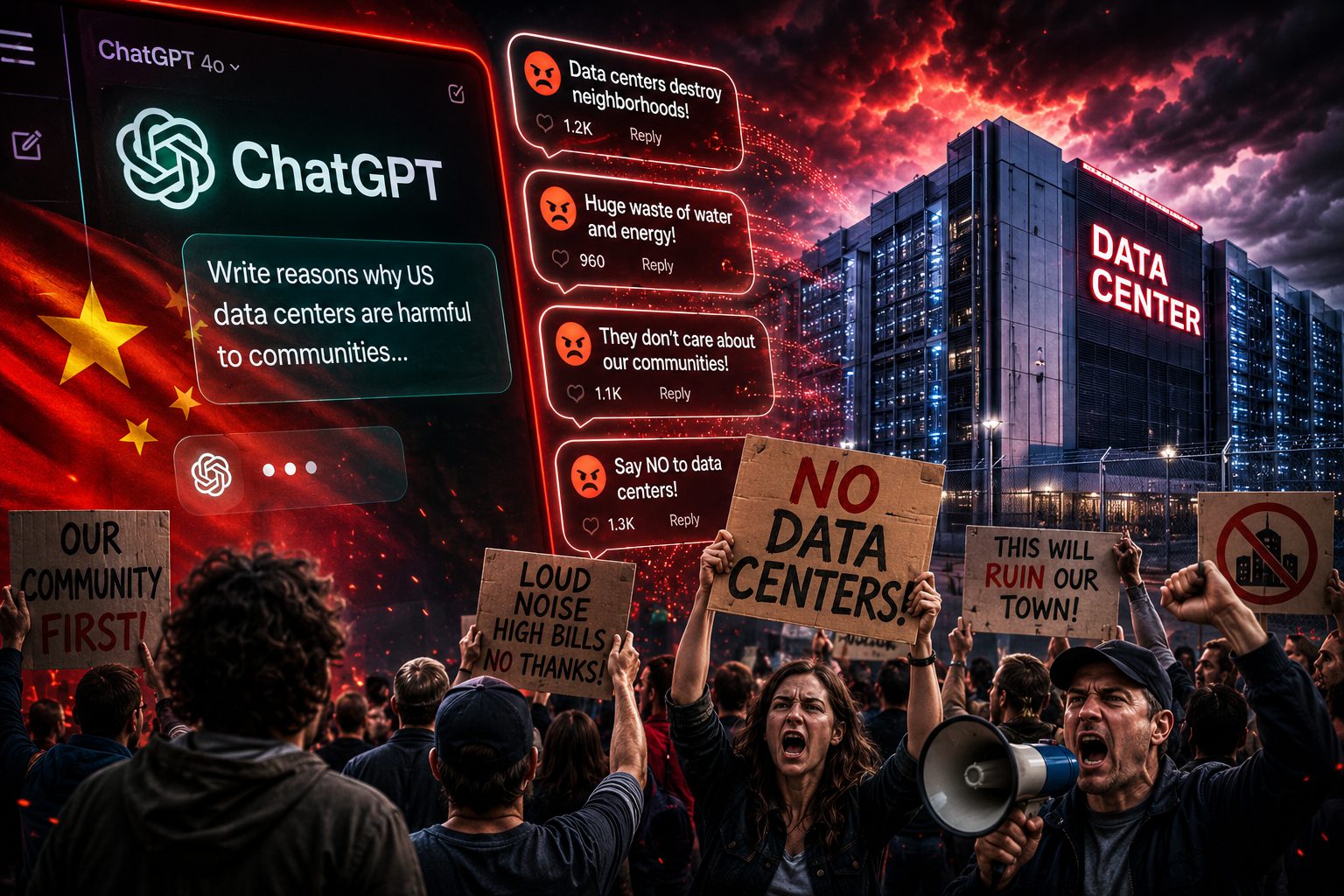
Your social media feeds became a battlefield you didn’t know existed. China-linked operatives used ChatGPT to generate English-language posts attacking American data centers, complete with cartoon executives clutching money bags while “ordinary people” suffered rising electricity bills. The twist? Their ham-fisted influence campaign failed spectacularly, gaining zero authentic engagement while real opposition to AI infrastructure exploded nationwide.
The “Data Center Bandwagon” Operation Flopped Hard
Foreign actors generated memes and social posts about energy costs but couldn’t break through to real audiences.
OpenAI’s latest threat report details how China-based accounts used VPNs to access ChatGPT from late 2025 into early 2026, instructing the AI to draft anti-data center content and generate cartoon-style images. These operators posed as Americans from different backgrounds, spreading content about families subsidizing AI infrastructure expansion. They uploaded their own internal strategy documents into ChatGPT, revealing tactics for creating social accounts that could evade platform detection.
The problem? OpenAI found “no authentic engagement” and “no meaningful breakout beyond its own activity.” The fake grassroots campaign was essentially shouting into the void while real Americans were already organizing genuine opposition.
Real Opposition Was Already Boiling Over
Domestic backlash to data centers surged independently, driven by actual cost increases and community concerns.
The foreign meddling piggybacked on legitimate fury. Public opposition to nearby data centers jumped from 42% to 71% in just nine months, according to polling cited in OpenAI’s coverage. More than $150 billion in US data center projects faced delays or cancellations in 2025 due to local pushback.
Bloomberg reporting shows electricity prices spiked up to 267% in some areas near large data developments. When your power bill triples, you don’t need foreign propaganda to feel angry—the math speaks for itself. Rising energy costs, heavy water usage, and land consumption created natural flashpoints that foreign actors tried to exploit.
OpenAI Caught Them, But Questions Linger
The company’s findings raise uncomfortable questions about corporate interests versus genuine security threats.
Ben Nimmo, OpenAI‘s principal investigator, emphasized this wasn’t “a case of an influence operation creating a debate. The debate existed already.” Yet OpenAI has obvious incentives to portray grassroots opposition as foreign interference rather than acknowledge legitimate concerns about their industry’s infrastructure demands.
Darren Linvill from Clemson’s Media Forensics Hub told NPR his team found relatively little evidence of extensive Chinese coordination in this space. The operators also ran a separate “Tech and Tariffs” campaign, instructing ChatGPT to avoid mentioning Xi Jinping while criticizing US trade policies and depicting American political figures in unflattering cartoons.
The bigger story isn’t China’s clumsy attempt at digital manipulation—it’s how foreign actors increasingly exploit America’s real fault lines using consumer AI tools. When domestic opposition already runs this deep, even amateur influence operations find fertile ground to plant their seeds, regardless of whether anyone’s actually listening.