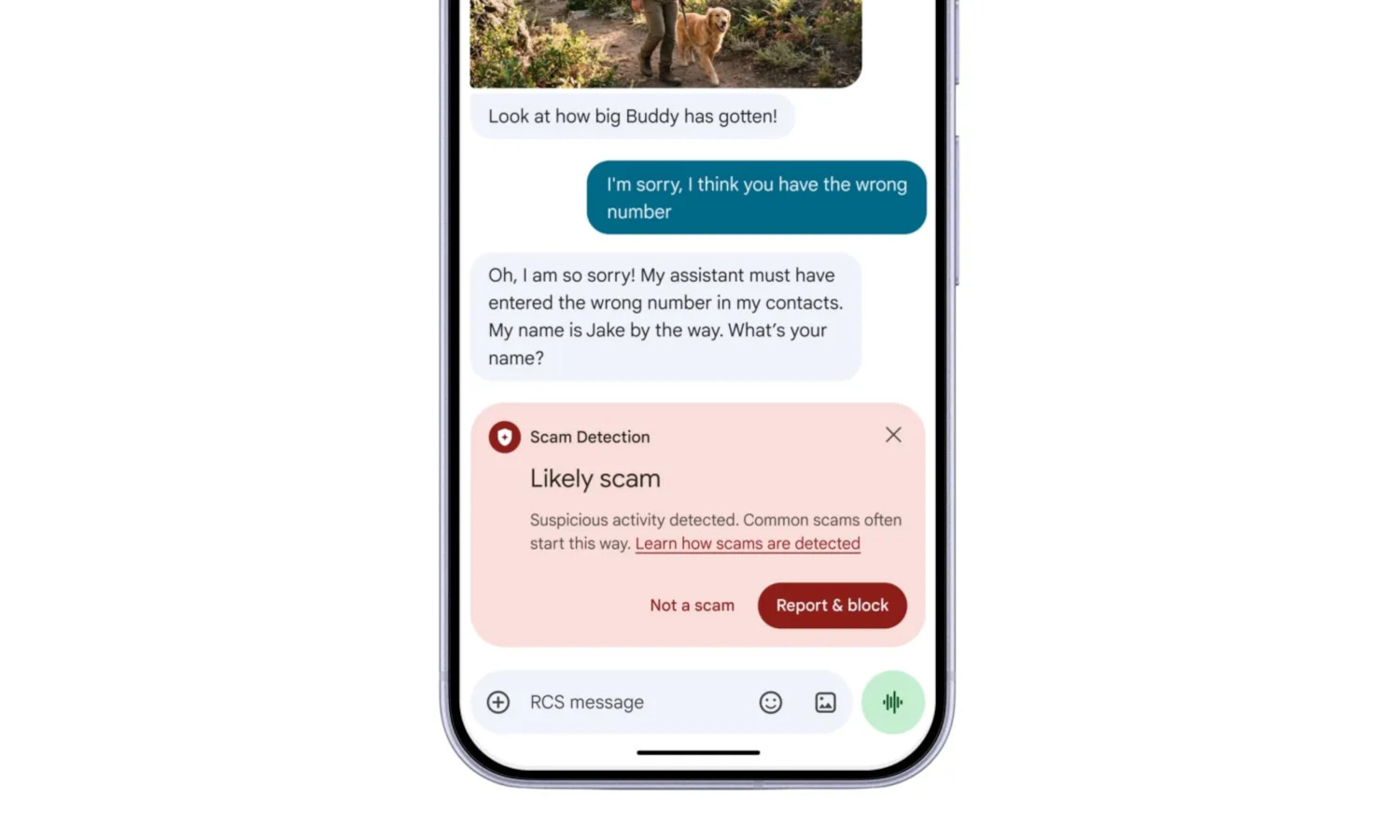
A message arrives from an unknown number. It looks like a job offer, or maybe a package delivery notice. Over the next few days, the sender builds rapport, earns trust, then asks for money or login credentials. Basic filters may miss scams that develop gradually over time.
That’s the pattern Google is now targeting directly. On October 14, 2026, the company announced an opt-in Enhanced Protection mode for Google Messages, layering cloud-based Gemini analysis on top of the on-device detection already running in the background.
How the Two-Layer System Works
Existing on-device detection catches obvious fraud; Gemini in the cloud goes after the slow burn.
Google Messages already uses on-device machine learning to flag suspicious patterns in SMS, MMS, and RCS conversations from unknown senders. When something looks off, the app surfaces a warning and gives you options to dismiss it, report the sender, or block them entirely.
Enhanced Protection extends that foundation with cloud-based Gemini models that assess broader conversational context, according to Google’s announcement and reporting by The Verge. The goal is catching sophisticated fraud that develops gradually and may never trigger simpler filters.
Gemini Nano also evaluates real-time web signals around unfamiliar links before you tap them. Redesigned warnings provide more context and give you a longer pause before you commit to opening anything.
The Privacy Trade-off You Should Know About
Stronger detection requires sending messages to the cloud, and that is worth understanding before you opt in.
Google’s original Scam Detection is designed primarily for on-device message-content analysis. Enhanced Protection changes that equation by sending message content to cloud Gemini models for analysis.
Google says the processing happens inside Private AI Compute. Google describes that environment as encrypted and inaccessible to both Google and third parties, raising questions for users concerned about apps secretly tracking users.
Users who prefer their messages never leave the device will reasonably want to stay with on-device-only analysis. Because Enhanced Protection is opt-in, that decision is yours.
It is also worth noting that Google’s own support documentation already acknowledges spam protection may send URLs to Google for malicious-link verification. Some cloud contact is not entirely new territory.
Which Devices Get It First
Initial availability is limited to recent flagship hardware, with broader rollout to follow.
According to 9to5Google, the first wave of supported devices includes the Pixel 10 series, Samsung Galaxy S26 series, Galaxy Z Fold 8, and Galaxy Z Flip 8, with other select hardware to follow. Google says availability will roll out to additional devices in the coming weeks.
The existing on-device Scam Detection already reaches more than 20 countries and multiple languages. Enhanced Protection is expected to expand further as rollout continues.
Where This Fits in Google’s Broader Push
Romance and investment scams are a particularly difficult class of fraud that has resisted simpler automated detection.
Google started with on-device protections for delivery and job-related scams, then expanded to cryptocurrency, financial, toll-road, and gift-card fraud. Enhanced Protection targets a particularly difficult class of scams: slow-burn schemes that spend days building trust before the actual ask arrives.
If contextual AI screening becomes the baseline expectation for messaging platforms, competitors including Apple, Meta, and mobile carriers may face pressure to close the gap. That outcome remains a potential implication rather than a certainty, but the direction is clear.
Enhanced Protection is opt-in. If your device is on the supported list, the setting will appear inside Google Messages. The central question for Google going forward is accuracy: false positives that flag legitimate recruiters, delivery services, or unfamiliar businesses are a potential concern that could erode the trust this feature is designed to build. Readers wanting broader tips to stay safe from digital threats may find additional context useful.