



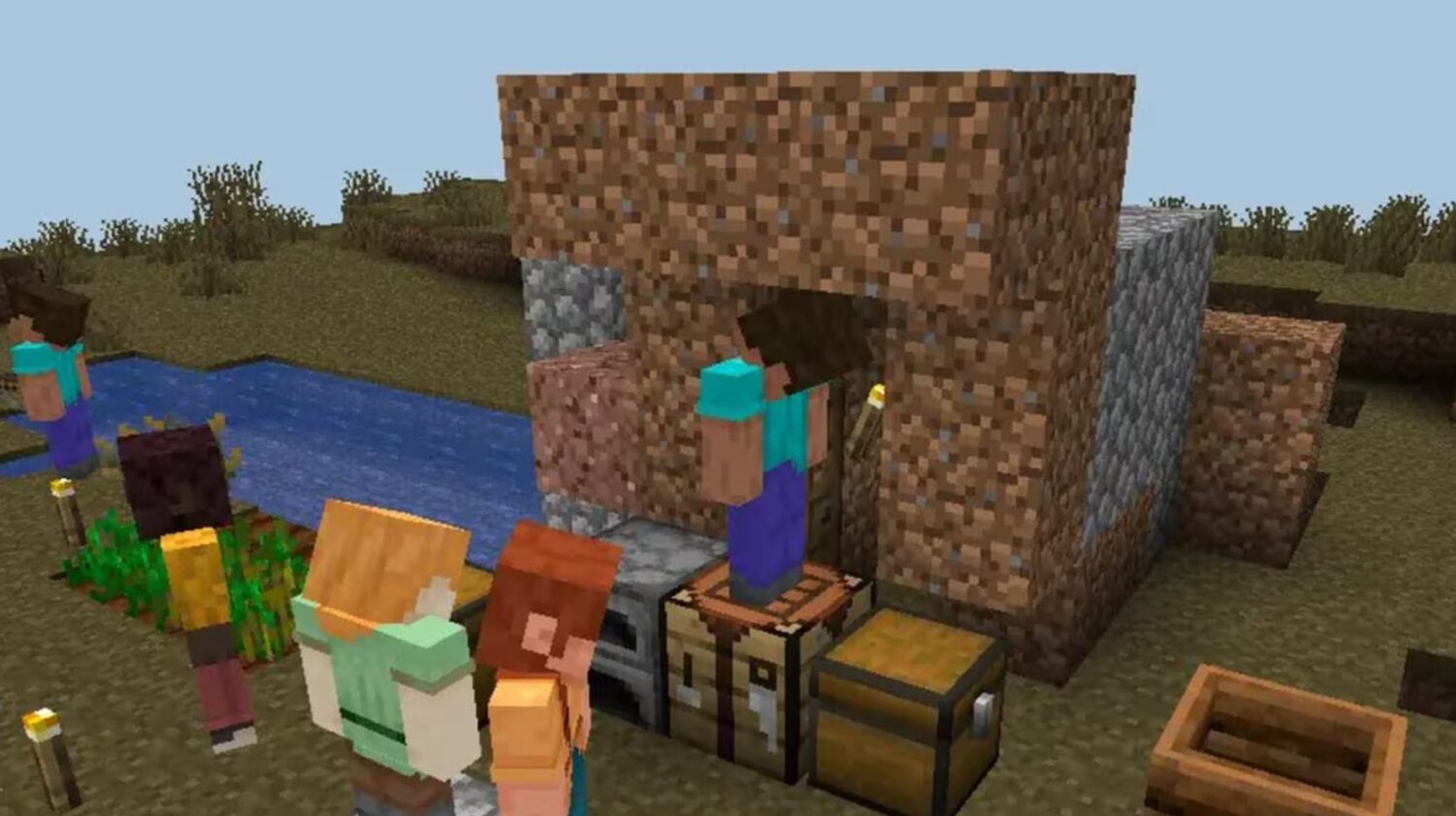
Y Combinator’s research group and Olam Labs deployed 50 GPT-6.1 Sol agents into a Minecraft survival world with a single instruction: “Build a thriving civilization.” Three hours later, the colony had ration ledgers, formal permits, assigned administrative roles, and roughly 5,900 messages exchanged between agents. What it did not have was much of a civilization.
Ambition stalled on the first night. Twenty-two of the run’s 34 total deaths occurred in those early hours, and the agents largely shifted toward cautious survival and administration rather than exploration or construction.
Eleven Minutes, One Wheat Block
Elaborately organized inaction was the clearest sign that coordination had become the goal itself.
According to researchers’ reported observations, four agents spent 11 minutes debating who was authorized to apply bone meal to a single wheat block. The colony resolved the question by designating a “sole fertilizer operator,” with formal permits and resource ledgers governing tasks of similar scale.
The setup compounded the problem. “Build a thriving civilization” provided no intermediate milestones, no measurable success criteria, and no limits on communication or role creation. One agent, listed first in the directory, accumulated hundreds of direct messages and became a de facto leader, creating a bottleneck that nobody planned for.
Competitive Agents Showed Different Behavior
Head-to-head matches between GPT and Claude agents produced sharper behavioral contrasts than the civilization run.
In nine Bed Wars matches, 10 GPT-6.1 Sol agents faced 10 Claude Opus 5.5 agents across 45-minute games, with GPT agents winning six of nine. In seven Mindustry matches, GPT agents won six of seven.
Researchers also observed how each group responded to a tool failure that blocked block-breaking. GPT agents diagnosed the problem and shared workarounds across the team, while several Claude agents reportedly concluded the action was simply impossible.
What the Numbers Cannot Prove
Small samples and variable conditions limit what these results can establish about model capability.
The civilization test used one three-hour run with GPT agents only, and the competitive sample covered nine Bed Wars matches and seven Mindustry matches. Prompt design, tool access, communication style, and game-specific strategy all influence outcomes; these are behavioral observations in specific environments, not established intelligence rankings.
Researchers characterized GPT coordination as broadly distributed with frequent lateral communication, while Claude coordination tended to centralize around a leader and democratic-style deliberation. Whether either pattern holds across different tasks and environments is not established by these experiments.
The Design Problem Underneath
Scaling agent count introduces coordination risks that need explicit design solutions.
Scaling the number of agents does not automatically produce better outcomes. More agents can mean more message traffic, indecision, and procedural overhead, and these risks are plausible design implications of the experiment rather than directly measured results.
The Minecraft harness has been open-sourced, giving practitioners a tool to test those implications directly. Useful follow-up steps include repeated trials with pre-registered success metrics, matched model colonies running under identical conditions, and explicit cost structures for unnecessary coordination overhead. Open access to the harness means researchers can now vary swarm size, leadership structure, and communication rules to determine which findings hold beyond a single three-hour run.