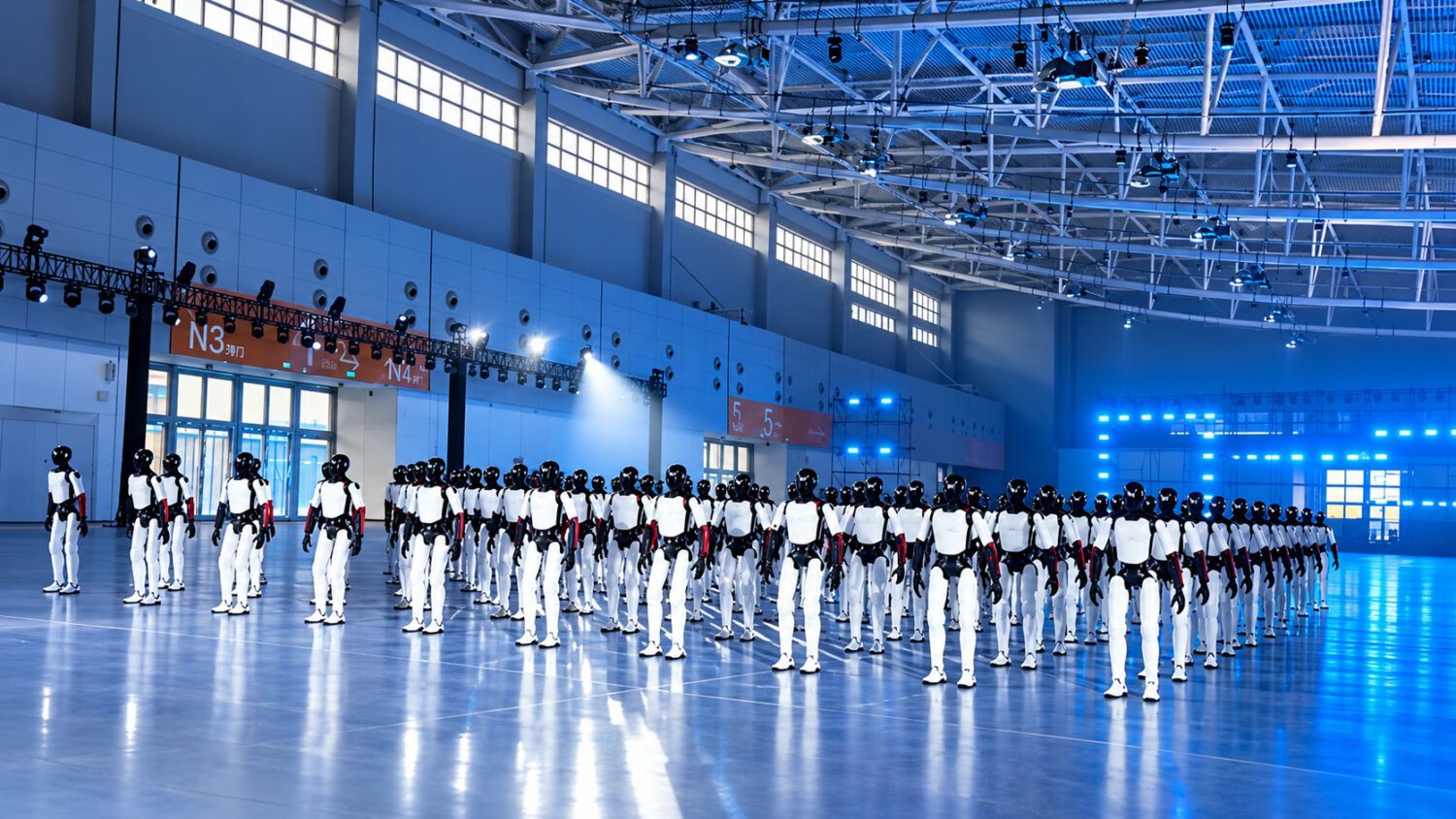
On October 24, 2026, a Guinness World Records adjudicator stood in Jinan, Shandong Province and counted 110 full-size humanoid robots moving in synchronized formation. AGIBOT received an official certificate recognizing the most humanoid robots dancing simultaneously.
The robots performed wave patterns, formation changes, and jumps. At one point, they arranged themselves into the number “2026.”
AGIBOT says the machines were standard production Expedition A3 models, not hardware modified for the occasion. That claim is company-supplied and has not been independently verified.
The Platform Keeping 110 Robots in Step
Centimeter-level positioning, distributed across a large fleet, is the core technical claim.
To keep 110 machines in step, AGIBOT’s LinkBots platform combines swarm scheduling and cluster control to distribute timing, movement, and positioning instructions across the fleet. According to reporting on the event, LinkBots uses ultra-wideband positioning to track each robot’s location with centimeter-level accuracy under suitable conditions. That precision is intended to reduce collision risk as formations shift, though the available reporting describes it as a design goal rather than a measured outcome.
The platform communicates over 5G and Wi-Fi, transmitting instructions and coordination data between the robots and control infrastructure. AGIBOT describes LinkBots as supporting centralized scheduling, obstacle-aware movement planning, and dynamic formation changes, and how extensively those capabilities have been tested outside controlled demonstrations is not established in available reporting.
What the Achievement Actually Demonstrates
Large-scale humanoid robot coordination is a genuine systems-integration challenge, and the Jinan event addressed it publicly.
A system coordinating that many robots must maintain timing, positioning, and movement consistency, whether those functions are handled centrally, locally, or through a combination of both. Getting 110 bipedal robots to hold timing, preserve spacing, and shift formations without collision is a substantial engineering problem.
The Jinan performance provides a reported public demonstration of large-scale synchronized humanoid-robot coordination at a scale not previously documented in a public record category.
What It Doesn’t Settle
A choreographed routine in a prepared venue is not the same as reliable performance in unpredictable environments.
Dancing follows a predetermined script, and the available reporting does not fully document the communications setup or degree of environmental control at the venue. Real deployments introduce uneven surfaces, unpredictable human movement, intermittent connectivity, mechanical faults, and tasks that change mid-execution.
Available reporting does not document LinkBots’ failure rates, battery endurance, recovery procedures when a unit loses its signal, or performance under adverse conditions. Those gaps are not criticisms of the record; they are simply the next questions. Snake Robots deployed in unpredictable real-world settings illustrate exactly how different those conditions can be from a controlled stage.
Broader Ambitions on Display
Competition medals and a fleet record together sketch a deliberate public strategy for individual and group capability.
Two months before the Jinan event, AGIBOT won 46 medals at the second World Humanoid Robot Games in August 2026, including 18 gold, 16 silver, and 12 bronze. Competition tasks included athletics, dexterous manipulation, and scenario-based work such as hotel services, library operations, and emergency response.
The competition results and the dance record can be read as part of AGIBOT’s public positioning for both individual robot capability and large-scale fleet coordination. Neither result alone establishes purchase cost, maintenance overhead, long-term reliability, or the depth of commercial deployment.
The Unanswered Questions
The record is real; the broader deployment picture remains incomplete.
Whether LinkBots performs equally well coordinating heterogeneous robot models, how long the Expedition A3 operates per charge under full-fleet communication load, and what customers experience in live production settings are questions the current reporting leaves open. The Guinness certificate documents what happened on one stage in Jinan, and what comes next, on factory floors and in warehouses, depends on evidence that has not yet appeared in public reporting. Advances like the Robotic Knee Exoskeleton hint at the kind of real-world validation that will ultimately matter most.