For people with quadriplegia, controlling a phone or computer often means a mounted joystick, a voice command, or a mouth stick visible to everyone nearby. Tomás Vega, co-founder and CEO of Augmental, built MouthPad to address that reality: a custom-fitted intraoral interface, priced at approximately US $1,400 according to IEEE Spectrum, that connects to compatible robotic knee exoskeleton devices without any external hardware.
How It Works
MouthPad turns the roof of your mouth into a touch-sensitive control surface that works with your existing Bluetooth devices.
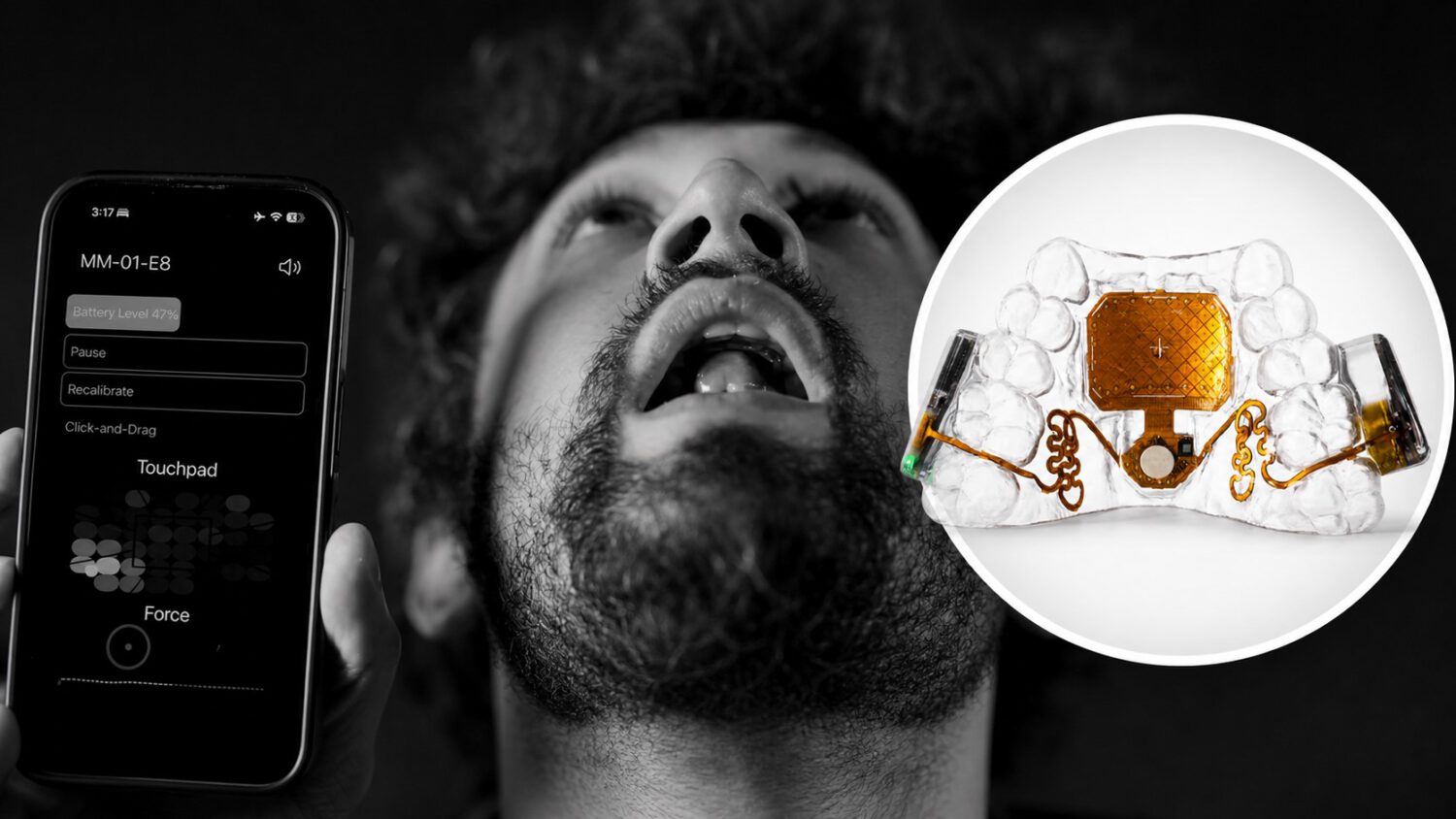
The device sits against the roof of your mouth. A touch-sensitive surface reads your tongue’s movements and translates them into cursor control, clicks, scrolls, swipes, and drags.
An accelerometer, gyroscope, and barometric pressure sensor extend the input vocabulary further. Head-tracking for cursor movement requires no external camera or mounting hardware in the standard configuration, according to IEEE Spectrum.
Engadget, which tested an early unit, reported the device weighs approximately 7.5 grams. Most of its body measured about 0.7 millimeters thin in that tested unit, with the touchpad section thickening to around 5 millimeters. Treat those figures as one reporter’s measurements of an early unit, not independently verified specifications; Augmental’s current product page lists different figures, and specifications can change.
Each MouthPad is custom-fabricated using a 3D dental scan, using a resin comparable to materials found in aligners and bite guards. You can speak while wearing it. You need to remove it to eat.
“If you design for those who are most constrained, you design better interfaces for everybody.” Tomás Vega, co-founder of Augmental (IEEE Spectrum).
Who It Is For and What It Enables
Augmental built MouthPad around the real needs of people with quadriplegia and severe motor impairments.
Augmental developed MouthPad with direct input from people with quadriplegia and spinal-cord injuries, according to TechCrunch. One documented use case involved a player with quadriplegia using MouthPad to add a simultaneous control layer on top of an existing joystick setup, expanding what he could do in a game without switching input methods.
Other demonstrated uses include navigating computers and phones, working with creative software, and controlling smart home devices. TechCrunch also reported a demonstration involving personal-autonomy technology, specifically sexual-assistance devices, a detail worth noting plainly because accessibility covers the full range of human life, not only work and communication.
MouthPad is designed to complement speech recognition rather than replace it. Its low-profile form allows voice commands and physical input to run in parallel.
Cost, Availability, and Limitations
The approximately US $1,400 price is only part of the total cost, and several practical constraints shape who the device suits.
The price reported by IEEE Spectrum does not include dental-fitting costs, which add time and expense before the device is in your mouth. Augmental does not classify MouthPad as a medical device, so standard health insurance is unlikely to cover it. IEEE Spectrum noted that vocational rehabilitation programs may offer a reimbursement path in some cases, though availability varies by jurisdiction.
IEEE Spectrum also reported an anticipated device lifespan of roughly two years, with battery cycles as the primary limiting factor. Augmental currently lists 7-plus hours of continuous use; earlier reporting from Engadget cited about five hours per charge and a roughly 90-minute recharge window on a tested early unit. Confirm current battery specifications directly with Augmental, as details can change.
The device is not a universal solution. Its usefulness depends on your tongue mobility, head control, oral anatomy, and comfort with an electronic device inside your mouth during much of the day.
MouthPad represents a meaningful shift in assistive human-computer interaction: no external camera, no visible mount, and Bluetooth-mouse compatibility that works across a broad range of devices without requiring every application to support a proprietary interface.