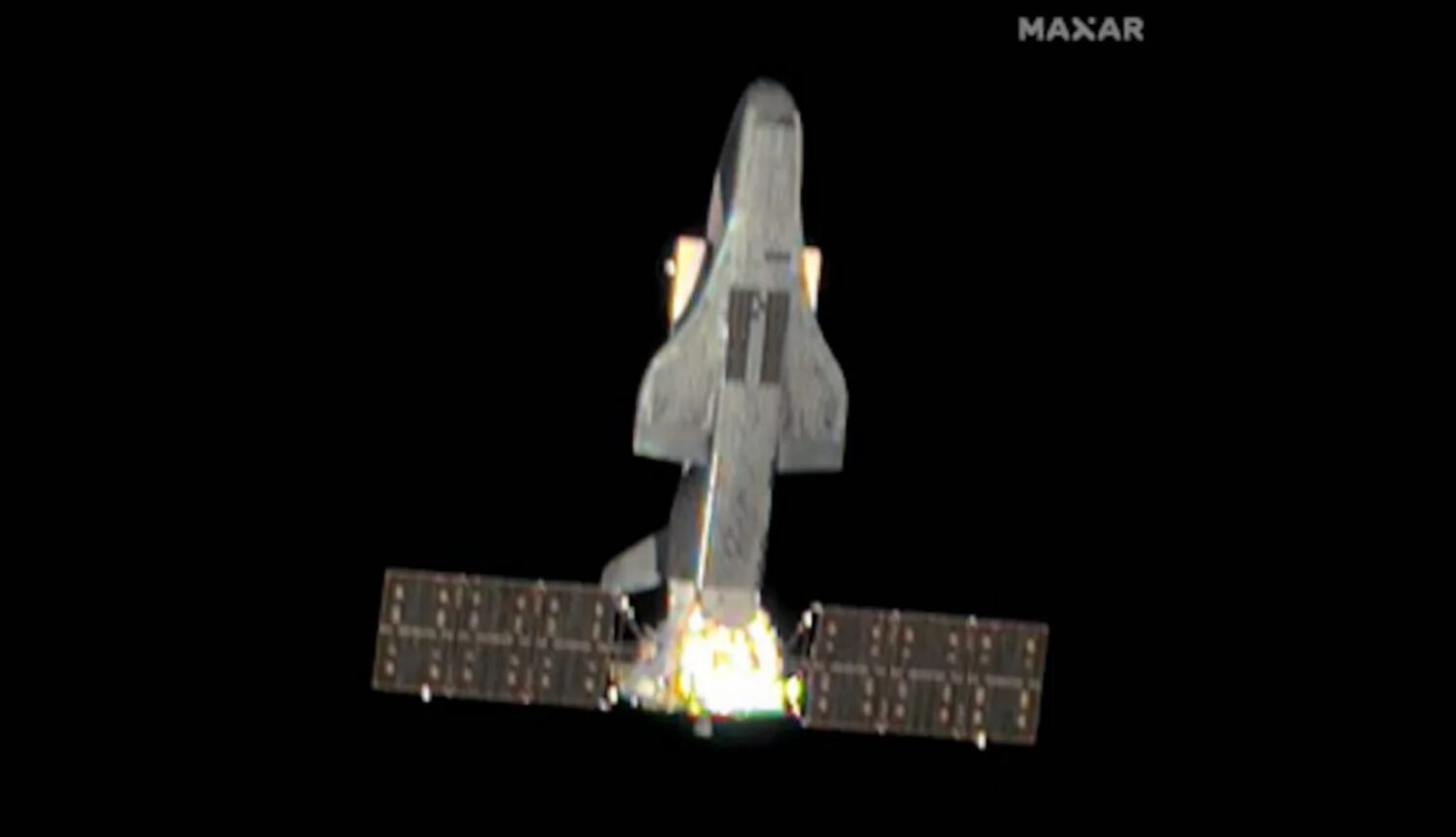
A commercial imaging satellite caught a clear look at one of China’s most classified spacecraft, and the U.S. government published it in an unclassified report. The Defense Intelligence Agency’s 2026 “Challenges to Security in Space” document includes a Maxar photograph showing the underside of an unnamed Chinese spaceplane in orbit, which analysts describe as a highly detailed public image the program has never before produced.
What the Photograph Shows
The Maxar image, captured in 2024 and published on page 53 of the DIA report, shows rear-mounted solar arrays extending from what appears to be a service module attached to the main lifting-body vehicle. The DIA caption does not name the spacecraft.
Open-source analysts and subsequent reporting widely identify it as Shenlong, China’s experimental reusable orbital vehicle. That attribution remains unconfirmed by any official source. The DIA report also references both Shenlong and a separate Tengyun spaceplane concept, leaving the precise identification short of certain.
Six Years of Increasingly Long Missions
Shenlong’s first reported orbital flight launched in September 2020 and lasted roughly two days. A second mission in 2022 stayed aloft for 276 days, and a third launched in December 2023 and returned in September 2024 after approximately 268 days. China launched what it described as a technology-verification mission from the Jiuquan Satellite Launch Center in February 2026, the program’s reported fourth flight.
The DIA’s account of the third mission is the most significant publicly available operational detail. According to reporting on the document, the agency assessed that the vehicle “released and interacted with an object” during that flight. That finding is consistent with rendezvous and proximity operations observed on earlier missions, including at least one approach to within roughly 100 meters of a companion object.
The Double-Edged Capability
Rendezvous and proximity operations cover a wide range of activities. A spacecraft that can maneuver close to another object can perform inspection, servicing, refueling, or debris removal.
No public evidence establishes that the photographed vehicle is configured as a weapon, and that distinction matters. The program draws frequent comparisons to the U.S. Space Force’s Boeing X-37B, another reusable, uncrewed military spaceplane with a similarly opaque mission profile that invites comparisons to supersonic flight research programs. Both programs are classified enough to make direct capability assessments unreliable.
Why One Photograph Changes the Conversation
Commercial satellite imagery is an increasingly important tool for monitoring classified space programs. This photograph is a clear illustration of that trend.
Analysts widely note that the program has operated for six years with almost no public visual record. A single Maxar pass produced more structural detail than years of state-controlled silence, demonstrating how open-source imagery is narrowing the information gap around secretive spacecraft.
The Questions That Remain
The image confirms what the vehicle looks like from below. It does not establish what the vehicle carries, what missions it has performed, or what objectives guide its continued development. Those questions remain unresolved in the available public evidence.