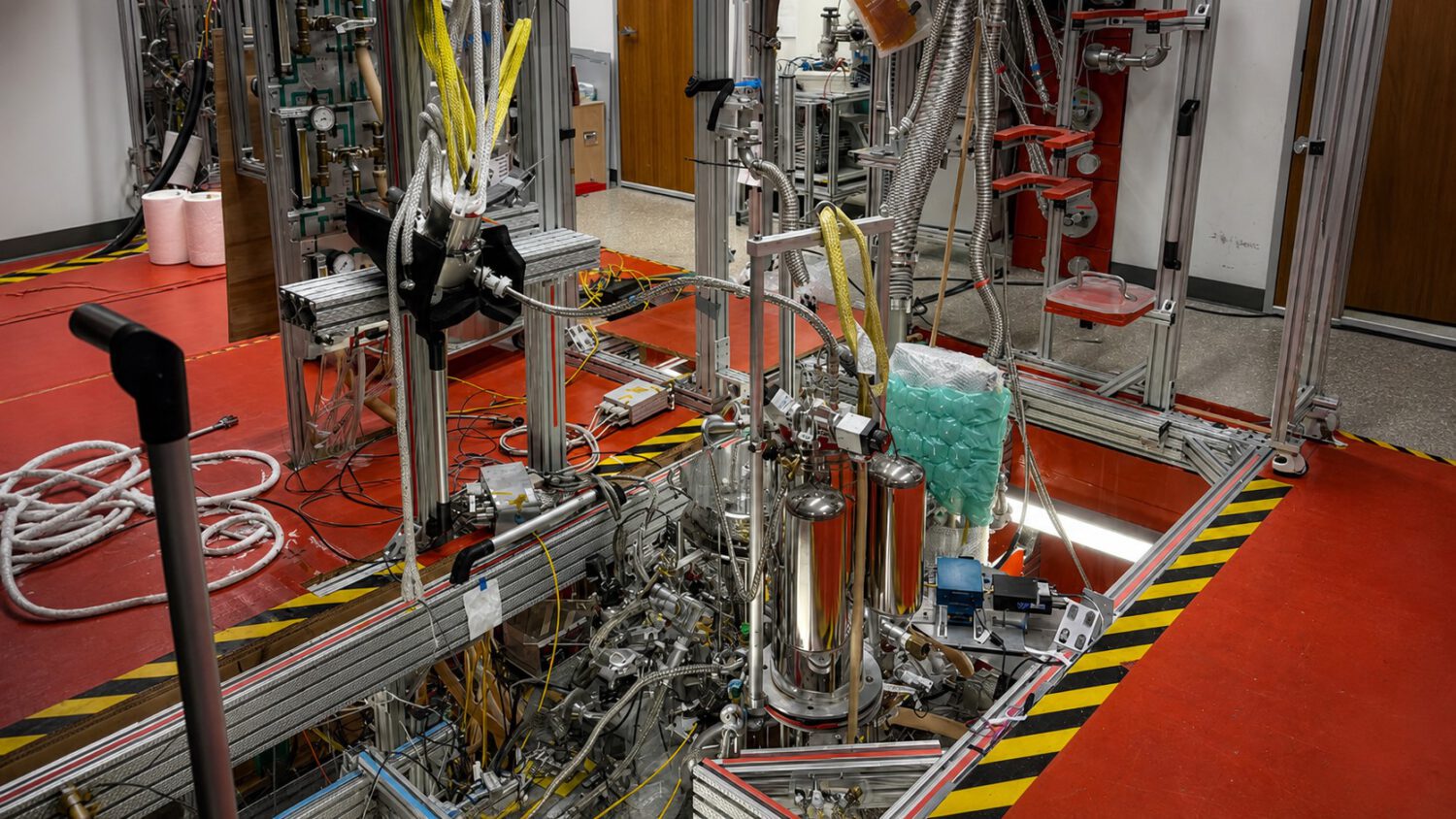
A single particle of antimatter, suspended inside a vacuum apparatus for months without touching its walls. No material walls holding it in place. Just electromagnetic fields doing the seemingly impossible work of keeping a positron confined long enough to study it seriously.
A positron is the antimatter counterpart of an electron: identical mass, opposite electric charge. Contact with ordinary matter causes mutual annihilation, which has made antimatter notoriously difficult to study with precision. Northwestern University physicists, led by Gerald Gabrielse, have now cleared that hurdle with a new device they call a “one-positron quantum cyclotron,” according to the university’s published announcement.
The central question the apparatus sets up: if electrons and positrons differ even slightly in their measurable properties, parts of the current theoretical framework for matter and antimatter could require revision.
Trapping Antimatter Without Material Walls
What keeps the positron confined is precise electromagnetic confinement. Electric and magnetic fields suspend the particle inside an ultrahigh-vacuum apparatus, applying a kind of control that no solid material could offer without destroying what it is trying to hold. Physical walls are made of ordinary matter, and ordinary matter causes annihilation on contact.
Cooling the positron to approximately 0.3 kelvin suppresses unwanted particle motion. That temperature sits just 0.3 degrees above absolute zero, roughly 272.85 degrees Celsius below zero. The resulting stillness makes discrete quantum energy levels far easier to resolve and control. Researchers could then repeatedly induce and observe transitions between those energy states on the same particle, over the course of months.
Why This Matters More Than a Storage Record
Standard early-universe reasoning implies that matter and antimatter should have been produced in comparable amounts. The observable universe, however, is overwhelmingly matter, and the reason for that imbalance remains unresolved. A tiny, reproducible property difference between an electron and its antimatter twin could provide a clue.
The next measurement target for the Northwestern team is the positron’s magnetic moment, a property tied to the strength and orientation of the particle’s intrinsic magnetic behavior. According to Wired’s reporting on the study, this apparatus could eventually enable measurements roughly 30 times more precise than earlier positron work. Comparing that result with the electron’s magnetic moment could improve sensitivity to a possible difference between the two particles.
That precision figure represents the platform’s potential, not a result already in hand. This initial demonstration established the conditions that make a future comparison possible; it did not report a new electron-positron property difference. Months-long confinement lets researchers repeat measurements on the same particle, which can reduce experimental error in ways that brief, single-use observations cannot.
If future measurements detect a genuine difference in the positron’s properties, parts of the theoretical framework describing matter and antimatter may need revision. If no difference appears, the experiment will still narrow the limits on where symmetry violations between matter and antimatter could possibly hide. Either outcome advances the science.