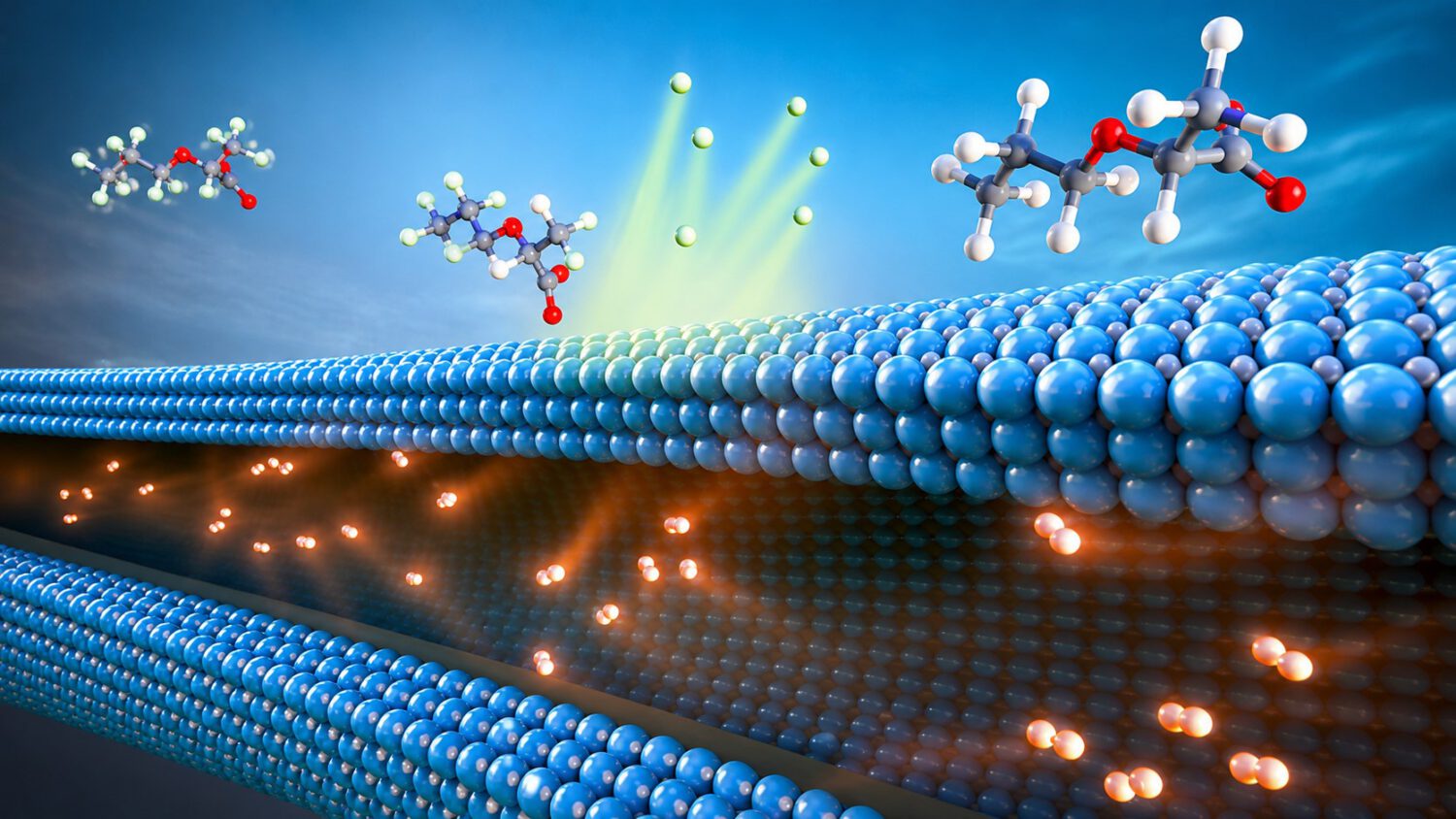
Most established PFAS-removal technologies face the same uncomfortable truth: they move the problem rather than eliminate it. A new palladium-coated membrane developed by researchers at Arizona State University and four international partners breaks that pattern. It removed and chemically transformed six regulated PFAS compounds across a continuous 58-day laboratory test, achieving more than 90% removal for each compound, according to a study published in the Proceedings of the National Academy of Sciences.
Activated carbon filters, ion-exchange resins, and reverse osmosis systems all pull PFAS out of water. Those compounds then sit in spent filters or concentrated waste streams, requiring further management or destruction. This membrane attacks the carbon-fluorine bond directly, which is the chemical structure that makes PFAS nearly impossible to break down through conventional treatment.
How the Membrane Works
The design combines contaminant capture and chemical destruction at the same surface, instead of treating them as separate steps.
Hollow membrane fibers carry hydrogen gas through their interior. Palladium nanoparticles on the exterior surface split that hydrogen into reactive species, and PFAS molecules in the surrounding water are drawn to and concentrated on the palladium surface, placing them in direct contact with the activated hydrogen.
The resulting reaction, called hydrodefluorination (a process that strips fluorine atoms directly from the molecule), dismantles the structures responsible for PFAS persistence.
“PFAS are hard to break down, and normal processes that we use don’t work.” Bruce Rittmann, Director, Biodesign Swette Center for Environmental Biotechnology, Arizona State University.
What the Results Actually Show
Across six regulated compounds and nearly two months of continuous testing, the membrane demonstrated chemical transformation, not just filtration.
Over 58 continuous days, the system removed more than 90% of each of six PFAS compounds: PFOA, PFOS, PFNA, PFHxS, PFBS, and GenX. Compound-specific removal rates ranged from approximately 93% to 99%, as reported by Genetic Engineering and Biotechnology News.
Approximately 83% of total fluorine was removed during the test, a figure that points to chemical transformation rather than simple retention. “We showed that this mechanism worked for all six,” Rittmann said, as reported by Waste Management Review.
A Promising Result With Real Limits
The laboratory performance is encouraging, but the distance between a controlled experiment and a municipal water plant is significant.
This is a laboratory result, not a municipal water deployment, and that gap matters. Palladium is a precious metal, making large-scale use expensive. The test used prepared water mixtures, not real-world source water carrying the competing contaminants that routinely complicate treatment performance.
One proposed deployment pathway would position the system as a destruction step downstream of conventional filtration, processing a concentrated PFAS waste stream rather than handling raw source water at full municipal flow rates. Before that approach becomes viable, researchers need to reduce palladium loading, improve flow rates, evaluate all transformation byproducts, and validate performance in actual water matrices.
What Comes Next
Several engineering and safety hurdles remain before the technology can move from the laboratory to the communities most affected by PFAS contamination.
The research team includes scientists from Rice University, Tongji University, the National University of Singapore, and Nanjing University. They will need to clear those hurdles before the technology reaches affected communities. If your community sits near a military base, airport, landfill, or industrial facility, the distinction between capturing PFAS and chemically transforming them determines whether remediation reduces the problem or simply relocates it.