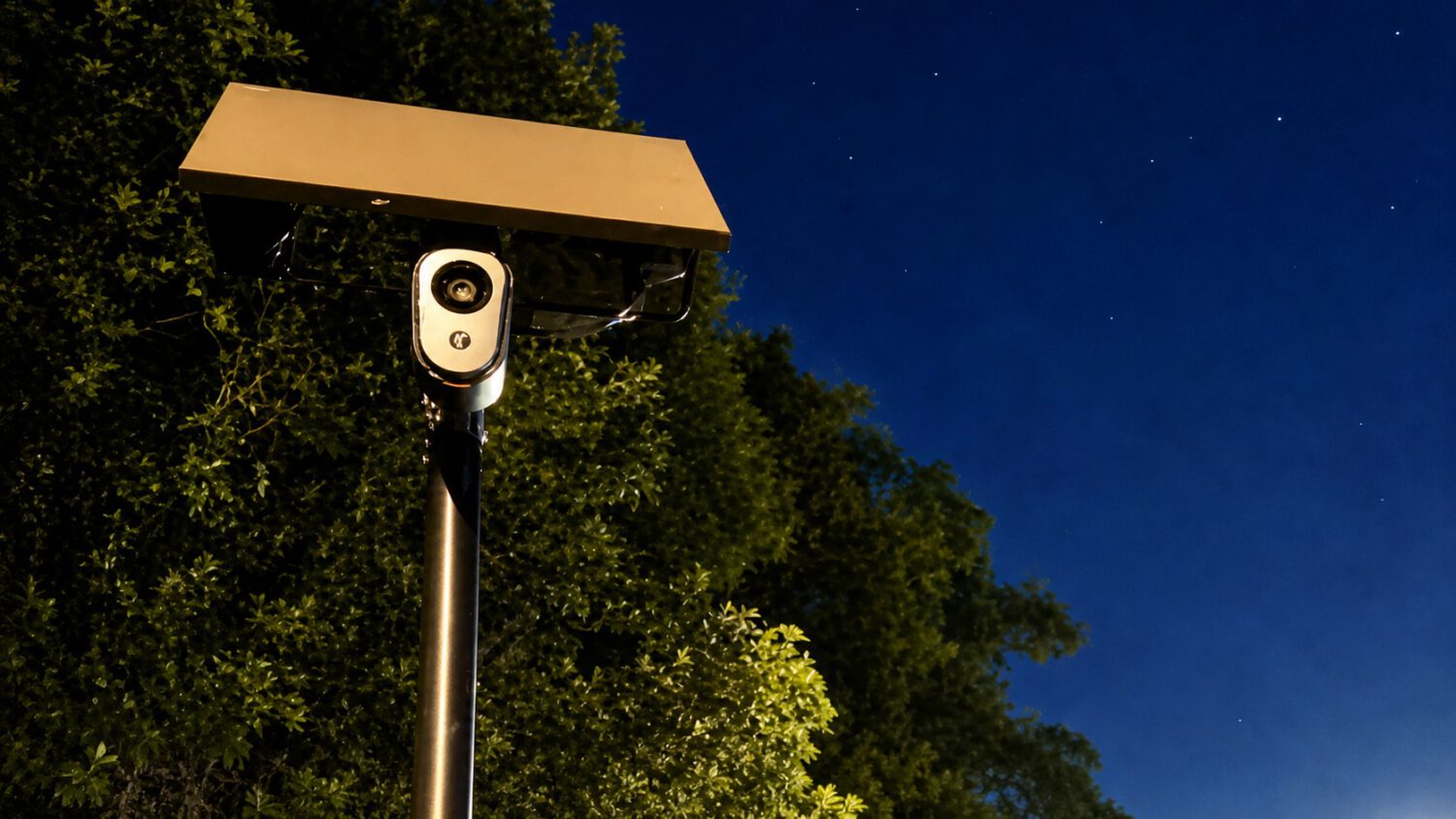
On Race Street in the neighborhood locals call “Little Tijuana,” resident Bioleta Herrera noticed something mounted at the end of her block: a Flock Safety camera that, from where she stood, appeared to face her house. She is not alone in wondering what it is watching.
The dispute in Santa Clarita touches something larger than one camera on one street. It sits at the crossroads of surveillance technology, community trust, and data-governance questions that local officials have not yet answered publicly.
What Officials Say the Camera Does
Both Santa Clarita and Flock Safety say the cameras capture vehicles, not homes, but the gap between that assurance and resident experience remains unaddressed.
Santa Clarita spokeswoman Carrie Lujan said in a written response to ABC7 that the city’s cameras are aimed at roadways, not homes.
“All Flock cameras are positioned to face the roadway, not residential properties. The cameras capture still images of vehicles as they pass by; they do not record homes or capture images of residential properties.” Carrie Lujan, Santa Clarita city spokeswoman, in a written response to ABC7.
The company does not publicly disclose camera counts, locations, or deployment details, directing all local policy questions to the customer agency, which in this case is the City of Santa Clarita.
What Residents and Critics Are Asking
Residents and a local advocacy group say the camera’s location raises fairness concerns that a statement about lens direction does not resolve.
Herrera’s account, reported by ABC7, describes a camera that appeared to face her home directly. Jae Chan Lee, founder of DeFlock SCV, told ABC7 that the concentration of cameras in the neighborhood led him to question what about the area might be prompting deployment. That is his interpretation, not documented proof of discriminatory targeting, but it reflects a distrust that official statements alone have not dispelled.
Brett Haddoak, a City Council candidate who has campaigned against Flock cameras, raised a pointed logistical question: why would a device designed to read license plates be positioned on a low-traffic residential street rather than a higher-volume road? ABC7’s reporting did not identify a public answer from the city.
The Harder Questions
The more consequential debate involves data access, retention, and whether Santa Clarita’s contract protects residents from searches unrelated to local public safety.
Flock says its system captures point-in-time still images containing plate numbers, make, model, color, and distinguishing vehicle features, and the company says it does not use facial recognition. According to Flock’s company statements, images not used in investigations are deleted after 30 days by default, though local law or agency policy can establish different retention periods. That default is Flock’s policy, not necessarily Santa Clarita’s actual practice.
In practical terms, a vehicle’s plate may sit in that database for up to 30 days and remain searchable by agencies with access under the terms of the local contract. Fox13 Seattle reported that Lynnwood, Washington ended its Flock contract amid concerns about indirect federal immigration-authority access to license-plate data. Flock has denied holding contracts with ICE and says federal agencies do not have direct platform access; critics and investigative reporting have described indirect, or side-door, pathways to that data.
The available reporting does not identify a publicly accessible deployment map, retention policy, or agency-access list for Santa Clarita’s Flock system. Whether the city has restricted sharing with federal immigration authorities, or whether any traffic or crime analysis justified placing a camera on Race Street specifically, remains publicly unanswered. Those are the questions residents and their elected representatives should be pressing: lens direction is a starting point, but data governance is the whole conversation.