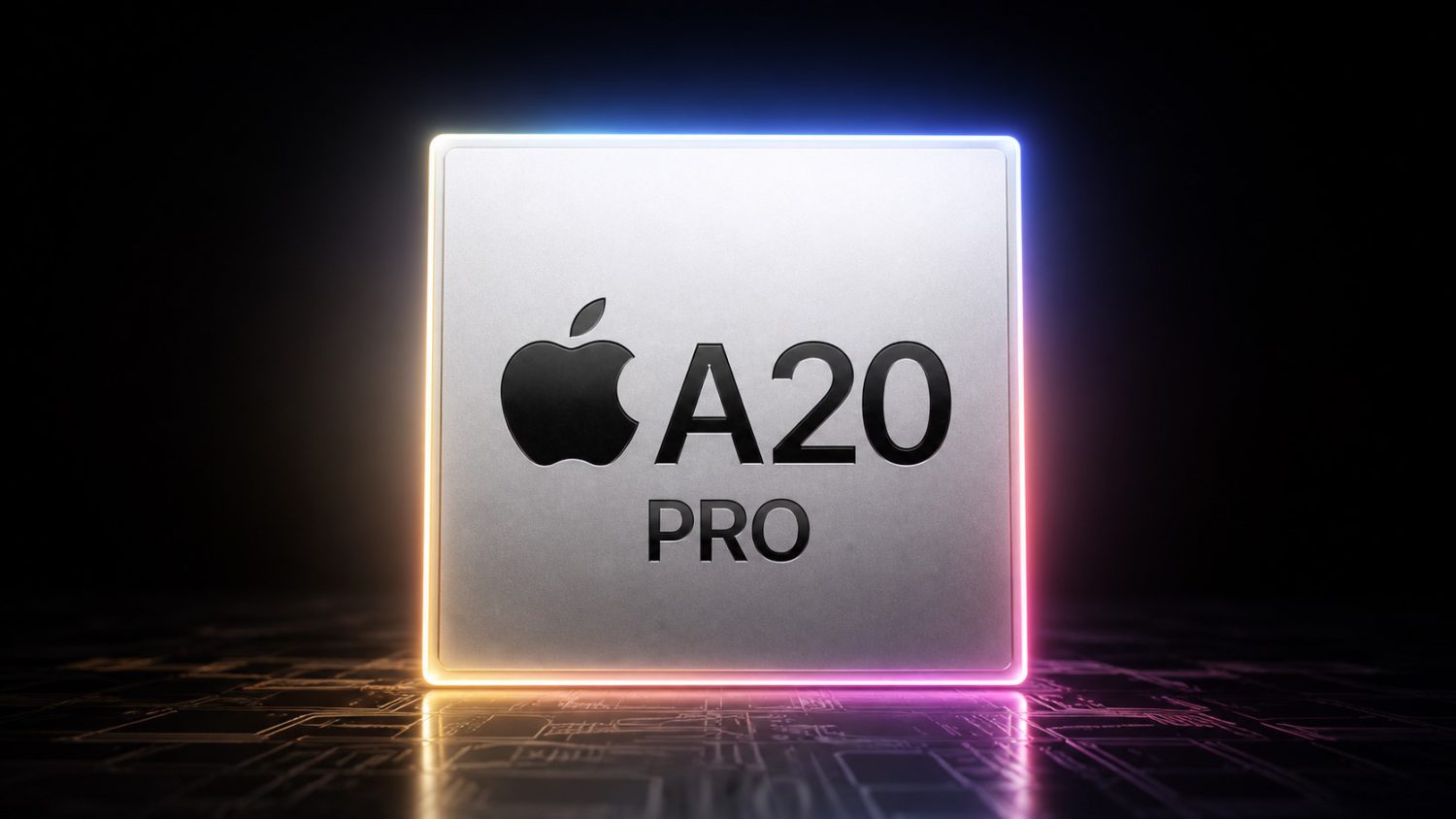
You know the moment. Forty minutes into a gaming session or halfway through exporting ProRes footage, your phone gets warm, then hot, then suddenly sluggish — technically still running, practically useless. Like a streaming service that buffers right at the climax. Apple built the A20 Pro specifically to address that experience. The chip — the first smartphone SoC on TSMC’s 2nm N2 process — claims 40% more sustained performance over the A19 Pro and double that of the A18 Pro. Those are significant numbers. Here’s what’s actually behind them, starting with Apple’s approach to custom silicon.
What 2nm Actually Changes
The shift to TSMC’s N2 node isn’t just a smaller number — it’s a fundamentally different transistor architecture that tightens electrical control at scales where traditional designs start to leak.
Traditional FinFET transistors wrap a gate around three sides of a silicon fin. TSMC’s N2 node switches to gate-all-around (GAA) nanosheet transistors, surrounding stacked silicon sheets on all four sides for better electrical control and less leakage at extremely small geometries. TSMC’s published N2 targets: roughly 10–15% performance uplift at equal power, or 25–30% lower power at equal performance. Apple’s claimed gains for A20 Pro sit comfortably inside that envelope, according to Apple’s own figures.
The headline specs break down like this:
- 6-core CPU with two new “super” performance cores (up to 20% faster, Apple claims) and four efficiency cores
- Redesigned 7-core GPU delivering up to 40% faster graphics with increased memory bandwidth
- 32-core Neural Engine with 2× compute versus the prior generation and native FP8 support for on-device AI
- Custom silicon packaging that connects the chip and memory directly to the vapor chamber cooling system
- Widest memory interface Apple has ever shipped in an iPhone (exact width undisclosed)
The Part That Actually Matters for AI
A unified FP8 pathway across the GPU and Neural Engine is what makes running large language models locally a realistic prospect rather than a marketing promise.
The Neural Engine and GPU now share a unified FP8 — 8-bit floating point — pathway. Think of it like finally consolidating every streaming service into one app: the content existed before, but the plumbing finally caught up. FP8 is a format many modern large language models and diffusion models can effectively use. Running them locally, without pinging a server, becomes more viable — and, reportedly, without torching your battery in the process. Apple calls A20 Pro “the ultimate chip for running advanced on-device AI models.” Whether that holds up depends on software catching up to the hardware. Independent benchmarks don’t exist yet, and real-world AI gains will only materialise as apps and iOS updates tap into these new pathways. One outside data point worth noting: TSMC’s own published N2 process briefs underpin Apple’s efficiency claims, lending them more credibility than pure marketing copy — but third-party testing remains the real arbiter.
Thermals and Honest Caveats
The custom packaging is the engineering detail that makes sustained-performance claims credible rather than spec-sheet theater.
Apple’s custom packaging — described as “inspired by M-series chips” — connects silicon and memory directly to the vapor chamber rather than treating cooling as an afterthought. That’s the difference between a chip that sprints and one that actually holds pace. Hot climates and punishing workloads will still stress-test those limits in ways no controlled demo will, making battery life management an important consideration. Real-world thermal performance depends on the full chassis design and ambient conditions, so treat Apple’s sustained-performance figures as a ceiling until independent reviews confirm otherwise.
A20 Pro’s combination of 2nm efficiency, doubled AI compute, and redesigned cooling is the most coherent argument Apple has made for the Pro tier in years. Whether those sustained-performance claims survive contact with the real world is exactly what independent reviews are for.