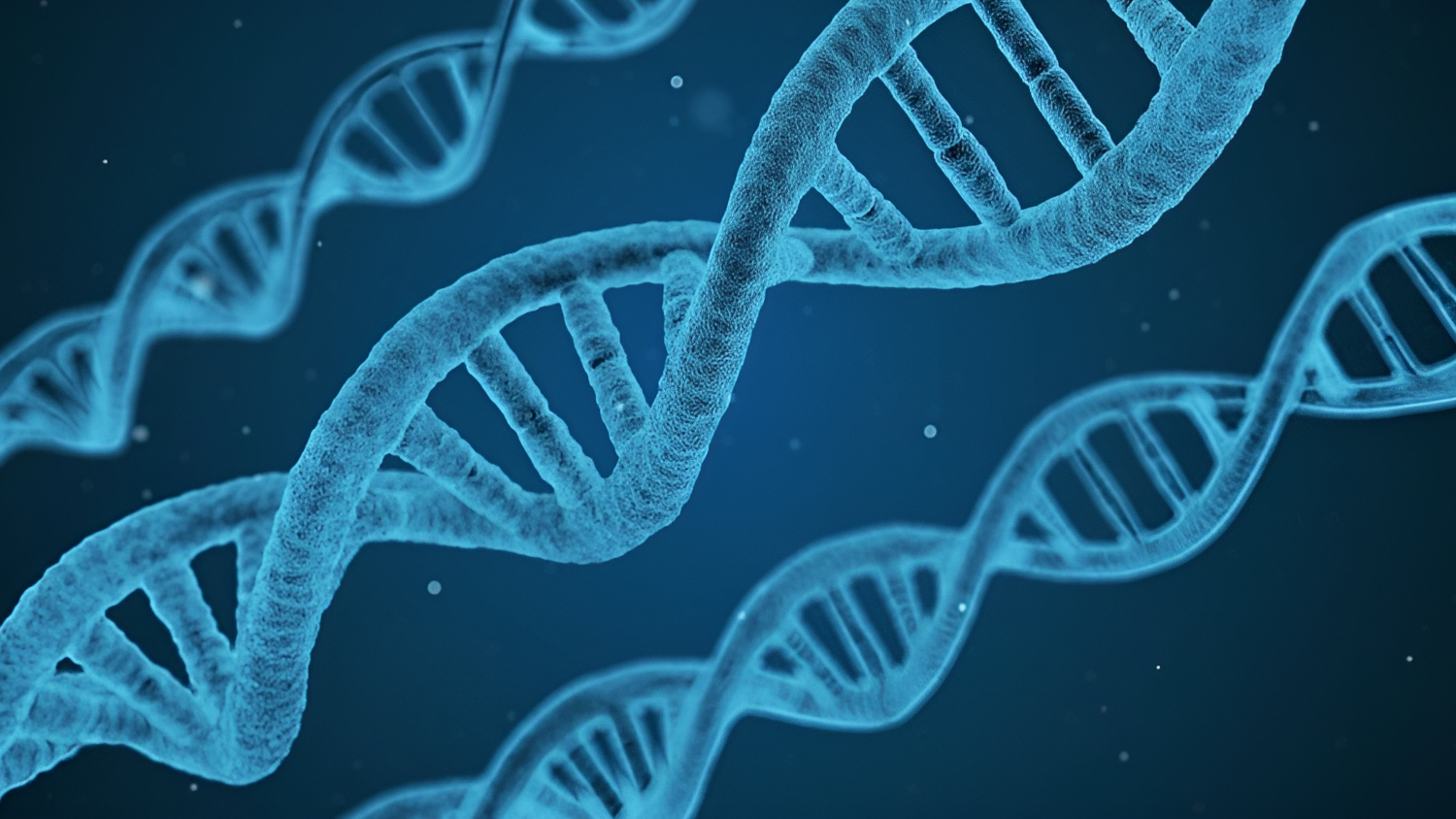
His credentials are solid. He holds a PhD in organic medicinal chemistry, is based in New Zealand, and has written five books, including DNA: The Elephant in the Lab. His doctoral work involved nucleosides — the building blocks of DNA — and compounds used in medicines. This is not a fringe voice; it’s someone who has worked at the molecular level for decades.
His case rests on three hurdles he believes undirected chemistry cannot clear:
- Statistical: Functional proteins require precise amino acid sequences drawn from an astronomically large space of possibilities — the odds, he argues, are effectively impossible without direction.
- Conceptual: DNA needs proteins to be copied, and proteins need DNA to be built — a chicken-and-egg loop with no obvious starting point.
- Chemical: No known natural process has yet produced a complete, self-replicating genetic system from scratch.
He calls the genetic code a “frozen accident” — established early and virtually impossible to alter, which he interprets as evidence it could not have evolved stepwise.
To separate “improbable” from “impossible,” Wedgwood offers a vivid analogy. A cow escaping through an open gate and somehow reaching New Zealand? Ridiculous, but you could trace the steps. DNA assembling by chance in a prebiotic ocean? That, he says, is the cow jumping over the moon — no coherent sequence of steps connects the chemistry to the system we see.
Every known code, he argues, originates from intelligence. DNA is a code. Therefore, DNA implies a designer. It reads like a clean syllogism — and that is precisely where the argument gets slippery.
“DNA provides evidence for intelligence — every other code we know of comes from intelligence.” — Dr. Orson Wedgwood, as reported by the Daily Mail
What the Lab Is Actually Finding
RNA World research offers experimental footholds on the very steps Wedgwood calls impossible.
Researchers at the Salk Institute are not waiting for the philosophy to settle. In a 2024 paper published in PNAS, Gerald Joyce, Papastavrou, and Horning reported an RNA enzyme capable of copying functional RNA strands while allowing new molecular variants to emerge — evolution happening entirely within an RNA system.
Ribozymes — RNA molecules that act as their own enzymes — sit at the core of the RNA World hypothesis: the idea that simpler RNA-based chemistry preceded both DNA and proteins, addressing Wedgwood’s chicken-and-egg objection without requiring both systems to appear simultaneously. Joyce described his team’s work as “chasing the dawn of evolution.”
“We’re chasing the dawn of evolution.“ — Gerald Joyce, Salk Institute press release, 2024
This does not recreate the full origin of life. It demonstrates that one proposed natural step is testable in a real lab. That distinction matters — Wedgwood’s argument treats the remaining gaps as proof no natural pathway exists, but demonstrating one plausible step shifts that claim considerably.
Design-leaning commentators have argued Joyce’s results actually prove intelligent agency, since the experiments required careful laboratory setup. Mainstream scientists treat directed evolution as a method for probing what natural selection can achieve — the same tool behind much of modern drug development — not as evidence that selection cannot work unaided.
Where Evidence Ends and Interpretation Begins
The gap in our knowledge is real, but a gap is not a proof.
Wedgwood’s case is philosophical and probabilistic, not experimental. No study demonstrates a creator acting on DNA. Pointing to unresolved steps in the natural account does not fill those steps with a designer — it marks where the research continues.
Origin-of-life science keeps narrowing those gaps incrementally. Whether something beyond chemistry is ultimately required remains genuinely open. That openness is not Wedgwood’s conclusion to claim — it is the question science is still working to answer.